Get Full Government Meeting Transcripts, Videos, & Alerts Forever!
Get email alerts on the Child Care Licensing topic
No spam. Unsubscribe anytime.
Committee pushes DHS on child-care licensing modernization; lawmakers adopt amendments and press for timeline and provider protections
Summary
The Senate Health and Human Services Committee heard an update from the Department of Human Services on its child‑care licensing modernization project and adopted amendments to a bill that would set engagement, translation and implementation timelines for revised family‑child‑care standards.
The Senate Health and Human Services Committee heard a status update on Minnesota’s child-care regulation modernization project and then considered related bills and amendments on March 26, 2025.
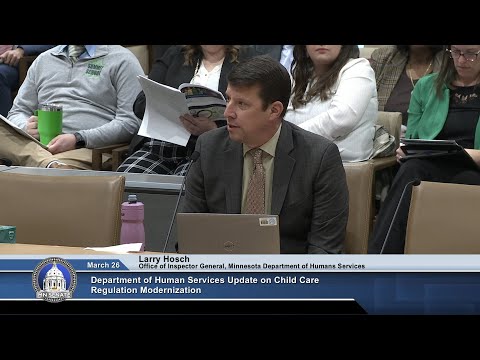
DHS presentation and draft changes: Larry Hausch of the Office of Inspector General (DHS) summarized draft 2 of revised licensing standards. He said the modernization project — created by 2021 legislation — has three parts: a risk‑based, tiered violation system; a key-indicator system to allow abbreviated inspections; and revised licensing standards. Draft 2 removed some prescriptive cleaning frequencies, rescinded a blanket ban on scents and aerosols in response to provider concerns, clarified language about pets and pest documentation, removed a requirement to test exposed soils for lead (citing cost and implementation impracticality), retained a radon-testing requirement while seeking flexibility on mitigation costs, and reduced specificity around fall-zone materials for family child care. The draft also proposed new family‑child‑care license classes (a B3 allowing up to 10 children with two adults, and a C3 allowing up to 18 with two adults, contingent on additional training) and a department-developed “child care basics” onboarding training for centers.
Stakeholder engagement and data: Hausch told the committee the department held 23 in-person listening sessions with roughly 950 participants and received more than 2,500 comments; an online survey drew about 1,600 responses. He said follow-up outreach on draft 2 would continue — including regional sessions with Minnesota Initiative Foundations — and that DHS planned a draft 3 for legislative consideration in 2026.
Provider and legislator pushback: Several senators and family‑child‑care providers said draft 1 had been interpreted by many providers and county licensors as overly prescriptive and in places impractical. Senator Lisky described dramatic provider reactions to draft 1; Sen. Abler urged the department to reject overly detailed rules and focus regulation on real safety risks. Family‑child‑care provider Cindy Cunningham testified that many providers were “horrified” by the first draft, that engagement had been reactive rather than proactive, and that providers who do not speak English needed targeted outreach and translated materials.
Legislative action: Senator Wicklund introduced Senate File 12 32, a bill with amendments aimed at altering the modernization process. The committee adopted an author's amendment (A4) that (among other changes) replaces the statutory phrase “grounded in national regulatory best practices” with language that requires updated family‑child‑care licensing standards to “protect the health and safety of children and be child‑centered, family‑friendly, and fair to providers.” The A4 amendment also added specific requirements for continuing engagement with family‑child‑care providers (including evening sessions) and moved a statutory deadline so that DHS must deliver a report and proposed legislation by Dec. 1, 2025 rather than early February 2026.
The committee also adopted two additional amendments: A3 (changes governing how DHS posts licensing correspondence and complaints on public lookup pages — aimed at redacting detailed certified letters that contain investigatory allegations and replacing them with short public summaries) and A5 (clarifying how family childcare providers may care for their own children while also serving paying families, removing ambiguity that providers said had led to inconsistent licensor guidance). After testimony and amendment votes, the committee laid SF 1232 over for possible inclusion.
Parallel reform bill: Senator Bolden presented Senate File 21 35, a broader reform measure supported by several provider groups. SF 21 35 would narrow the scope of state licensing to core physical health and safety standards, rely on national or industry accreditation for quality-assurance measures, and create technical-assistance teams that emphasize support rather than punitive enforcement. Think Small and nonprofit and center directors told the committee that current licensing often conflates facility safety with educational quality and requires time-consuming compliance efforts that reduce time available for child development activities. The committee adopted an author's amendment to SF 21 35 and laid it over for possible inclusion.
Access-focused proposal: Senator Bolden also introduced Senate File 16 29 to explore allowing an unrelated caregiver (a nanny) to provide care for two unrelated families in rural areas without being treated as a licensed family‑child‑care home. Legislators described the measure as a work in progress: the bill was laid over to allow further stakeholder work and does not change current statewide licensing rules.
What the committee asked DHS to do: lawmakers pressed DHS to make translations and evening engagement an explicit part of the process, deliver a clearer implementation timeline, and produce practical guidance items (for example: model supervision plans for unfenced play areas) rather than only detailed prescriptive rules. Several members also urged DHS to prioritize policy choices that will arrest the continuing decline in licensed family‑child‑care slots and to propose incentives to encourage new providers to enter the field.
Next steps: DHS said it will continue stakeholder engagement on draft 2, prepare draft 3 for 2026 legislative consideration, and respond to the committee’s requested clarifications; SF 1232, SF 21 35, and SF 16 29 were laid over for possible inclusion after amendment votes.