Get Full Government Meeting Transcripts, Videos, & Alerts Forever!
Albemarle Planning Commission reviews community facilities chapter of AC44; commissioners press for clearer guidance on rural services and green infrastructure
Summary
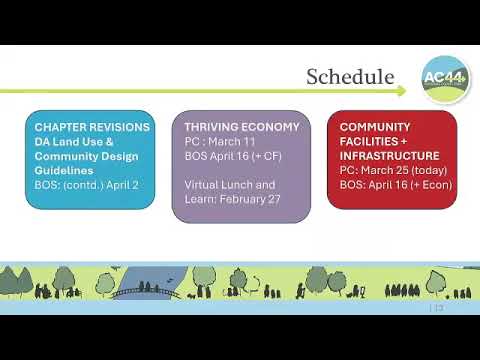
The Albemarle County Planning Commission spent its March 25 work session reviewing the Community Facilities chapter of AC44, concentrating on where public facilities should be allowed in rural areas, how to strengthen language on green infrastructure and low‑impact development, and the county’s role in utility and school facility planning.
The Albemarle County Planning Commission spent the bulk of its March 25 work session reviewing the Community Facilities chapter of AC44, the county’s comprehensive-plan update. Development Process Manager David Benish opened the item and said staff would highlight comments the commission and the public previously made and ask for focused feedback on two topics: Objective 1’s overarching objectives and allowances for public facilities in rural areas. “I’m David Benish, development process manager. We’re gonna go over the community facilities chapter, the comprehensive plan today,” he said.
Commissioners and staff discussed 11 objectives that cover public water and sewer, libraries, schools, emergency services, broadband and other utilities, stormwater, and climate resiliency. Commissioners repeatedly returned to the balance between protecting rural character and permitting public health-and-safety facilities outside designated development areas. Several commissioners asked staff to clarify how the plan’s recommended allowance for targeted public facilities in rural areas would work in practice and whether age or documented public-health failures should be a factor when considering extensions of services.
On public water and sewer, staff reiterated the comp plan policy that the development-area boundary should guide service authority jurisdictional expansions, and that exceptions are possible when documented health or safety issues exist and adjacent service is available. Commissioners pressed staff on practical priorities: one suggestion was to prioritize unserved parcels inside development areas…
Already have an account? Log in
Subscribe to keep reading
Unlock the rest of this article — and every article on Citizen Portal.
- Unlimited articles
- AI-powered breakdowns of topics, speakers, decisions, and budgets
- Instant alerts when your location has a new meeting
- Follow topics and more locations
- 1,000 AI Insights / month, plus AI Chat