Get Full Government Meeting Transcripts, Videos, & Alerts Forever!
Get email alerts on the Comprehensive Plan Ac44 topic
No spam. Unsubscribe anytime.
Albemarle Planning Commission reviews community facilities chapter of AC44; commissioners press for clearer guidance on rural services and green infrastructure
Summary
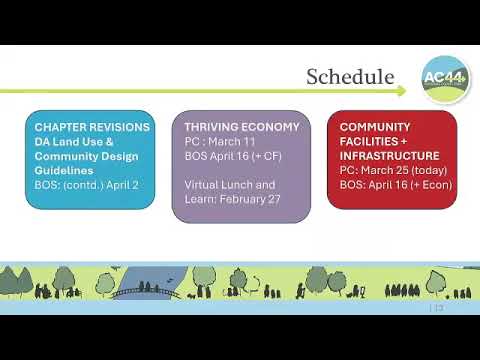
The Albemarle County Planning Commission spent its March 25 work session reviewing the Community Facilities chapter of AC44, concentrating on where public facilities should be allowed in rural areas, how to strengthen language on green infrastructure and low‑impact development, and the county’s role in utility and school facility planning.
The Albemarle County Planning Commission spent the bulk of its March 25 work session reviewing the Community Facilities chapter of AC44, the county’s comprehensive-plan update. Development Process Manager David Benish opened the item and said staff would highlight comments the commission and the public previously made and ask for focused feedback on two topics: Objective 1’s overarching objectives and allowances for public facilities in rural areas. “I’m David Benish, development process manager. We’re gonna go over the community facilities chapter, the comprehensive plan today,” he said.
Commissioners and staff discussed 11 objectives that cover public water and sewer, libraries, schools, emergency services, broadband and other utilities, stormwater, and climate resiliency. Commissioners repeatedly returned to the balance between protecting rural character and permitting public health-and-safety facilities outside designated development areas. Several commissioners asked staff to clarify how the plan’s recommended allowance for targeted public facilities in rural areas would work in practice and whether age or documented public-health failures should be a factor when considering extensions of services.
On public water and sewer, staff reiterated the comp plan policy that the development-area boundary should guide service authority jurisdictional expansions, and that exceptions are possible when documented health or safety issues exist and adjacent service is available. Commissioners pressed staff on practical priorities: one suggestion was to prioritize unserved parcels inside development areas before adding new rural-area extensions. Staff noted that the county already uses a jurisdictional-area amendment process for individual requests and that each exception has been handled case by case.
Commissioners raised several infrastructure themes repeatedly. Several asked for clearer language or cross-references on green infrastructure and low-impact development (LID). Chief of Environmental Services Greg Harper said the county is developing internal draft policies for greener county buildings, fleets and landscapes and that planners could cross-reference or add supporting language to the plan. “There has been development of some draft policies … that would address buildings, our fleet, and … manage landscapes to make all of those things more sustainable,” Harper said.
Stormwater and septic systems drew detailed attention. Commissioners asked staff to make stronger language discouraging small, decentralized package treatment plants; several speakers described recent failures in similar systems and recommended the plan flag them as a disfavored option unless there are no feasible alternatives. Commissioners also discussed sand-mound and other alternative septic systems and asked staff to coordinate with the health department and stewardship chapter for clearer guidance.
School capacity and facility jurisdiction were discussed at length. Commissioners asked for clarity on which decisions are within the county’s land-use guidance and which are the School Board’s domain. Staff said the county’s role is principally location and infrastructure access; facility design and maintenance remain School Board responsibilities. Commissioners also asked staff to emphasize continued coordination between county capital planning and school needs.
Broadband and power-grid resilience were recurring themes. Commissioners asked staff to include the electric grid and capacity planning among communications and utilities objectives, not just broadband access. Several commissioners noted that new high‑demand users (for example, potential data centers) increase urgency to evaluate local distribution and resilience, and asked for better articulation of county levers for managing impacts where legal authorities are limited.
On libraries, the commission discussed equity of facility locations and hours. Commissioners noted locations and hours matter for access — a recurring public comment point — and suggested staff include linkage to capital plans and proffered sites that may serve North District needs.
What commissioners asked staff to do next - Add clearer cross‑references and hyperlinks where related actions live in other chapters (resilience, stewardship, land use). - Strengthen guidance on green infrastructure and LID, including example practices and references to county pilot projects and local suppliers. - Tighten language discouraging decentralized package treatment plants and clarify how alternative septic-based systems will be considered. - Clarify the process and criteria for jurisdictional-area amendments to allow water/sewer service into rural areas in cases of documented health/safety need, including whether age/installation-date of systems should be explicit criteria. - Include clearer wording and possible conditions for library investments, including how proffered or future sites fit in the capital program.
Why it matters: commissioners framed the debate as a practical one — the county is trying to balance long‑term growth management and rural character with immediate needs such as failing septic systems, emergency services locations, and reliable broadband. Several commissioners asked staff to convert high‑level objectives into more concrete policy options and example implementation steps so future boards and staff can act without repetitive retooling. Harper and other staff committed to work with department leads to provide more concrete language and potential implementation actions for the next draft.
Next steps: staff will return revised text and clarified conditions to the commission for review before the plan goes to the Board of Supervisors, and commissioners asked for more example-based language (pilot projects, design examples, funding sources and links to supporting plans) so the chapter can be used directly by operating departments and partner agencies.
Ending note: the Planning Commission scheduled a special meeting on May 6 to cover transportation and asked staff to provide cross‑linked background materials and any relevant board presentations in advance so commissioners can review and ask targeted implementation questions.
Speakers quoted above are identified in the transcript; direct quotes are attributed to staff and agency speakers present at the March 25 work session. No outcomes or ordinance changes were enacted at this meeting; staff committed to follow up on the items above.