Get Full Government Meeting Transcripts, Videos, & Alerts Forever!
Get email alerts on the Solid Waste topic
No spam. Unsubscribe anytime.
Goshen planning board flags traffic, stormwater and contamination concerns in review of IWS transfer-station EAF Part 2
Summary
The Goshen Planning Board reviewed the draft EAF Part 2 for a proposed IWS transfer station on Hartley Road and identified unresolved traffic, stormwater/leachate, soil, gas‑migration, odor-control and emergency-response issues it wants addressed before forwarding comments to the Town Board.
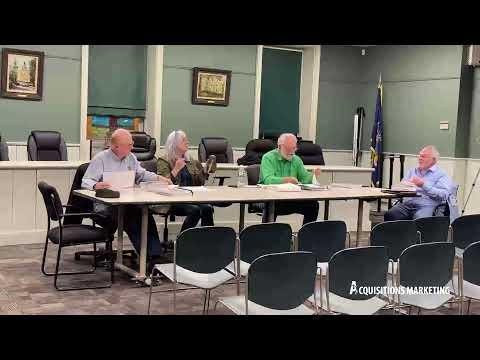
Goshen Planning Board members spent a special meeting reviewing the Environmental Assessment Form (EAF) Part 2 for a proposed IWS transfer station on Hartley Road, and identified multiple outstanding issues they want addressed before sending comments to the Town Board, the meeting record shows.
Board members said the Town Board has designated itself the lead agency for the project under the townsolid-waste permit process, which the planning board noted affects the scope of subsequent review and approvals. The planning board did not take a vote at the session; members discussed technical and public-safety topics the board wants clarified in the EAF and the applicantengineering documents.
The most frequently raised concern was traffic. Documents discussed at the meeting indicate the applicant seeks authorization for additional truck trips; the planning-board review notes an incremental increase of about 48 vehicle movements per operating day compared with what the board has observed, concentrated within the facilityoperating hours. Members said that increase would place more wear on Hartley Road and on the intersection with state Route 17M and urged the town to require traffic-mitigation measures and to pursue state coordination on intersection markings and geometry that only the state can change.
Board members also focused on stormwater, leachate and groundwater. The applicantsubmittal describes stormwater collection and two leachate-collection tanks; the board asked for clearer documentation of where stormwater and roof runoff will discharge, how on-site runoff will be treated, and whether existing pipes routing site runoff have historically carried contaminated leachate off site. Reviewers noted past DEC and EPA involvement at the adjacent outdoor landfill and said the EAF should either include a full stormwater pollution prevention plan (SWPPP) or justify why one is not required, and should document alarms, monitoring and contingency procedures for leachate storage tanks.
Several members said the sitehistory warrants soil and groundwater testing before significant excavation. The draft EAF and design materials describe a pit for truck tipping and foundations that will require excavation; board members repeatedly recommended core samples or other subsurface testing to determine whether soils contain hazardous constituents from years of transfer‑station use or from the neighboring landfill. Members said testing results would affect worker safety plans, dust control during construction, disposal options for excavated material and the need for remediation.
Gas migration from the adjacent, long-running landfill also drew scrutiny. Members said prior DEC work found landfill gas at elevated levels on the neighboring property and urged gas-monitoring, design measures to prevent migration into excavations or under slabs, and a remediation plan if monitoring finds gas in explosive concentrations.
Odor management and ventilation for the proposed enclosed tipping building were discussed. The applicantmaterials describe mechanical ventilation and an odor-control system that board members said appears to be manual; the board asked for clearer operational triggers, backup power for ventilation during outages, and quantitative assessment of odor potential beyond the building's interior.
Public-safety items raised included emergency response and fire protection. The plans note a 65,000-gallon water tank for fire-protection systems; board members asked that the applicant confirm whether the Goshen Fire Department can draw from that tank (for example via a yard hydrant or dedicated connection) and requested documentation of a spill-response and emergency plan that would be shared with local emergency responders.
Operational and site-layout questions included: interior circulation for tipping and transfer trucks; retention of existing scales; where employees will park (members reported seeing only a handful of staff vehicles at the site currently and said the EAF did not specify employee counts); and surface-imperviousness and landscaping. Board members said the applicantengineering plans should show existing and proposed impervious area, and whether the disturbed area or building footprint will exceed thresholds that require a SWPPP.
Heritage and archaeological issues were noted because nearby sites have produced artifacts during previous development. Members recommended referral to the State Historic Preservation Office (SHPO) or an equivalent review if the project area is contiguous with documented archaeological sites.
The board discussed site mitigation ideas raised in the meeting record, including a truck power-wash or tire‑wash station to limit contaminated material being tracked onto Hartley Road, painted stop lines set back from the intersection of Hartley Road and Route 17M to improve turning clearance, and requiring a leak-detection alarm for double-walled leachate storage. Several members suggested exploratory borings and gas probes be conducted before deep excavation.
No formal approvals or conditions were adopted at the meeting; planning board members said they will prepare written comments that the Town Board, as lead agency, will receive and consider during its SEQR review. The planning board asked that missing or ambiguous documents be supplied to support the EAFPart 2 conclusions, including: detailed stormwater routing and treatment, subsurface testing results, the applicantemergency/spill-response plan (shared with the fire department), design details for odor control and ventilation and a plan describing how excavated material would be handled if contamination is found.
The planning board also recorded past incidents at the site in the record: members referenced spills in the early 2000s that DEC responded to and said the history increases the need for current-site testing and explicit mitigation plans.
Next steps recorded in the discussion: the planning board will finalize comments for the Town Board and asked the applicant and its engineer to provide the requested clarifications and test results. The meeting record indicates planning-board staff will assemble a consolidated memo referencing Kelly Nortoncomments that were circulated to the board prior to the meeting.
Ending: the planning board concluded the review session with a request that outstanding technical materials be supplied promptly so the board's comments can reach the Town Board before the Town Board's scheduled meeting.