Get Full Government Meeting Transcripts, Videos, & Alerts Forever!
Get email alerts on the Open Government Notices topic
No spam. Unsubscribe anytime.
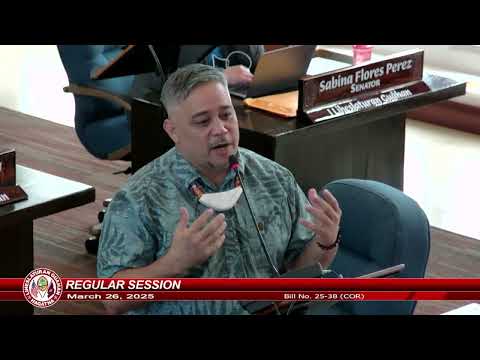
Guam Legislature debates Bill 25‑38 to broaden where public notices can appear; reporting amendment fails
Summary
The Guam Legislature opened extended debate over Bill 25‑38 on changes to the island’s open‑government public‑notice rules, with senators sharply divided over whether agencies may replace traditional newspaper, radio or television notices with notices on newly defined “eligible media platforms.”
The Guam Legislature opened extended debate over Bill 25‑38 on changes to the island’s open‑government public‑notice rules, with senators sharply divided over whether agencies may replace traditional newspaper, radio or television notices with notices on newly defined “eligible media platforms.”
Bill 25‑38 would amend 5 GCA §8104 (the open‑government chapter being revised by the bill) to allow public notices to appear on electronic newspapers, websites and other digital platforms described in the bill rather than requiring publication in print, radio or broadcast outlets. The author and multiple senators emphasized the change is intended to provide agencies with more publication options; opponents said it risks excluding residents without reliable internet access and could weaken archival safeguards.
Why it matters: Public notice statutes are a key transparency tool used to inform residents about hearings, legal actions and agency decisions. Senators noted Guam has limited print circulation, uneven broadband access across villages and an older population that may rely on print or broadcast media. Opponents warned that moving to online‑only notice risks reducing public participation and makes long‑term archival access harder to verify.
Senator Waines, who raised committee‑report and notice questions at the start of the session, told the chamber that “the wrong bill in terms of what was submitted to the committee was placed in the drive and also put on the floor,” and said legal counsel and rules staff had since reviewed and cleared bills remaining for the session. Waines also pressed for proof that the public‑hearing notice for Bill 25‑38 had been published as required under Guam’s open‑government statutes.
The bill’s critics repeatedly pressed two points: that the printed daily newspaper on Guam prints 8,000 physical copies, which some speakers said covers only about 5% of the island if counted as single‑copy distribution, and that some villages still lack reliable broadband. “To remove the mandate that agencies put ads in the newspaper or on TV or on the radio and replace those with other websites or blogs risks excluding parts of our population,” one senator said during floor debate. That speaker urged a hybrid approach — retaining traditional media requirements while allowing additional electronic platforms — rather than permitting agencies to substitute online publication for print entirely.
Supporters said the bill modernizes notice options and could lower costs or increase competition for notice placement; the bill’s author proposed an amendment to require quarterly reports from the newly defined “eligible media platforms” showing which government notices they published, which agencies paid them and the amounts paid. The amendment was presented as a transparency safeguard so the public could track where notice dollars were spent.
During debate, the author clarified that the bill would add a definition for “eligible media platform” to the act itself rather than relying on an external statutory definition. Senator Amy McSherry asked for the definitional language and the author confirmed a correction would be made so the requirement would read "defined by this act."
On the proposed transparency amendment — to add a new section requiring quarterly reporting by eligible media platforms — the chamber recorded five hands in favor; the motion failed after objection and tally, with the presiding officer announcing "Motion fails." (A roll‑call tally for that vote was not recorded in the available transcript.)
Separately, the chamber accepted a motion to append an invoice from PBS Guam to the committee report as evidence the author said demonstrated notice production; the presiding officer directed the clerks to attach the receipt and to continue repairing a hyperlink to archived hearing material. That motion passed on a voice/hand vote; no roll‑call tally was recorded in the transcript.
Several senators also used the debate to raise broader concerns about committee practices and transparency. Multiple speakers described a recent change toward committee markup meetings intended to give members and the public more opportunity to review bill changes before they reach the floor; others said some members still feel excluded from markups or that committee reports landed on desks with substantive changes without opportunity for wider review. The presiding officer repeatedly urged senators to use committee markups or to contact committee chairs and legal staff if they had questions.
Clarifying details recorded during the discussion: - The bill would amend provisions described in 5 GCA §8104 and related open‑government code sections as set out in the bill text (exact statutory citations in the motion and committee report were cited by senators). - A senator stated the island’s single printed daily newspaper prints 8,000 copies daily, a figure cited to argue limited physical distribution; another senator said that same outlet reported a larger online readership number (quoted as about 16,000) when combined with online audiences. - Committee staff referenced archived audio/video of hearings on the Guam Legislature YouTube channel; senators requested full minutes/transcripts rather than hyperlinks alone and reported a hyperlink to archived testimony was not working at 08:45 a.m. on the day of the debate. - The author provided an invoice from PBS Guam to the clerk to document publication/notice activity; clerks were instructed to append that invoice to the committee report.
What was decided: The chamber moved forward with floor consideration of Bill 25‑38 after legal counsel and rules staff said the bill text had been scrubbed and cleared for hearing. The chamber rejected the amendment requiring quarterly reporting by eligible media platforms. The clerks were directed to append the PBS Guam invoice and to continue efforts to repair the committee‑report hyperlink to archived material.
The debate closed with the chamber taking a brief recess; senators signaled they will return to continue consideration of the bill later in the day.
Sources and attribution: Quotations and specific procedural statements in this article are taken from the legislative session transcript. Speakers explicitly identified in the transcript and quoted in this article include Senator Waines. Other statements summarized here reflect floor debate by multiple senators recorded in the transcript; where a speaker’s full personal name was not provided in the transcript, the article cites role or chamber designation as recorded.
Ending: Lawmakers did not reach a final vote on Bill 25‑38 during the portion of the session captured in the transcript. The bill remains under consideration; senators signaled further floor debate and possible amendments when the chamber reconvenes later in the day.