Get Full Government Meeting Transcripts, Videos, & Alerts Forever!
Get email alerts on the Homelessness topic
No spam. Unsubscribe anytime.
Vista Council approves one‑time service agreement to shore up Operation Hope shelter
Summary
The Vista City Council unanimously approved a one‑time service agreement and grant to cover Operation Hope North County’s budget shortfall for the remainder of fiscal year 2025, and authorized the city manager to execute the agreement and oversee reporting requirements.
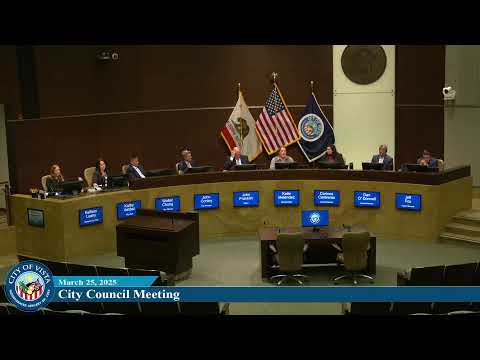
The Vista City Council on March 26 approved a one‑time service agreement and grant to Operation Hope North County to cover an identified budget shortfall for the remainder of fiscal year 2025.
The council voted unanimously to authorize the city manager to finalize the service agreement and to disperse the funds, with the expectation that Operation Hope will report back to council on use of funds, program outcomes and progress on a strategic plan to diversify revenues.
Operation Hope’s executive director, Esperanza (last name not specified), told the council the shelter — a high‑barrier facility serving families and single women — operated on a FY25 budget of $1,355,000 and had already secured about $900,000 in funding. She said the organization had a projected gap of roughly 34 percent, and reported fundraising and inflation pressures that left a shortfall for April–June of the city’s fiscal year. Councilmembers and Operation Hope leaders repeatedly described the requested funds as a bridge to allow the nonprofit time to complete a strategic planning process and secure longer‑term support.
Former program participants gave personal testimony about the shelter’s impact. “Operation Hope accepted me with my kids,” an alum who identified herself as Martha said, describing how shelter services, childcare connections and classes helped her graduate from California State University. Jeanette Godinez and Amanda Romero, both identified in public comment as Operation Hope alumni, gave similar accounts of moving from homelessness to employment and stable housing after shelter stays.
Councilmember Jeff Fox, who moved the original motion to approve a one‑time grant, said the council’s intent was to preserve a locally important shelter that serves many families in Vista. Councilmember Jesse Contreras (Councilmember Contreras) seconded and later supported a friendly amendment that authorized the city manager to execute the service agreement so funds could be released promptly.
Esperanza described program scale and outcomes: Operation Hope has served more than 1,800 individuals since 2003; it operates about a dozen private rooms (maximum capacity roughly 45 residents), a weekly food pantry serving an estimated 2,000 people per year and a boutique program. She reported program performance metrics including that over 50 percent of clients transition into stable housing on program exit and that client participation in financial‑readiness classes exceeds 75 percent. The shelter’s recent reporting cited a FY25 per‑night cost figure (reported to council as $25.93 per night) and said the agency had been offered capital and operational support from multiple public and private sources.
Council members pressed for financial transparency and suggested two accountability steps: (1) regular fiscal and program reporting to the council and the city’s homelessness standing committee, and (2) a short financial review by city finance staff as part of the service agreement. The council required regular reporting on outcomes and recommended that Operation Hope include city staff in its forthcoming strategic‑planning stakeholder committee.
The motion passed unanimously (5–0). Council members said the funding is intended to operate the shelter through the end of FY25 and to buy time for Operation Hope’s planning and fundraising efforts.
Notes: the organization told the council it turned away 67 families and 44 single women in the prior year because of capacity limits; it identified community development block grant (CDBG), foundation and private donor revenue among its funding sources and noted a 2012 city forgivable loan of $200,000 toward acquisition of the current property.