Get Full Government Meeting Transcripts, Videos, & Alerts Forever!
Get email alerts on the Sanitation Recycling topic
No spam. Unsubscribe anytime.
Cheektowaga board weighs bringing recycling in-house amid rising contract costs
Summary
Council members discussed whether the town should bring recycling collection in-house after a sharp contract price increase. The board debated vehicle needs, labor and union constraints, existing contract length and potential start-up costs.
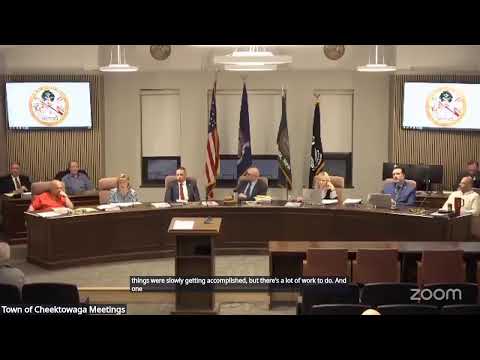
Council members spent substantial time on March 25 discussing whether the Town of Cheektowaga should take recycling collection in-house to reduce sharply rising contract costs.
Council members said the town has seen a significant increase in recycling contract expenses and suggested evaluating whether municipal provision would save money in the long term. Speakers cited several factors to consider: the upfront cost of vehicles and equipment, ongoing labor and benefits costs if the work shifts to town employees, dump fees that the town would still incur, union contract language (TCEA) that may limit which staff can perform grass pickup or recycling, and how many trucks are actually available in the sanitation fleet.
Supervisory staff and others noted there are 16 total sanitation trucks with a small number reserved for grass pickup and backup, but there is disagreement over whether the town owns two dedicated recycling trucks. Some board members said they were told two recycling trucks had been purchased and stored in the garage; others said they had not seen them. Members also noted the current recycling contract has multiple years remaining, and early termination could incur penalties.
Board members agreed it was worth exploring further but noted the need for detailed cost modeling, inventory of trucks, discussions with union leaders, and a review of the remaining term and exit clauses in the existing contract. Several members proposed a field trip to nearby municipalities that operate recycling in-house to learn best practices.
Why it matters: Recycling is an unfunded state mandate in some respects and rising contractor costs have direct budgetary impact; bringing services in-house could reduce long-term costs or increase them depending on equipment and labor costs.
Follow-up: The board asked highway and sanitation staff to prepare a study including fleet inventory, projected capital costs for trucks, labor cost estimates (salary and benefits), contract exit penalties, and potential savings scenarios; the board also requested follow-up meetings with union representatives.
Ending: The board did not reach a decision but placed the topic on a list for detailed study and possible future action.