Get Full Government Meeting Transcripts, Videos, & Alerts Forever!
Get email alerts on the School Finance topic
No spam. Unsubscribe anytime.
Board approves February budget transfers; finance staff outline options for year-end surplus and a non-lapsing account
Summary
The board approved two budget transfers for special-education consultant services and lost tuition revenue, and finance staff outlined a projected positive balance and options for year-end use of surplus funds including pre-purchases or establishment of a non-lapsing account under new state law.
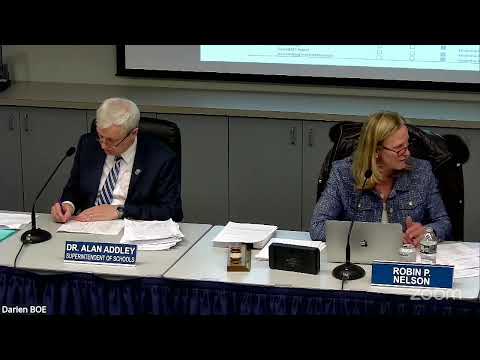
The Darien Board of Education approved proposed budget transfers for February and discussed options for any projected year-end surplus at its March 26 meeting.
Finance director Rich reported the district's forecast through February showed a projected positive balance of $462,859. Major drivers included an increase in state excess-cost reimbursement following the governor's action to add $40 million to that fund. Rich summarized salary and operating variances and said revenue swings were largely tied to updated excess-cost payments.
The board voted unanimously to approve two transfers: $98,000 into consultant services for special education (from out-of-district tuition lines) and $30,009.75 from tuition to cover lost tuition revenue for newly classified students.
Board members then reviewed options for any end-of-year surplus. Finance staff described the practical choices: (1) pre-purchase nonrecurring items (technology, textbooks, uniform replacements) that were deferred in the FY26 budget, (2) return surplus to the town, or (3) establish a non-lapsing (non-lapsed) account and place surplus funds there for identified one-time uses. Counsel and staff noted that, under Public Act provisions taking effect July 1, the Board of Education may establish and fund a non-lapsing account, subject to statutory caps (typically 2% of the appropriation).
Board members stressed the need to avoid using one-time funds for recurring staff costs and asked for further analysis. The finance committee will reconvene in May with a clearer end-of-year figure and a prioritized list of potential pre-purchases and recommendations about a non-lapsing account.