Get Full Government Meeting Transcripts, Videos, & Alerts Forever!
Get email alerts on the Landscape Maintenance Policy topic
No spam. Unsubscribe anytime.
Committee forwards draft landscape maintenance district policy with polling threshold and reserve guidance
Summary
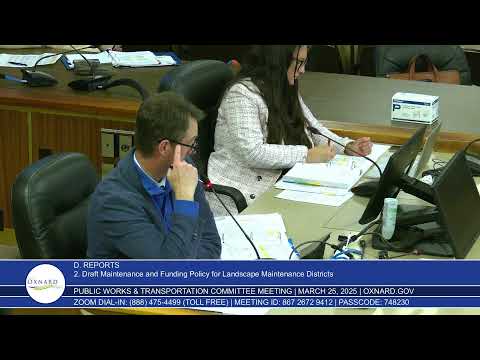
The Oxford Public Works and Transportation Committee voted 3-0 on March 25 to send a revised draft maintenance and funding policy for landscape maintenance districts to City Council, endorsing staff recommendations on polling thresholds, reserve guidance and decision order for underfunded districts.
The Oxford Public Works and Transportation Committee on March 25 voted 3-0 to recommend that City Council consider a draft maintenance and funding policy for landscape maintenance districts (LMDs), with committee-directed preferences on polling thresholds, reserve guidance and the order of remedies for underfunded districts.
Committee members and staff reviewed specific policy tables and reached these principal decisions for the draft policy to be forwarded to council: adopt the left-side option in Table 4 (polling and balloting) including a recommended polling threshold of two-thirds plus one (66%+1) to assess community interest before pursuing a Proposition 218 ballot; adopt the left-side option in Table 5 (prioritization of levy and service changes); adopt the right-side option in Table 6 with edits directing that the upper reserve limit not exceed the Streets and Highways Code ceiling (discussed as about 47.4%) and that underfunded districts “endeavor to ensure” a minimum reserve, and adopt the left-side option in Table 7 with an additional sentence that other City Council direction may supersede items A through F.
Anthony Miller, special districts manager, said the tables in the staff report reflected prior committee feedback and highlighted areas needing final direction, including polling and balloting procedures, fund balance guidance and operating reserve targets. "A polling is effectively an opinion poll. Do you support this or do you not? A ballot is actually where you mark your choice yes or no," Miller said, distinguishing an informal poll from a formal ballot count.
Public Works Director (identified in the record as Mr. Wolf) described the cost and administrative burden of a Proposition 218 balloting process: "The Prop 2 18 process is expensive. You have to do an engineer's report, you actually have to do balloting, you have to count that ballot." Staff and council members said a higher pre-ballot polling threshold (two-thirds plus one) is intended to avoid expending the city’s resources on formal balloting that is unlikely to pass. The committee also discussed a staff-recommended cooling-off provision that would prevent the city from funding new balloting for at least one fiscal year after a failed ballot unless City Council directs otherwise.
On operating reserves, staff proposed a flexible range for fully funded districts and a softer “endeavor to ensure” floor for underfunded districts. Staff explained the range (presented as about 16.6% to 47.4%) is intended to balance flexibility for small districts with caution against too-low cash reserves; committee members discussed that some districts’ monthly-equivalent assessments are below $10, making very high percentage reserves impractical in dollar terms for capped districts. Miller noted the staff recommendation to tie any upper limit to the Streets and Highways Code and to allow City Council to authorize exceptions or loans in specific cases.
Committee members debated whether to present priorities as a fixed sequence (left-side option) or as a set of options (right-side option); staff said the practical first steps would likely be the same either way but that a defined process assists staff in consistent decision-making. A council member requested language allowing City Council direction to supersede the order in extraordinary circumstances; the committee added the sentence "other City Council direction may supersede items A through F." The committee also asked staff to update the draft to reference the Streets and Highways Code ceiling as the upper limit rather than specifying a hard percentage in the policy text.
There were no public speakers on the item. A committee member moved to approve the draft with the recommended suggestions; another seconded. The clerk recorded Committee member Teran (Yes), Committee member Basula (Aye) and Chair McArthur (Yes). The motion carried 3-0.
The committee directed staff to present the revised draft policy to City Council for consideration and to incorporate the agreed table choices and language clarifications for polling thresholds, the cooling-off period following failed balloting, reserve range language tied to Streets and Highways Code limits, and the added City Council supersede clause.