Get Full Government Meeting Transcripts, Videos, & Alerts Forever!
Get email alerts on the Housing Element topic
No spam. Unsubscribe anytime.
Guadalupe council directs staff to circulate draft housing element and negative declaration for 30-day review
Summary
The council voted unanimously March 20 to send the city's draft sixth-cycle housing element and a related initial study/negative declaration out for a 30-day public review period after state reviewers signaled the draft substantially complies with state requirements.
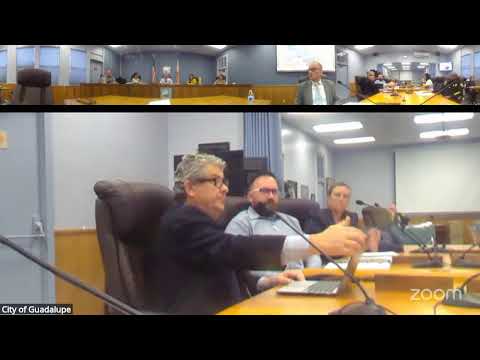
At its March 20, 2025 meeting the Guadalupe City Council voted unanimously to direct staff to circulate an initial study and draft negative declaration and to proceed with the public review of the city's sixth-cycle housing element.
The housing element is the policy document required by the state to show how the city will meet its regional housing needs. Larry (city staff) told the council the city's sixth-cycle draft (version 6) received preliminary acceptance from the California Department of Housing and Community Development and that the council must now circulate the CEQA initial study/negative declaration for a 30-day review before returning for final adoption and submittal to HCD.
Larry said the state "basically, you don't have a choice" about many of the required changes and that the city and consultant had worked to keep changes to a minimum as they responded to HCD comments. The consultant's presentation traced the document's review history, described edits made to conform to recent state law changes and summarized the next steps for CEQA clearance and certification by HCD.
Why it matters: certification by HCD is a prerequisite for many state planning and construction grants. The council and consultant emphasized that an adopted, certified housing element will also allow the city to rely on the document when seeking planning grants and other state funding.
Key details presented to the council - State review and acceptance: staff said the city's sixth-cycle draft had gone through multiple rounds of review and that HCD issued an acceptance letter (included in the council packet) stating the draft "meets the statutory requirements" and will "substantially comply" with state housing element law when adopted and submitted. Staff noted the draft was labeled version 6 and that the most recent HCD interaction included a March 7 communication. - CEQA finding: staff and the consultant reported that the initial study, which draws on environmental review prepared for the city's general plan update, recommended a negative declaration because the housing element does not propose development beyond what the general plan already analyzed. - Substantive changes required by HCD and state law: the consultant summarized categories of changes the state required, including (a) assurances that units under deed restrictions remain affordable (examples cited included Pointe Sal Dunes and Guadalupe Courts), (b) clarification of affordability across income categories to meet Guadalupe's regional housing need allocation (RHNA), (c) reasonable accommodation procedures for special-needs groups, (d) removing a two-story restriction in some zones so three-story buildings can be considered within the existing 35-foot height limit where safe and feasible, and (e) updated accessory dwelling unit (ADU) rules that reflect frequent state changes. - Affirmatively furthering fair housing and community projects: the draft links several capital and community projects'such as improvements at the Amtrak station, Central Park and Leroy Park, flood-control work near the Santa Maria River, and civic amenity upgrades like the Royal Theater'to fair-housing objectives required by HCD. - Sites and capacity: staff said the city's site inventory was approved by HCD last year and that the inventory, zoning adjustments and pipeline projects are adequate to meet the city's RHNA for this cycle.
Council questions and public input: Council members asked about floodplain mapping updates and ADU capacity. Staff replied that the housing element uses the most recent FEMA/FIRM maps available and that updates would be incorporated if FEMA issues new maps. On ADUs, staff noted the document estimates a potential increase in ADU units (the consultant referenced an example estimate of roughly 600 ADUs as a theoretical maximum under state rules, while noting actual buildout depends on utility capacity and code requirements); the council was told public works will assess whether water and sewer capacity constrain approvals.
Formal action: Council member Amelia Villegas moved to set the revisions and direct staff to circulate the initial study/draft negative declaration (recommendations 3 and 4 in the staff report). The motion passed unanimously on a voice/roll call vote. Council members Eugene Acosta, Whitney Fernandez, Amelia Villegas, Christina Hernandez and Mayor Julian voted in the affirmative.
Next steps: Staff will circulate the initial study/negative declaration for at least 30 days to state and local agencies and interested parties, then return to the council with a final negative declaration and an adoption resolution for the housing element. After local adoption the city will submit the housing element to HCD for final certification.
The action starts the formal public review and keeps the city on schedule to finalize the housing element and pursue any related grant opportunities that require a certified housing element.