Get Full Government Meeting Transcripts, Videos, & Alerts Forever!
Get email alerts on the Industrial Growth North Richland topic
No spam. Unsubscribe anytime.
Richland council backs study into acquiring DOE industrial land, expanded fire coverage and power options
Summary
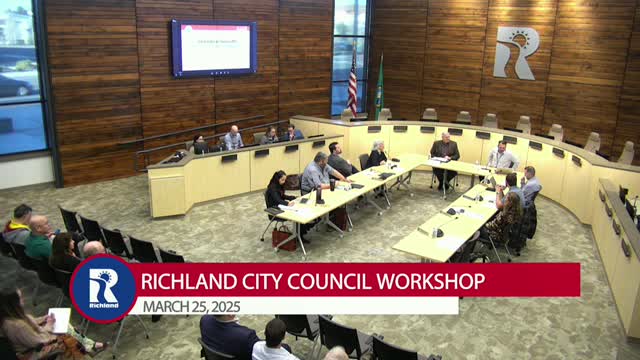
At a March 25 workshop the Richland City Council instructed staff to explore pursuing additional industrial land north of the Northwest Advanced Clean Energy Park from the U.S. Department of Energy, examine expanded fire-service arrangements for DOE facilities, and study the feasibility of gaining control or access to an underused DOE substation.
Richland city staff will study options to acquire additional industrial land from the U.S. Department of Energy, pursue an accelerated timeline for expanded city fire coverage of DOE facilities, and evaluate whether to take on an underused DOE electrical substation, after a March 25 workshop where council members signaled support for further analysis.
City planning and economic development staff described a swath of land north of the Northwest Advanced Clean Energy Park on the Hanford site that is designated industrial in the Department of Energy’s Comprehensive Land Use Plan and in the city’s planning documents. Staff said past federal transfers — including a 1,341-acre transfer led by a community reuse organization — were completed through congressional action and were given to local redevelopment partners at no cost with conditions tied to economic development.
The council’s interest was prompted in part by several pending and recent commitments on nearby land, including a large solar feasibility area negotiated with Hecate, an option agreement with Washington Energy LLC and an expression of interest from Atlas Agro for a data center. Staff said the larger corridor includes roughly 5,200 acres identified north of the Clean Energy Park and that some feasibility work has identified up to about 8,000 acres of potential solar study area; staff emphasized final usable acreage could be smaller after environmental study and feasibility analysis.
Why it matters: council members and staff said the work could expand Richland’s industrial base and diversify the local economy while noting the transfers and development would be multi-year efforts. Past transfers took several years; staff estimated the last federal-to-local transfer required roughly six to eight years from start to finish, and that environmental study and deed restrictions would affect what land could be transferred and used.
Key policy and constraints: staff pointed to the city’s strategic plan and comprehensive land use plan goals supporting industrial growth — including policy language that specifically contemplates industrial development on lands formerly owned by DOE and transferred to local entities — and to federal limitations. City staff noted deed restrictions used in prior transfers prevented certain activities (for example, restrictions on digging to groundwater) and that the DOE’s longtime treaty consultation obligations with tribes have been carried forward through an Intertribal Advisory Board (ITAB) arrangement. Staff also said the federal position, reflected in DOE planning, is that much of the corridor is intended for industrial uses and not for new residential development.
Fire-service proposal and timing: Thomson DOE and lab representatives asked whether the city could expand emergency-response coverage further north sooner than previously planned because the DOE fire station known as Station 93 is deteriorating. DOE and PNNL representatives explained they are building a new DOE fire station on the Central Plateau that will not be online for roughly 2½ to 3 years, but said Station 93’s condition — including failing drains, an aging roof, obsolete fire-detection components and worn electrical distribution — is pushing an earlier transition.
City and DOE staff outlined a possible interim approach in which firefighters currently assigned to Station 93 would relocate into an existing but underused city station (described in the discussion as Station 94/75) while the DOE project is completed, and the city would assume primary first-response responsibility to the north under normal operating conditions. Fire department staff said the current call volume from the lab and nearby DOE facilities is low (roughly two to three calls per month) and that existing city assets could likely cover response without immediate additional sworn staffing, though equipment, training, operational agreements and cost-sharing would need detailed analysis.
Utilities and substation: council members also asked staff to study a DOE-owned 451 Substation and its overhead distribution line, which staff described as well-built but older equipment operating at a different voltage than the city grid. Public-works and energy staff said the substation is operational, appears to be overcapacity for current local loads (two transformers discussed in the workshop were described as large compared with present demand) and might be useful for temporary construction power or longer-term service if modernization and compatibility work were performed. Staff said parts are getting harder to source because of age and that any repurposing would require engineering and cost study.
Council direction and next steps: council members did not take a formal vote but broadly supported moving forward with studies. The council asked staff to scope feasibility work on three tasks: (1) develop options and a legislative strategy to request transfer or joint use of suitable DOE lands, including environmental due diligence and tribal consultation pathways; (2) evaluate the operational, training, staffing and cost implications of expanding city fire and emergency medical response into the DOE north corridor on an interim and longer-term basis; and (3) assess the 451 Substation’s condition, modernization cost, compatibility with the city grid and potential for serving new industrial customers. Staff warned the fall could be a fast-moving window for some of these operational decisions and said it would return to council with a more detailed, “finished staff work” package in the coming months.
Meeting context and caveats: staff and DOE representatives repeatedly emphasized that any land transfer would follow DOE’s formal processes and congressional action when required, that environmental conditions will determine what areas — if any — could be transferred, and that deed restrictions and tribal consultation obligations could shape outcomes. Council members requested cost and risk analyses and made clear they expect staff to return with options and proposed cost-sharing arrangements before any commitments are made.
Other item — wildfire update: near the end of the workshop the council received an operational update on a nearby marsh fire. Fire officials said the incident had burned more acreage than originally estimated, that ground access was limited and that aerial resources had been used; they said no structures were threatened and that investigation into the cause remained open.
No formal ordinance, resolution or transfer was adopted; the council’s action was direction to staff to study and return with recommendations and cost estimates.