
Matanuska-Susitna district proposes $281.6 million preliminary budget as charter and staffing shifts drive changes
Get AI-powered insights, summaries, and transcripts
Sign Up Free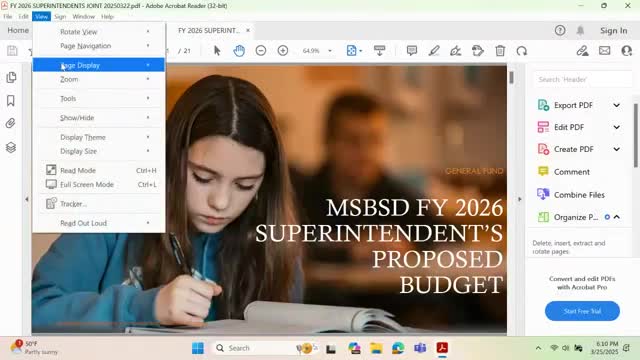
Summary
Superintendent Katie Traini presented the Matanuska-Susitna Borough School District—s proposed fiscal 2026 budget, a balanced preliminary plan totaling $281,601,753 that assumes a $1,000 increase in the base student allocation and anticipates modest enrollment shifts, charter funding increases and reductions to discretionary transfers and some positions.
Superintendent Katie Traini presented the Matanuska-Susitna Borough School District—s proposed 2026 operating budget on March 25, saying the board has approved a balanced preliminary budget of $281,601,753 in revenues and expenditures and that the figure reflects assumptions about state and borough funding.
"The 1 thing I can guarantee about this is that it is not going to be what actually happens," Traini said, describing the revenue uncertainty tied to ongoing state legislative work and the borough appropriation process.
The district—s plan assumes a $1,000 increase to the base student allocation (BSA) as outlined in House Bill 69 and treats some one-time state funds (about $680 per student) as likely to be replaced rather than added. Deputy Superintendent Gardner told the assembly that the district chose conservative revenue assumptions and is monitoring the legislature and borough decisions as it moves from a superintendent-proposed budget toward the final adopted budget in late May or early June.
Why it matters: The district depends primarily on state funding and the borough—s required local contribution, and both drive nearly all revenue. Gardner said the district requested a 4% borough funding increase for FY26 to cover a rise in the required local contribution; the required local contribution itself is calculated by the state and reduces the state entitlement. "If borough funding doesn't at least keep up with that minimum required, then the school district uses less in funding on an annual basis," Gardner said.
Key numbers and drivers cited by district staff: - Preliminary FY26 revenues and expenditures: $281,601,753 (balanced) - FY25 revised totals cited around $278.1 million; the FY26 proposal is about $3.5 million higher overall - Charter school funding projected to rise from about $24.17 million to $26.4 million (an increase of roughly $2.3 million) - The district projects total average daily membership (ADM) of 19,164 and an adjusted ADM for funding formula purposes near 35,549 - The presentation assumed a $1,000 BSA increase (as in HB69) but noted that translates to roughly a 3.2% increase in state funding once other one-time payments and transportation adjustments are considered - Student allotments (for correspondence/homeschool students): $3,000 for grades 9'012 and $2,600 for K—; the presentation set aside about $7.7 million for those allotments and flagged a carryover balance of $6,361,739 - Transfers include roughly $6 million to support pupil transportation and about $570,000 that will return to the borough to support the new Mat Su Central School building per the project agreement
Expenditure adjustments: The district said most discretionary non-personnel budgets face approximately 15% reductions, but because more than 80% of the budget is salaries and benefits, achieving a balanced budget requires position reductions. District staff said many reductions fall outside the district—s pupil-teacher ratio (PTR) allocation metrics and reflect roles previously sustained with one-time funds. Staff cited a projected net loss of about 600 in-person students compared with earlier projections and showed the largest personnel reductions in classroom teachers and instructional support positions.
Enrollment, funding formula and charter impacts: Deputy Superintendent Gardner explained how borough contributions and the state foundation formula interact: the state computes a district—s "basic need" from adjusted ADM and the BSA, then subtracts the minimum required local contribution. The district noted that because charter schools receive per-pupil funding and have local discretion, projected charter enrollments are a major driver of the FY26 increase in charter funding; if charter students do not materialize, those budgets will be adjusted in the fall.
Questions from assembly and board members focused on the mechanics of the foundation formula, preschool funding (largely grant-funded, staff said), pupil-teacher ratios versus average class size, and the growth of correspondence (homeschool) enrollment. Traini and Gardner said the district has seen correspondence enrollment rise from around 14% pre-pandemic to roughly 18—9% at the start of this year and estimated it may be approaching 19% now. The district—s documentation posted for the assembly includes line-item detail and a budget handbook that staff said they would continue to supplement as the assembly reviews appropriations.
What the district asked of the borough: The board transmitted a request for a 4% increase in local education funding for FY26 to cover required local contribution growth and maintain services. Staff reiterated that any borough decision that does not at least track the minimum required local contribution will reduce the district—s ability to receive state entitlement funds.
Outlook and next steps: Traini and Gardner said the district will adjust the proposed budget as the legislature completes its work and as the borough finalizes appropriations; they described the March presentation as the superintendent-proposed budget (the board approved that proposal) and said the assembly will adopt a final borough budget in late spring once revenue figures are known.
Ending: Assembly and school board members thanked staff for the presentation and asked for additional historical budget trend data and clarifications about preschool and correspondence enrollment; staff said they would provide supplemental reports and that a more final budget would reflect known state and borough appropriations.