League City explores buying streetlights, converting to LED to cut costs and improve service
Loading...
Summary
A consultant told League City council members a purchase-plus-LED-conversion could cut the city's annual street-lighting expense by about $750,000 in year one and save roughly $18 million over 20 years; staff recommended further audit and negotiations with utilities before any purchase.
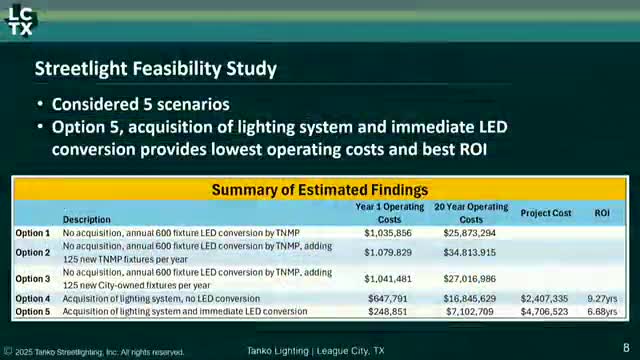
League City council members discussed a proposal to acquire the city's streetlight system and convert fixtures to LED during a March 25 work session, hearing a consultant's estimate that buying the system and converting to LED could reduce annual lighting costs by about $750,000 in the first year and save more than $18 million over 20 years.
The consultant, Neil Tolley of TANCO Lighting, told the council the city currently pays TNMP (Texas-New Mexico Power) and CenterPoint for roughly 5,546 and about 790 fixtures, respectively, and that most TNMP fixtures are older high-pressure sodium units. Tolley said the study modeled five options and found that acquiring the system and converting to LED (option 5) produced the largest savings: "This yielded the best results. In fact, when compared to option 1, option 5, the acquisition and subsequent LED conversion, could reduce your annual lighting cost by over $750,000 in the first year and save more than $18,000,000 over the next 20 years," he said. Tolley estimated the project cost at about $4,700,000 with an ROI of roughly 6.7 years.
Why it matters: Council members framed the discussion as a potential way to lower long-term operating costs, gain local control over lighting design and maintenance, and improve nighttime visibility. David DeKalb, League City's public works manager, said the city currently pays roughly $14.12 per fixture per month under TNMP for energy, maintenance and the fixture fee and that owning assets would cut the comparable operating cost to approximately $3.75 per fixture per month (roughly $1.75 for energy plus an estimated $2 for outsourced maintenance).
Key details and debate
- System size and ownership: Tolley reported TNMP owns about 5,546 fixtures in League City; CenterPoint owns about 790. The consultant's analysis focused on TNMP-served areas because they make up the bulk of the system.
- Cost comparison: Under TNMP's current all-in charge, council was told the city pays about $14.12 per fixture per month. If TNMP owns and converts to LED, that figure could rise to about $29.32 per fixture per month, Tolley said. If the city acquires the fixtures and converts to LED, the city's operating cost would drop to approximately $3.75 per fixture per month (energy plus contracted maintenance).
- Projected savings and costs: The consultant estimated a one-time acquisition-plus-conversion cost of $4,700,000, an ROI of about 6.7 years, and 20-year savings in the tens of millions. Tolley said the city's current annual TNMP bill is about $930,000 and that acquisition/conversion could reduce that to under $250,000 (about $680,000 annual savings).
- New development and ordinance change: Staff (Christopher Sims) said new development averages about 125 lights a year entering the city system. Sims said staff plan to propose an amendment to the Unified Development Code (UDC) chapter 125, section 5.9 so that newly installed streetlights would be owned by the city moving forward; that amendment was described as item 10A on the regular meeting agenda. Hillwood, a legacy developer, agreed to act as a pilot on its next phase, with the city owning the poles/fixtures while TNMP retains the primary service pedestals near transformers.
- Maintenance and service: Tolley and staff outlined maintenance options: in-house, bid out to contractors, or contract TANCO to provide maintenance. TANCO generally recommends outsourcing for a large city, estimating typical contracted maintenance at about $2 per fixture per month and repair response times written into contracts (staff discussed a 5-business-day standard with emergency responses in about an hour). Tolley said contractors typically complete repairs within five business days and handle insurance billing for knocked-down poles.
- Questions and concerns from council: Council members asked for a full comparison that includes new lights added each year rather than only the existing system; wanted figures for filling gaps on unlit arterials (infill/backfill); asked whether the city had factored inflation (staff said they used a 3% inflation assumption and 1% utility escalation); and whether utilities could refuse to sell fixtures (staff said TNMP could decline, which could make acquisition more expensive or more complex). Several members supported proceeding with the UDC amendment to begin owning lights in new subdivisions and returning with a bid/RFP for maintenance.
Next steps: Staff and TANCO proposed a two-step path: (1) perform a lighting audit/inventory and negotiate acquisition terms with TNMP, and (2) implement an LED conversion and solicit maintenance proposals or contractors. Staff said the planned ordinance amendment (item 10A) would come before the regular council meeting for possible first-and-final action; the work session produced discussion and direction but no formal council vote on acquisition.
Prognosis and risks
Council members and staff noted risks and contingencies: TNMP or CenterPoint could decline to sell fixtures or set terms that raise the acquisition cost; taking maintenance in-house would require hiring licensed electricians and possibly equipment; and a partial approach (taking only existing fixtures, not the new ones) could complicate operations and customer reporting unless the city fully accounts for mixed ownership across service areas. Staff described the likely acquisition timeline as roughly a year to negotiate and implement an initial phase, and presented the UDC amendment and a pilot with Hillwood as ways to limit near-term risk while testing operational procedures.
The work session concluded with staff directed to return to council with a contract scope for a TANCO-led inventory and with options for maintenance procurement and financing so the council could consider next steps at upcoming regular meetings.