Get Full Government Meeting Transcripts, Videos, & Alerts Forever!
Get email alerts on the Infrastructure Projects topic
No spam. Unsubscribe anytime.
Bee Cave leaders review candidate capital projects for Recreation & Entertainment District — roads, trails and park access
Summary
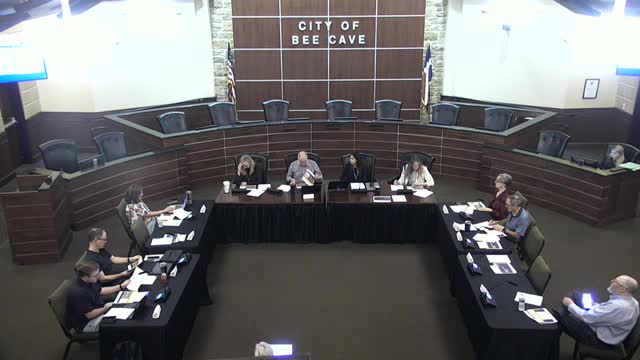
At a March 25 joint session, Bee Cave EDC directors and city council members reviewed a set of capital projects pulled from the city’s CIP intended to support the Recreation and Entertainment District around Central Park.
At a March 25 joint session, Bee Cave EDC directors and city council members reviewed a set of capital projects pulled from the city’s Capital Improvement Program (CIP) intended to support the Recreation and Entertainment District around Central Park.
Staff identified several project categories that repeatedly surfaced in prior CIP planning: a Tordera Drive extension and intersection signal near the proposed library site, a potential new connector called “Skaggs Parkway” that would rely on right-of-way not currently city-owned, multiple trail and pedestrian projects including a shared-use path along Bee Cave Parkway, and park infrastructure improvements that would increase circulation and add parking at Central Park.
Julie (staff member, finance) and Chelsea (staff member, planning/economic development) cautioned that the numbers presented are “rough orders of magnitude” and have not been engineered. Chelsea said a new shared-use path along Bee Cave Parkway — from City Park to the new intersection near Willie Way — could cost about $900,000 to $1,000,000 to design and construct; she said topography makes the north side of the corridor more complicated and the south side is the initial focus. Chelsea also noted a more complicated eventual pedestrian bridge over US‑71 and behind-linkage trails would require extensive work and may be lower priority because much of the needed right-of-way is private.
Directors and councilors debated sequencing and dependencies. Council member Hite observed that if the library is sited adjacent to the track, “we're gonna have to build half the road anyway just to allow access and parking,” making the road-and-signal project closely connected with the library decision. Staff noted that environmental and floodplain considerations affect cost on some segments. The group also discussed whether planned private developments — including an as-yet-unseen site plan amendment for the Backyard mixed-use project — can be relied upon for parking; staff warned developers’ timelines are uncertain and recommended EDC plans assume the city must provide public access and parking rather than rely exclusively on private contributions.
On park infrastructure, staff described a first-phase set of circulation, parking and site-development work intended to make more of Central Park accessible by vehicle and to add roughly 110 parking spaces in the first phase without constructing a parking garage. Chelsea said the park-phase estimate of about $7,000,000 covers site development and earthwork required by steep topography and drainage improvements; staff described the work as “drive aisles” and circulation rather than thoroughfare construction.
No formal capital commitments were made at the workshop; staff asked directors and councilors to rank project priorities in a forthcoming survey so that the EDC and council can align the EDC’s sales-tax spending with the city CIP during the summer budget cycle.