Get Full Government Meeting Transcripts, Videos, & Alerts Forever!
Get email alerts on the Streets topic
No spam. Unsubscribe anytime.
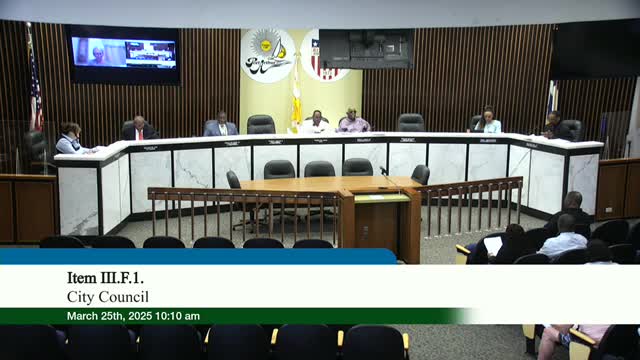
Port Arthur council debates who should decide which streets get fixed and when
Summary
Council members, staff and residents spent more than an hour debating whether elected council members or city engineers should set priorities for street reconstruction, with officials agreeing to schedule a workshop to align district allocations, project lists and design timelines.
Councilwoman Hamilton Everfield urged the Port Arthur City Council on March 25 to defer selection of streets for reconstruction to the city’s engineers and to amend a five-year program so repairs are chosen based on subsurface data rather than council preference. "I am asking that we yield to our engineers to give us instruction as to which streets should be repaired and when," Everfield said during the discussion item on proposed street reconstruction, rehabilitation and new design.
The request grew out of previous council action in 2019–2020 that divides money among council districts based on linear feet of roadway; Everfield said the resolution does not clearly require council members to pick specific streets and that technology and engineering studies now make data-driven decisions possible.
Several long-serving council members defended the existing process, saying the original program was designed so licensed engineers identify candidate streets and council members then prioritize a short list for the upcoming year. "That list is not determined by the council member — it was determined by the engineer," Councilman Calvin Doucette said, describing how the selection method worked when the program was adopted. Doucette and others said the full council ultimately approves the final list and the dollar amounts for each project.
Councilmember John Lewis and Councilman Doucette recounted how the program originally assigned a district allocation based on miles of road and allowed each district representative to distribute that money within the district, using engineer-collected data for reconstruction-versus-resurfacing decisions. Doucette said stopping that practice and allowing ad hoc choices has reduced the program’s efficiency.
Councilman Jimmy Frank and others raised concerns about perception and fairness: when a councilmember drives their own district and selects streets, critics can question whether choices favor specific homeowners. "How do you put away the appearance of evil when you're doing that?" Frank asked, urging use of consistent engineering criteria to avoid any appearance of favoritism.
Members of the public echoed both sides. Raymond Scott, a resident who said he was present when the program was created, urged the council to follow the established process and to use the engineer-prepared list as intended. He told the council the program can work “if everybody just come together to work the process and stop trying to reinvent the wheel.”
City staff said they have been gathering the data councilmembers asked for. Finance and engineering staff told the council the capital accounts for reconstruction and rehabilitation are largely committed to projects now under way, and that remaining balances are shrinking as design and construction contracts are approved. Lynn (finance director) told council members the staff is finishing a reconciled, district-by-district accounting of linear footage and money spent; she said the updated list would be completed within the week.
Council members agreed to hold a workshop after staff completes the updated street inventory so all members can review the same project lists, the district allocations and the projected timing for design, bidding and construction. Councilmember Doucette said the city should use design funds now available so selected projects will be ready to bid when their turn comes.
The council did not take formal action on ordinance language at the meeting. Instead members directed staff to produce the complete, up-to-date inventory, including linear feet by district, estimated construction costs for projects already in the pipeline, and an explicit, councilwide plan that shows which funds will be used for design and which for construction.
Council members emphasized they want a transparent, repeatable process. Everfield said she supports council input but wants the engineering analysis to be the primary determinant; Doucette and Lewis said they support a hybrid approach that preserves district accountability while relying on engineers’ data. The group agreed the next step is a staff-led workshop to align the program with current data and council expectations.