Get Full Government Meeting Transcripts, Videos, & Alerts Forever!
Get email alerts on the Pensions topic
No spam. Unsubscribe anytime.
Georgetown council hears TMRS briefing on option to adopt non‑retroactive COLA before legislative deadline
Summary
TMRS actuaries briefed the City of Georgetown on a new non‑retroactive cost‑of‑living adjustment option that the city can adopt this year under HB 2464; council members asked about budget impacts, service‑ratio effects and timing for including the option in the 2026 budget.
Georgetown council members received a detailed briefing from actuaries with the Texas Municipal Retirement System (TMRS) on a new non‑retroactive cost‑of‑living adjustment (COLA) option that cities can adopt this year under state legislation known as HB 2464.
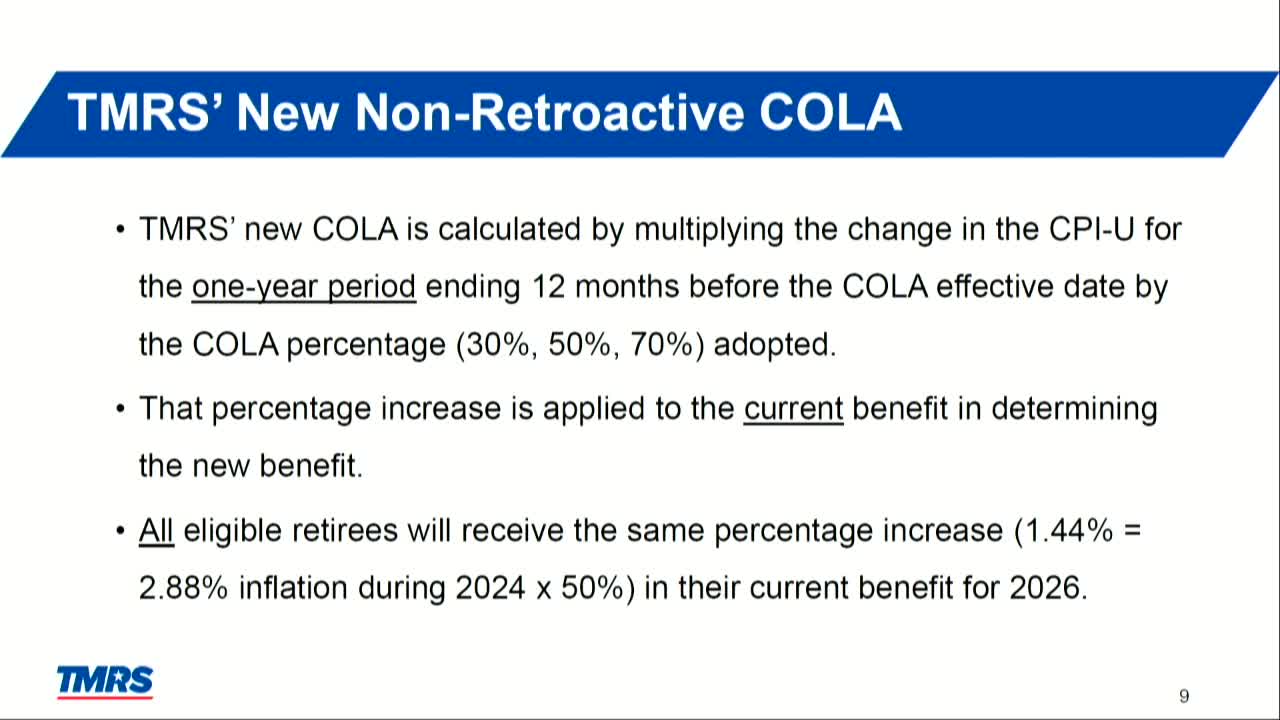
The presentation, led by Kenneth Oliver, an actuary with TMRS, explained differences between the traditional retroactive COLA (which applies cumulative inflation to retirees’ original benefit) and the non‑retroactive COLA established by HB 2464 (which applies a single year increase based on the most recent December CPI‑U to retirees’ current benefit). Oliver and TMRS colleagues told the council this is the last year the state law authorizes cities to adopt the non‑retroactive option without further legislative action.
Why it matters: Council members said they want budget‑ready numbers for 2026 because choosing a non‑retro COLA would raise the city’s actuarially determined contribution and be amortized over 20 years. TMRS staff said the non‑retro option tends to be simpler, more equitable across cohorts of retirees and in many scenarios less expensive than adopting a retroactive COLA at the same percent — because non‑retro calculations do not “catch up” retirees to past cumulative inflation.
Key details given to council members included: Georgetown’s TMRS plan uses a 7% employee contribution and a fixed 5% account crediting rate; Georgetown’s funded ratio based on the 12/31/2023 valuation was 87.2% (smooth assets vs. actuarial accrued liability); the city adopted a 2:1 city match and currently has a 30% repeating retroactive COLA on its plan provisions. TMRS actuaries walked through comparable model results for 30%, 50% and 70% non‑retro options and described plan‑change study outputs showing how prior‑service rates (the amortization component) would increase under higher COLA percentages.
Budget and timing questions dominated the discussion. TMRS said adoption of a non‑retro COLA increases the city’s prior‑service amortization ladder and therefore lifts the city’s contribution rate for 20 years; the increased cost is amortized and paid through the actuarially required contribution rather than as a single lump sum. TMRS offered to provide seven‑year projections and more granular plan‑change studies, including a 70% non‑retro modeling that the presenters did not bring to the workshop but said would be included in updated materials.
Council members asked about who pays COLA increases (the city), whether the city could absorb the higher rate without a large one‑time payment (yes — TMRS amortizes the increase), and what would happen to the city’s statutory step‑max for contribution rates. Presenters said the statutory “step‑max” is an older provision in the TMRS Act that limits the employee + city contribution step in some cities; if a chosen option produces a contribution above the statutory cap the city would need to adopt language agreeing to pay the actuarially determined contribution regardless of the step‑max. TMRS staff said many Texas cities have already removed or waived the step‑max in local ordinances and that the Legislature has seen proposals to remove the cap statewide.
Council direction and next steps: Staff said they were presenting the option to inform budget‑year planning and to gather initial council feedback; no formal action was taken at the workshop. Council members generally expressed interest in seeing specific budget‑year impacts and phasing options (for example, adopting a lower option now and paying more immediately toward future liability if the council later chooses to increase the benefit). TMRS agreed to provide the city with detailed plan‑change studies, seven‑year projections and modeled scenarios for the 70% options to support budget deliberations.
What remains uncertain: HB 2464 currently authorizes the non‑retroactive option for a limited period; TMRS staff said bills have been filed to extend or clarify the law but their status was uncertain and cities would be notified if the Legislature acts. TMRS emphasized adoption would be a city policy decision and that its staff’s role is to provide actuarial modeling and explain how different choices affect contribution rates and funded status.
Speakers quoted in this article spoke at the council workshop and included TMRS actuaries and Georgetown council members.
Ending note: Staff requested council feedback and said any decision on whether to include a non‑retroactive COLA option in the 2026 budget would come through the regular budget process after the city receives TMRS’ updated modeling.