Get Full Government Meeting Transcripts, Videos, & Alerts Forever!
Get email alerts on the Water Service Disconnections topic
No spam. Unsubscribe anytime.
Committee advances proposal to add owner-focused tools, notifications to reduce apartment water shutoffs
Summary
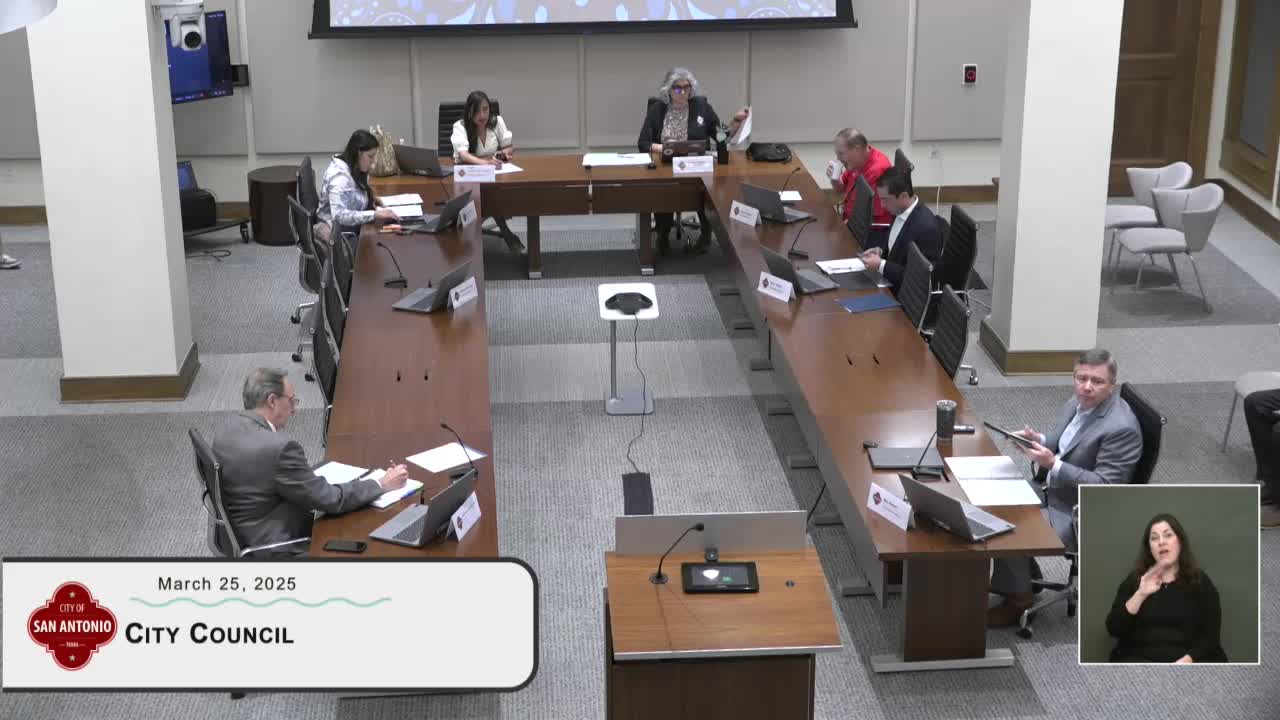
San Antonio committee advanced a recommendation to send proposed code changes and new owner-liability tools to Council Session A after hearing from tenants, property managers and San Antonio staff about recurring water disconnections when property owners fail to pay utility accounts.
The San Antonio City Council committee voted to advance a package of recommendations aimed at reducing water shutoffs in apartment complexes where owners or property managers fail to pay utility accounts.
The committee's recommendation, moved during the meeting and then approved by voice vote, asks staff to advance code amendments and a set of operational changes to Council Session A addressing notifications to owners and property managers, financial tools for large delinquent accounts, and stronger enforcement measures under Chapter 34 and related city code provisions.
Why it matters: Tenants in multifamily properties have reported losing water service when property owners or managers allow large unpaid utility balances to accumulate. Committee members and staff said changes are intended to increase owner accountability, improve multi-party notification, and preserve service to residents where possible.
Mike Shannon, identified in the meeting as Director of Development Services, told the committee the city and partner organizations have returned in the last 30 days with a recommended approach after receiving feedback from the apartment industry and other stakeholders. Shannon described how tenants who pay rent that is supposed to include utilities still lose water service when property owners fail to pay the utility bill for the complex. He said the city and utility partners have added steps in their notification process over the past six months, including certified letters, door hangers and direct contact with property owners and managers.
Shannon said the typical timeline before disconnection includes roughly five to six weeks of notice and outreach. He said the proposed package would formalize those operational steps, expand coordination with city staff, and add a “tool” in code to address large indebtedness on an account. "We wanted to work with Source in the notification process along with city staff," Shannon said.
Public commenters and committee members pressed staff on the scope and thresholds of the financial tool. The staff presentation mentioned starting with accounts that represent very large balances; one proposal discussed a pilot threshold of $50,000 for owner-level intervention. Councilmembers, several of whom said $50,000 seemed high, suggested beginning at $25,000 and leaving the threshold adjustable based on results and additional data. Shannon said nine accounts out of 600 were identified in a February dataset as having very large balances; staff also said roughly 30 properties had balances at or above $25,000, and that about 40 properties appeared on an inspection list though only two of those were labeled delinquent during the discussion.
Committee members emphasized multiple parallel steps: improve notifications to owners and managers, expand payment-arrangement options for affected tenants, and create a code-based enforcement mechanism that can escalate penalties or place a lien-type charge on a property when owners repeatedly fail to address large delinquent balances. One councilmember suggested that notices to owners should explicitly warn that the city and partner programs exist to assist with payment and that inaction could result in a lien or charge on the property.
The committee recorded no roll-call vote naming individual votes in the transcript; the chair called for those in favor and then said, “la moción pasa” (the motion passes). The motion as recorded asked staff to advance the recommended changes to Council Session A for further consideration.
The committee asked staff to return with additional legal analysis and implementation details, including the financial and legal implications of placing charges on property and how the proposed tools would interact with bankruptcy or other collections processes. Staff agreed to provide follow-up materials for Council and the legal department to review.
The committee also noted continued collaboration among city staff, the apartment association, and utility partners to refine notifications and on-the-ground practices such as door hangers and certified mail to reduce disconnections while preserving tenants' access to water.
Members asked staff to provide more detailed counts and financial estimates before final Council action; staff said they would return with that information.