
Hays County commissioners vote 4-1 to terminate Austin Pets Alive contract for Pet Resource Center; direct Broadus & Associates to coordinate local partners
Get AI-powered insights, summaries, and transcripts
Sign Up Free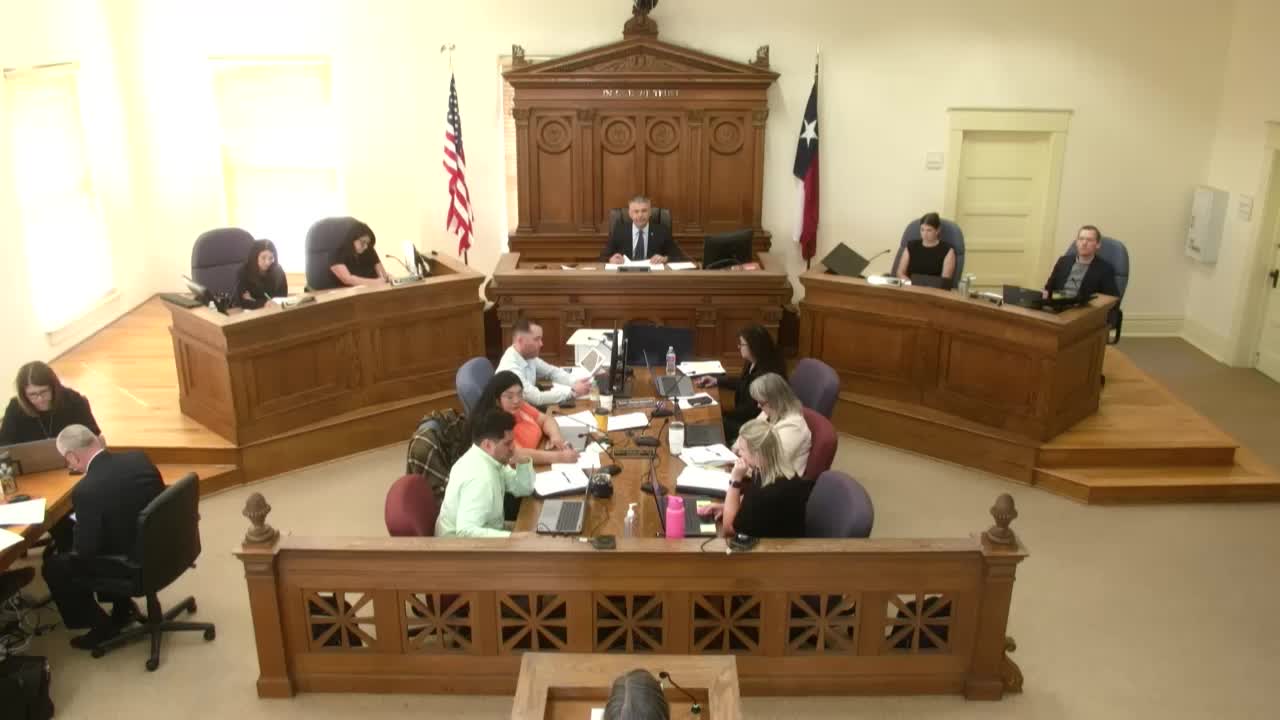
Summary
Hays County commissioners voted 4–1 to terminate the county’s professional services agreement with Austin Pets Alive for the Hays County Pet Resource Center and directed Broadus & Associates to coordinate with local municipalities and nonprofits to deliver the facility and programming.
Hays County commissioners voted 4–1 on March 25 to terminate the county’s professional services agreement with Austin Pets Alive (APA) for development of the Hays County Pet Resource Center (PRC), and directed Broadus & Associates — the county’s project management contractor for a future facility — to work directly with local municipalities and nonprofit organizations to deliver a pet-resource and education center.
Supporters and opponents of APA’s contract filled the commissioners’ courtroom for roughly three hours of public comments, offering sharply different views about who is best positioned to run countywide animal-welfare programs. APA representatives, including Maggie Lynch (senior director of research and development) and Dr. Ellen Jefferson (president and CEO), described APA’s national expertise, a recent PetSmart Charities grant and plans for on‑the‑ground programming. Local nonprofit leaders and volunteers — particularly representatives of PALS (Prevent A Litter of Central Texas) — urged the court to direct more county funding to local providers and criticized APA’s rollout and community outreach.
Why it matters: The county has for months been trying to address chronic overcrowding at the San Marcos Regional Animal Shelter and to build a network of services — spay/neuter, microchip and reunification, community-based diversion and vaccines — that reduce shelter intake. The contract with APA was intended to create a systems approach (a “pet resource center”) that pairs programs with a physical facility; opponents said the county’s money would be better spent expanding established local services.
Most of the public testimony focused on two competing claims: APA says it has national experience and outside grant funding to build the systems the county needs; local groups say they already run effective programs in Hays County and that county dollars should fund and grow those local operations. Kendra Lugo, the PRC’s pet-reunification coordinator, said the PRC has already diverted animals from the shelter and run large food-distribution and microchip events. PALS leaders and numerous volunteers countered that PALS has decades of local experience, new clinic space, and can scale services if given more county funding.
Contract history and grant funding: County documents and speakers said the county’s original contract with APA provided roughly $375,000 to begin program development; county staff later authorized additional payments (one figure cited in court was about $79,880). APA told the court it also secured a multi‑year grant from PetSmart Charities to fund the national Human Animal Support Services work and to provide technical assistance to Hays County; APA said that grant is awarded to APA’s national program and would not automatically transfer to the county if the contract is canceled. APA also said portions of the PRC program that were to include direct spay/neuter were not funded in the first year of the county contract and would be implemented as funding becomes available.
Court action: Commissioner John Smith moved to terminate the APA professional services agreement and to direct Broadus & Associates to work directly with local municipalities and nonprofits to deliver the PRC facility and programming. Commissioner Cory Cohen seconded. The vote was: Commissioner Debbie Inglesby — yes; Commissioner John Smith — yes; Commissioner Cory Cohen — yes; Commissioner Maureen Hammer — yes; County Judge Ruben Becerra — no. The court directed county staff to draft the termination letter consistent with the contract’s requirements.
What commissioners said: Supporters of termination said county-funded services should be built with clear local participation and transparency, and they cited an outreach shortfall between APA and longstanding local providers. Opponents — including Judge Becerra — said APA brings expertise and external grant resources that are difficult for a small local nonprofit to supply and that terminating the contract risks losing technical assistance and multi‑year grants if they were contingent on the APA–Hays County agreement.
Local service landscape and numbers cited in court: Multiple speakers and county staff provided figures during testimony. County budget staff noted that Hays County has provided direct funding to PALS in recent years — for example, PALS received about $60,000 in 2024 and roughly $20,625 in 2020; county staff estimated roughly $250,000 total county funding to PALS over the past five years. APA said it had secured a multi‑year grant valued in the “hundreds of thousands” to over $1 million for national program support; APA representatives said that grant would finance national technical assistance rather than all local services. County officials said the county had paid roughly $375,000 under the original contract and approximately $79,880 in subsequent payments.
Next steps: The court instructed county counsel and staff to prepare a termination letter under the contract’s notice provisions. Commissioners also directed Broadus & Associates — already contracted for project management of the physical facility — to convene and coordinate with municipal partners and local nonprofits to develop the PRC facility and to explore program partnerships. The court did not specify a single nonprofit operator to replace APA.
Community response and contention points: Many local nonprofits, volunteers and municipal officials addressed the court. PALS leaders and other local rescue volunteers urged funding be kept local, saying PALS already runs large spay/neuter and trap-neuter-return (TNR) clinics, microchip and vaccine events, and a food pantry. Several speakers said PALS’ current programs served thousands of animals and that the organization can expand with county support. APA leaders stressed their national model links shelters and community programs and that a PRC without comprehensive programs alongside a shelter will not solve systemic intake pressures.
What the decision does not do: The court’s action did not order a specific replacement operator for programming, did not adopt a new program budget, and did not cancel the county’s separate contract with Broadus & Associates for facility project management. County staff said they will return with the draft termination letter and next steps for facility planning and partner coordination.
Ending note: The vote highlights a deep divide among advocates about whether to centralize technical experience with a national nonprofit or to invest directly in multiple local providers already running programs. Commissioners said they expect Broadus & Associates to convene local partners quickly to avoid further service gaps while the county transitions away from the APA contract.