Get Full Government Meeting Transcripts, Videos, & Alerts Forever!
Get email alerts on the Child Welfare topic
No spam. Unsubscribe anytime.
Assembly committee backs bill to require counsel to follow wishes of non‑minor dependents in foster care
Summary
The Assembly Committee on Human Services voted to pass AB 373 to the Appropriations Committee. The bill would clarify that attorneys appointed in dependency proceedings must represent the expressed wishes of non‑minor dependents (ages 18–21) rather than substitute their judgment.
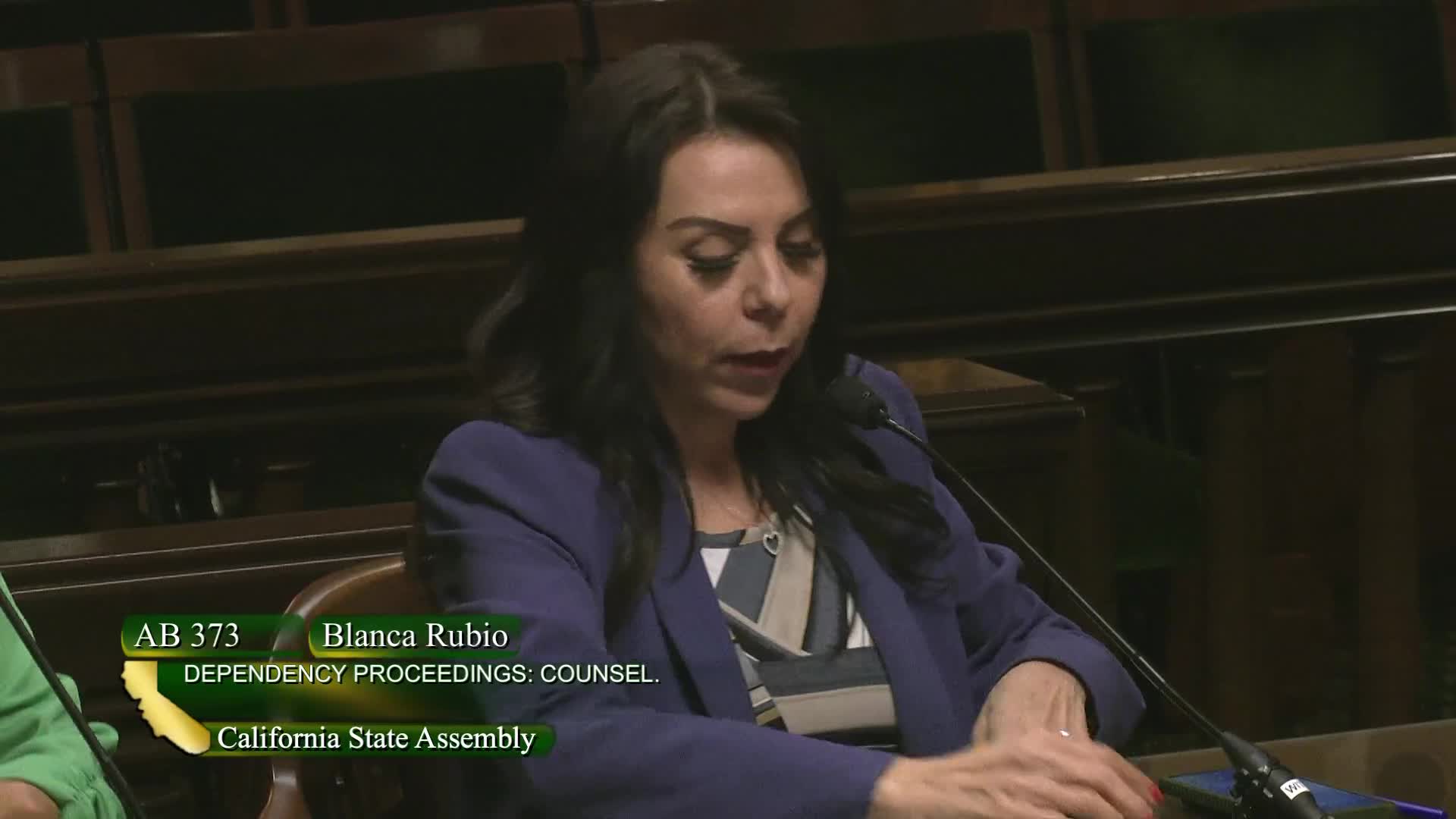
Assemblymember Blanca Rubio’s AB 373 would make explicit that attorneys appointed in juvenile dependency proceedings must respect the expressed wishes of non‑minor dependents — foster youth ages 18 to 21 — and not substitute the attorney’s judgment for the adult client.
The bill's author told the Committee on Human Services that current law allows counsel appointed for dependents to advocate for what the attorney perceives as the client’s best interest, a standard appropriate for minors but inconsistent with the legal status of adults. “Non‑minor dependents do have greater autonomy and the ability to express their wishes about court proceedings, but counsel is still able to substitute their judgment,” the author said during the hearing.
The measure would align counsel’s obligations with the autonomy of non‑minor dependents in extended foster care, the author and supporters said. Anne Quirk, a policy attorney with the Children’s Law Center of California, explained that, under current practice, appointed attorneys both report client preferences and may substitute their judgment: “As a child's attorney, I'm one of those adults. My role is to tell people what my client wants, but additionally, if I don't agree with it, I get to substitute my judgment and argue for what I think is best.” Quirk said AB 373 would require attorneys to advocate for the client’s stated position while leaving the social worker's report and the judge's decision‑making roles unchanged.
Caitlin Ratigan, statewide policy coordinator for California Youth Connection and a former foster youth, told the committee the bill addresses a broader problem of young adults feeling silenced by systems meant to protect them: “When I was in foster care, I was disempowered at every turn... protection without empowerment can actually be harmful.”
Committee members voiced support for expanding decision‑making autonomy for adults in extended foster care. The committee moved AB 373 to the Assembly Appropriations Committee; the roll call recorded ayes and the bill was reported out of the committee.
AB 373 references the Welfare and Institutions Code provision governing dependency practice and extended foster care (WIC 303) and would clarify counsel responsibilities for non‑minor dependents who retain all legal decision‑making rights under that code section.
Supporters said the bill is narrow in scope: it does not remove the judge’s authority or a social worker’s ability to submit reports; it directs appointed counsel to respect, rather than override, the expressed wishes of adult foster youth. The committee will consider the bill further in the Appropriations Committee.