Get Full Government Meeting Transcripts, Videos, & Alerts Forever!
Get email alerts on the Stormwater Capture topic
No spam. Unsubscribe anytime.
Assembly committee advances bill directing State Water Board to issue stormwater irrigation guidance
Summary
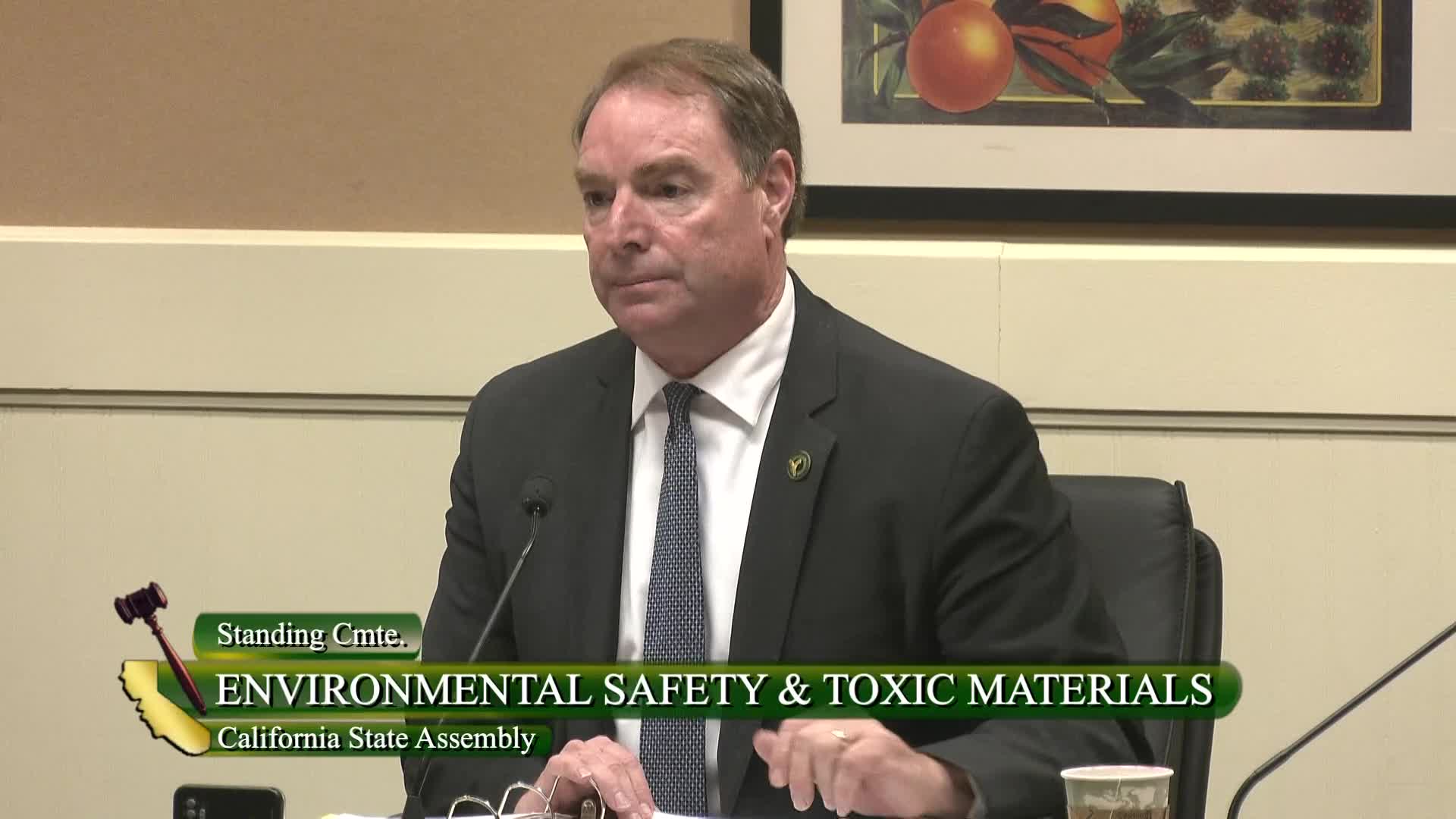
The Assembly Environmental Safety and Toxic Materials Committee voted to pass AB 638, which directs the State Water Resources Control Board to develop guidelines for capturing, treating and using urban stormwater for irrigation of public lands; proponents said guidance will speed project approvals and reduce potable water use.
Assemblymember Celeste Rodriguez introduced AB 638, which would require the State Water Resources Control Board to develop guidance on capturing and reusing urban stormwater for nonpotable irrigation of public lands, and the Environmental Safety and Toxic Materials Committee voted to pass the bill to the Committee on Appropriations.
The measure, Rodriguez said, seeks to fill “a glaring gap in California's urban stormwater management” by creating statewide best-management practices for capture, treatment — including disinfection — and reuse of stormwater on parks, parkways, golf courses, cemeteries and other public lands. “Clear guidance is essential to provide certainty on how to safely build and operate stormwater capture and use projects,” Rodriguez said during the hearing.
Supporters told the committee that, without state guidance, local projects face delay or local public health requirements that demand treatment to drinking-water standards, effectively preventing intended reuse. Mark Gold, director of Water Scarcity Solutions at the Natural Resources Defense Council, said California has seen “record drought followed by near-record rainfall” and that the bill would “reduce potable water demand and encourage local, state, and federal funding to be invested in this climate-resilient approach.” He described several Los Angeles–area projects built for stormwater capture that are not being used for park or golf-course irrigation because local public health officials required drinking-water treatment.
Several environmental organizations registered support in the hearing room and briefly spoke in favor, including representatives from San Francisco Baykeeper, Heal the Bay, the Green Science Policy Institute and California Environmental Voters.
Committee members voiced support and asked clarifying questions. One member asked whether the bill would remove “median nonfunctional turf” from the list of eligible uses; another emphasized wildfire-prevention needs for irrigated lands in wildland‑urban interface areas and asked that those uses be considered in the guidance. Two members asked that co‑authorship be added; the author accepted.
The committee adopted a motion to pass AB 638 to the Committee on Appropriations. The motion was moved and seconded on the record and the roll call recorded ayes from the chair and committee members present; the measure was reported out of committee.
Votes at a glance: AB 638 — Motion to pass to Appropriations: carried (committee roll call recorded unanimous support among members present). The committee clerk recorded the motion as passed to Appropriations.
Background: Supporters said the measure is intended to reduce potable water demand by enabling reuse of captured urban stormwater for irrigation of public lands. They noted large local investments that are delayed or underused in the absence of statewide guidance, including an estimated $50 million in Los Angeles projects and more than $1 billion pledged through the LA County Safe Clean Water Program that attendees said have not been applied to capture-for‑irrigation projects without clearer standards.
Implementation and next steps: If passed into law, AB 638 would direct the State Water Resources Control Board to promulgate guidance; the hearing did not set timelines for the board's deliverables beyond the statutory language proposed in the bill. The committee forwarded the bill to the Committee on Appropriations for fiscal review and next action.