Get Full Government Meeting Transcripts, Videos, & Alerts Forever!
Get email alerts on the Natural Gas Utilities topic
No spam. Unsubscribe anytime.
Texas Gas Service pauses conservation program as Railroad Commission reviews new filing; commissioners press for franchise-review input
Summary
Texas Gas Service told the Resource Management Commission its customer-facing energy-efficiency program was sunset Dec. 31, 2024, and rebate requests for work completed in 2024 will be processed through June 29, 2025.
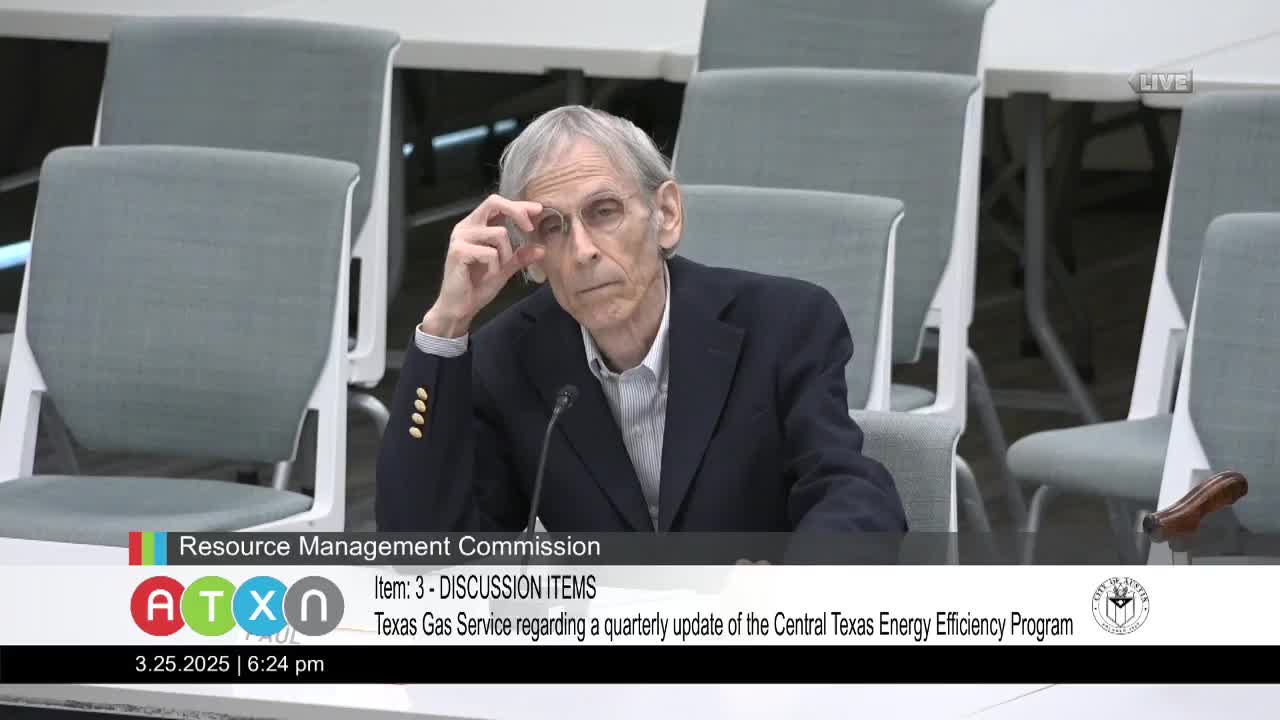
Texas Gas Service representatives briefed the Resource Management Commission on fourth-quarter 2024 activities for the Central Texas Energy Efficiency Program and said the program formally ended Dec. 31, 2024, leaving the company’s pending filing before the Railroad Commission of Texas as the vehicle for any new conservation program.
“Tonight, I’ll be providing an overview of the initiatives that our program undertook during the fourth quarter of 2024,” said Christy Bell, Energy Efficiency Program supervisor for Texas Gas Service. She told commissioners the program was sunset on Dec. 31, 2024, the company withdrew its conservation adjustment clause tariff and removed the program surcharge from customer bills, and that the utility will continue processing residential rebate applications filed within the program’s 180-day application window through June 29, 2025.
Jasmine King Busch, energy-efficiency program manager for Texas Gas Service, said the company had a filing before the Railroad Commission and that a ruling could come in June 2025 “barring any extension.” She added the proposed filing is “very similar to the program that we have in practice.”
Commissioners pressed Texas Gas Service staff about what would replace the conservation funding vehicle and whether the company had met the process expectations in its franchise agreement with the city. Commissioner Silverstein pressed that the commission be informed of the Railroad Commission’s decision and asked the company to brief the commission at its July meeting if a ruling is issued.
“Can you tell us whether the Railroad Commission has acted?” Silverstein asked; company representatives agreed to return to the July meeting to report any decision and to brief the commission on program details if the Railroad Commission approved a filing.
The briefing prompted a broader policy discussion led by Commissioner Robbins on the city’s authority and leverage during upcoming franchise negotiations. Robbins outlined a presentation to the commission on natural-gas utility rates, arguing Texas Gas Service bears most of the city’s gas-customer footprint in Austin and raising concerns about high customer charges, capital-recovery practices and low low-income-assistance funding. Robbins recommended stakeholder hearings as the city prepares for franchise negotiations that may lead to October 2026 decisions.
Austin Energy and Texas Gas Service staff clarified regulatory roles: franchise agreements require coordination on energy-efficiency programs, but oversight of statewide natural-gas program approval now rests with the Railroad Commission following state legislation. Commissioners requested that Texas Gas Service and Austin Energy return with a briefing on the Railroad Commission outcome and program details for the July meeting. No formal votes were taken.