Get Full Government Meeting Transcripts, Videos, & Alerts Forever!
Get email alerts on the Public Safety Legislation topic
No spam. Unsubscribe anytime.
Senate Public Safety Committee advances bills on gun dealer oversight, xylazine, school threats and diversion; several sent to appropriations
Summary
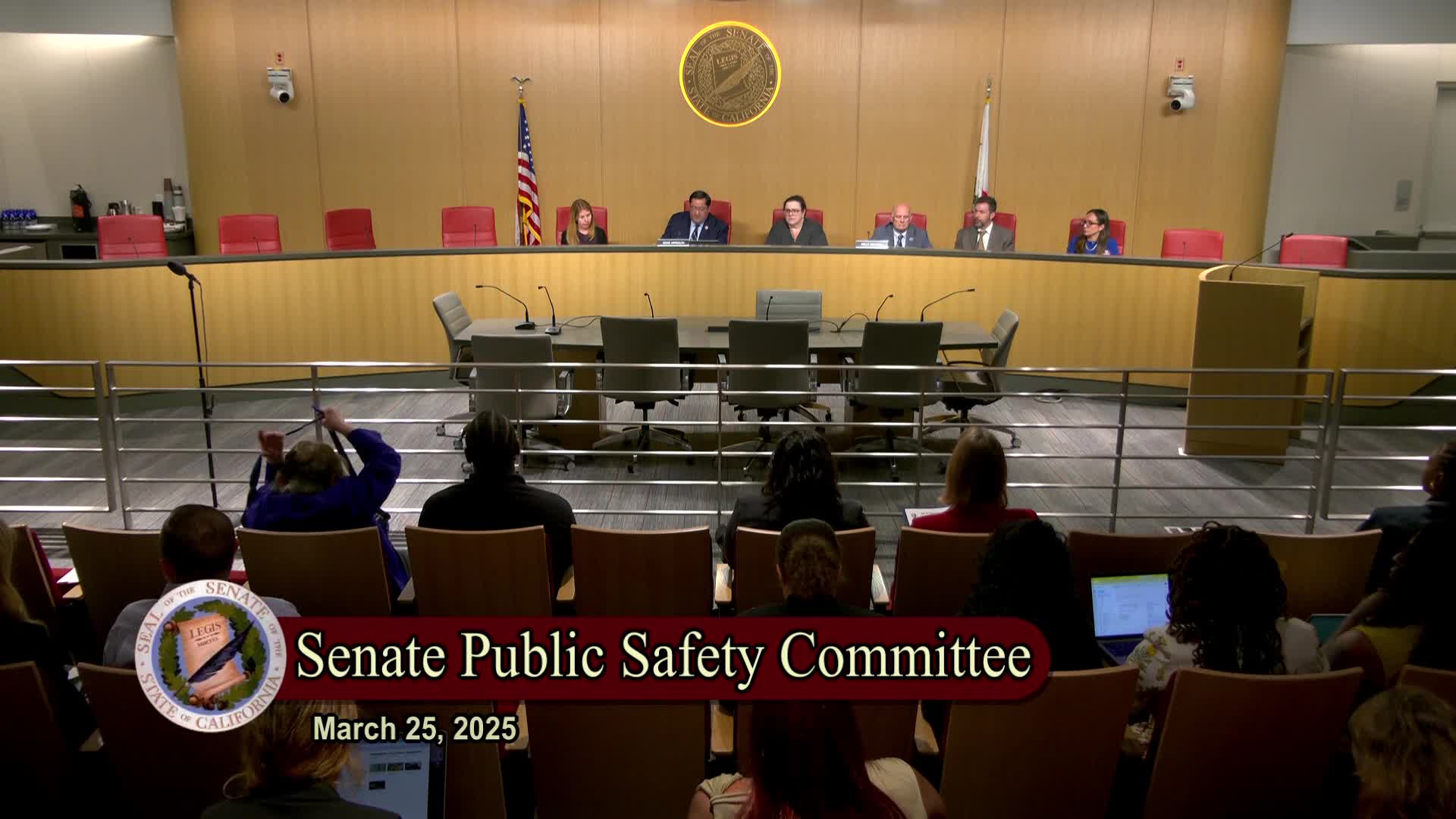
The Senate Public Safety Committee met March 25, 2025, and advanced a package of bills on firearms oversight, xylazine scheduling, school- and worship-related threats, criminal-justice diversion and county jail hygiene, sending most measures to appropriations for further review.
The Senate Public Safety Committee met March 25, 2025, and voted to advance a set of public-safety and criminal-justice measures to subsequent committees, including appropriations and rules. Committee members heard detailed testimony from lawmakers, law-enforcement representatives, medical and veterinary groups, civil-rights organizations and people with lived experience.
The most contested items on the agenda related to firearms policy and the scheduling of the veterinary sedative known as xylazine. Other bills considered included measures to clarify judges' advisements on immigration consequences of pleas, to standardize mental-health diversion procedures, to implement parts of Proposition 36, and to require consistent access to basic hygiene products in county jails.
Senate bill 15 (Blake Speer) — dealer oversight Sen. Blake Speer said California has “the strongest gun safety laws in the nation,” but argued parts of the system still need tightening to curb trafficking. Speer introduced SB 15 as a targeted approach to identify and increase oversight of firearm dealers whose sales are disproportionately traced to crimes. The bill would require the Department of Justice to inspect the 10 dealer locations with the highest percentage of sales recovered in crimes, require dealers to maintain inventory records and annually certify their accuracy, and clarify the DOJ's authority to remove a dealer from the state's centralized dealer list for up to two years. Supporters included Ethan Murray of Giffords, who described examples of dealers with dozens of traced crime guns and urged the committee to approve SB 15. Opponents — including Sam Paredes of Gun Owners of California and Keeley Hopkins of the National Rifle Association — said federal and state law already require recordkeeping and inspections and warned the bill could impose excessive fines or penalties on well-intentioned dealers. Committee discussion focused on whether SB 15 duplicates existing tools and on the proposal’s targeted, percentage-based selection of dealers rather than raw counts. The committee voted to pass SB 15 out of the committee and refer it to the Rules Committee; several members recorded aye votes during the roll call.
Senate bill 6 (Ashby) — xylazine scheduling Sen. Ashby presented SB 6 to add xylazine to California’s schedule III controlled substances, a change intended to reduce unlawful diversion and illicit use while preserving veterinary access for large animals. Ashby described xylazine as “commonly referred to as tranq or the zombie drug” and noted it is often mixed with fentanyl and cannot be reversed with naloxone. The bill includes exceptions and guardrails to maintain veterinary availability. The measure drew support from the California Veterinary Medical Association and city officials including representatives of San Diego Mayor Todd Gloria. Opposition came from the Drug Policy Alliance and ACLU-affiliated witnesses, who said criminalizing xylazine would not prevent its spread in the illicit supply and could complicate research and harm people who use drugs. Committee members debated harm-reduction alternatives and how the state should balance enforcement, medical response and prevention. The committee voted to pass SB 6 to the Appropriations Committee.
Senate bill 19 (Rubio) — threats to schools and places of worship Sen. Rubio introduced SB 19, described as the Safe Schools and Places of Worship Act, to criminalize communications that threaten shootings or other deadly acts at schools, places of worship, hospitals and public venues even when no specific individual is named. The bill is intended to close what supporters called a prosecution gap in Penal Code section 422, which prosecutors said sometimes requires proof that a specific person was placed in sustained fear. Rochelle Beardsley of the California District Attorneys Association told the committee that current statutes limit prosecutors when a threat is directed at a place rather than at an identified individual. Opponents — including youth advocates and public defenders — said the bill risks criminalizing adolescent jokes or mental-health crises and urged diversion and investment in supports. The committee approved SB 19 and sent it to Appropriations; the author and several members urged lawmakers to pair the measure with juvenile diversion and mental-health resources.
Senate bill 248 (Rubio) — safety information to firearm purchasers SB 248 would require the Department of Justice to send educational materials by mail to purchasers during the existing 10-day waiting period about safe storage, suicide prevention, domestic violence resources and applicable state laws. Supporters, including faith leaders and gun-violence-prevention organizations, called it a low-cost, informational step to reduce accidental and intentional shootings. Opponents including Gun Owners of California and the NRA argued the state already provides pamphlets at dealers, questioned the program’s effectiveness and raised cost and privacy concerns. The committee voted to pass SB 248 to Appropriations for further review.
Other bills advanced or discussed - SB 28 (Umberg) — a measure to implement parts of Proposition 36 by directing courts and collaborative programs to ensure treatment options are available to people eligible for treatment-mandated felonies. Supporters urged a consistent statewide approach; opponents including Californians for Safety and Justice and the Drug Policy Alliance said the bill could overload treatment courts and preferred investment in new treatment capacity. The committee moved SB 28 to Appropriations.
- SB 320 (Limon) — voluntary "do-not-sell" registry for people who want to prohibit firearm sales to themselves. The bill, cosponsored by the Attorney General’s office and sheriffs’ associations, would create a confidential state database. Supporters said it would help prevent suicide; opponents raised privacy and enforcement concerns. The committee passed the bill as amended and sent it to the Judiciary Committee.
- SB 380 (Jones) — study on transitional housing for conditionally released sexually violent predators (SVPs). The bill would require the Department of State Hospitals to study feasibility of specialized transitional housing options for persons conditionally released from the civil commitment program. Supporters, including victim-advocacy groups, said the current housing process is inadequate; the committee approved the measure and sent it to Appropriations.
- SB 483 (Stern) — clarify mental-health diversion process. The bill would confirm that courts should be satisfied a treatment plan is in place when determining suitability for mental-health diversion in individual cases. Supporters said that guards against people being diverted without clinically appropriate services; county behavioral-health directors raised concerns about judicializing clinical placements and urged collaboration. The committee voted to send the bill to Appropriations.
- SB 498 (Becker) — indigent hygiene in county jails. The bill would set a uniform $25 threshold in county inmate trust accounts to qualify for free hygiene items, prohibit withholding hygiene as a reward or punishment, and require counties to clear existing hygiene-related commissary debt by a date specified in the bill. Supporters described sanitary access as a public-health and dignity issue; the committee advanced SB 498 to Appropriations.
- SB 281 (Perez) — plea advisement on immigration consequences. The bill would require judges to use the exact statutory wording that a criminal conviction “may” have immigration consequences, rather than telling a defendant they will face specific immigration penalties. The sponsor argued the change restores long-standing uniform language, prevents misinformation in court and preserves defendants’ ability to get counsel. The committee voted to send SB 281 to the floor for further consideration.
- SB 385 (Sayarto) — clarifications to the PEACE Act and peace-officer education timelines. The bill would clarify degree and education timelines for peace-officer candidates and extend the time allowed to complete required coursework. Supporters including the California Police Chiefs Association argued the change is needed to ease recruitment and retain officers; the committee advanced the bill to Appropriations.
Votes at a glance (committee action and next step) - SB 15 (Blake Speer): Passed out of committee; referred to Rules (motion moved by Sen. Gonzales; recorded ayes during roll call). - SB 6 (Ashby): Passed to Appropriations. - SB 19 (Rubio): Passed to Appropriations. - SB 248 (Rubio): Passed to Appropriations. - SB 28 (Umberg): Passed to Appropriations. - SB 320 (Limon): Passed as amended to Judiciary Committee. - SB 380 (Jones): Passed to Appropriations. - SB 483 (Stern): Passed to Appropriations. - SB 498 (Becker): Passed to Appropriations. - SB 281 (Perez): Passed to the Senate floor. - SB 385 (Sayarto): Passed to Appropriations.
Why this matters Committee members repeatedly returned to two themes: the limits of local capacity (for treatment, housing or court resources) and the trade-offs between enforcement-focused policy and health- or service-based approaches. Several authors and witnesses urged pairing enforcement changes with funding for treatment, school safety resources or juvenile diversion so that criminal penalties do not substitute for mental-health care.
What to watch next Most bills advanced to Appropriations or Rules, where fiscal and implementation questions will be examined. SB 6 (xylazine) and the firearm-related bills (SB 15 and SB 248) are likely to draw further committee scrutiny because of cross-cutting enforcement, public-health and civil-liberties concerns. Lawmakers and stakeholders flagged follow-up topics—juvenile diversion funding, county jail and behavioral-health capacity, and design of any confidential registries—that will be part of future hearings.
Ending note Committee hearings produced extensive, sometimes sharply divergent testimony from law enforcement, public-health advocates, civil-rights groups and people with lived experience. Several authors pledged continued engagement with opponents to refine implementation language and address capacity concerns as the measures move through the Legislature.