Get Full Government Meeting Transcripts, Videos, & Alerts Forever!
Get email alerts on the Interchange Fees topic
No spam. Unsubscribe anytime.
Rhode Island commerce committee holds bills limiting card fees on taxes and tips
Summary
The Senate Commerce Committee heard extensive testimony March 25 on two related bills (S 768 and S 842) that would restrict merchant interchange fees on sales-tax and gratuity amounts; the committee voted to hold both measures for further review.
Two related bills that would limit credit- and debit-card processing fees on taxes and tips drew hours of testimony before the Rhode Island Senate Commerce Committee on March 25 and were placed on hold for further study.
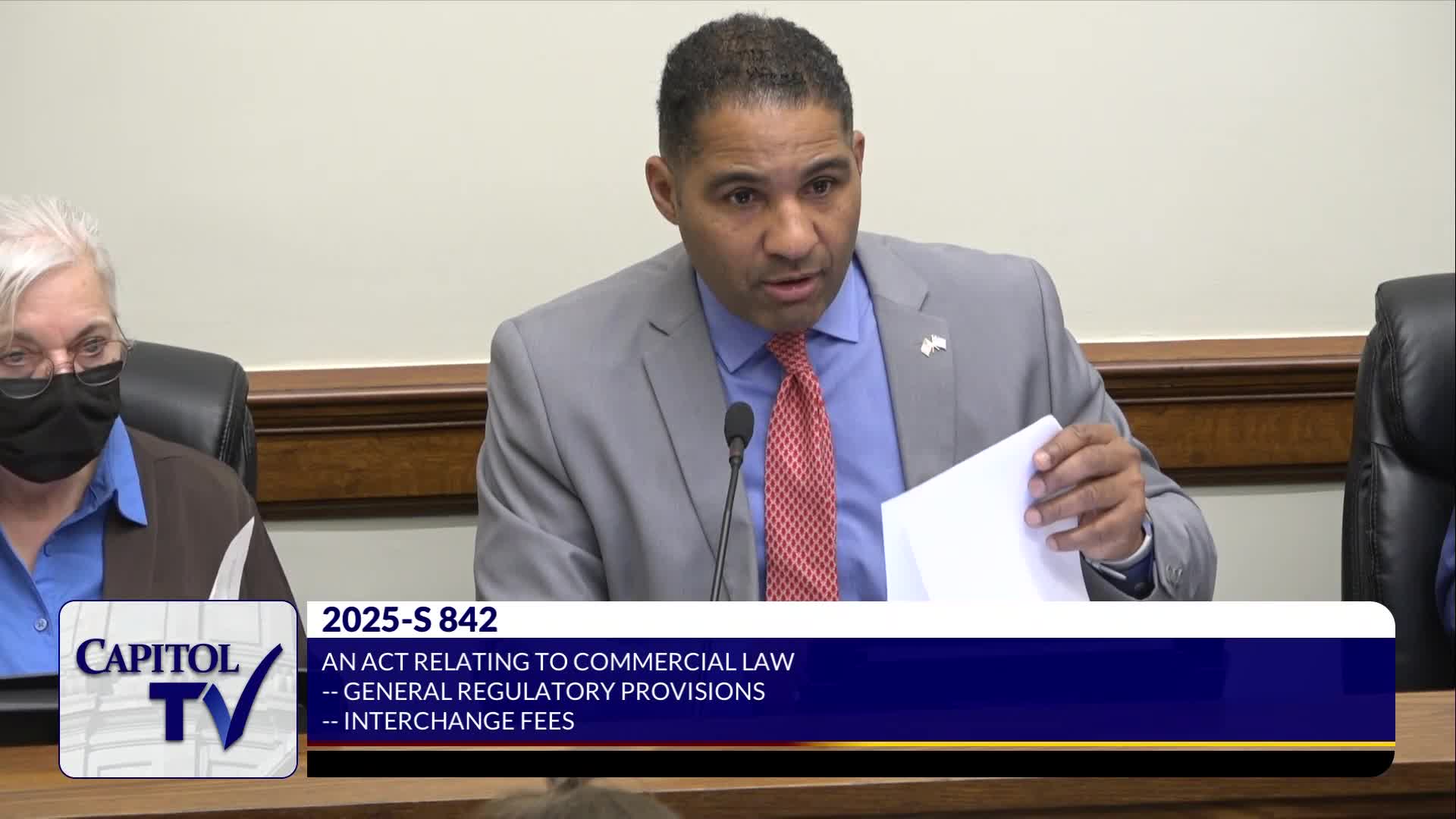
Senate Bill 768, sponsored by Senator Burke, would bar processors from charging interchange fees on the portion of a transaction that represents sales or other government taxes. Senate Bill 842, introduced by Senator Filag, would extend such restrictions to include gratuities and contains a separability clause to address legal challenges. Both measures were the subject of lengthy testimony from business groups, payment-industry representatives and consumer-facing trade associations.
Supporters told the committee the bills would return money to Rhode Island businesses and local economies by preventing processors from charging fees on amounts the merchant does not retain. Paul Khazab, president of the Rhode Island Hospitality Association, said the hospitality industry’s combined meal, beverage and lodging taxes and related fees amounted to millions of dollars annually and that including gratuities could nearly double savings. "A hotel in Newport will save $150,000 annually if you pass this bill," Khazab said. Ryan Moot of the Rhode Island Hospitality Association told the committee an average restaurant could save about $7,600 per year.
Small-business owners and industry groups also described how rising card use and payment platforms have increased fee burdens. Edmond Naceli, who operates several restaurants, said one location paid nearly $10,000 in card-processing fees in 2024 on amounts that were tips and taxes, not the restaurant’s revenue. "That $10,000 could have been reinvested in equipment, wages or other needs," he said.
Opponents and technical witnesses warned of operational and legal hurdles. Steven Rauschenberger, a former Illinois state senator who testified for the payments industry, said the global card network does not receive line-item details of a shopping cart and that payment systems and point-of-sale systems are not the same. He told the committee requiring processors to segregate tax and gratuity portions for fee calculation could force costly software and settlement changes for processors and merchants. Visa’s written opposition and other payment-industry comments were entered in the record.
Several trade groups, including the Rhode Island Brewers Guild, the Rhode Island Retail and Hospitality associations, and national retailers such as Walmart, urged the committee to move forward. Walmart’s representative said merchants should not pay processing fees on taxes collected for the state.
After questions from senators about technical implementation, litigation risk and federal preemption, Senator Sadowski moved to hold the bills for further work; the motion was seconded and the committee recorded the motion as carried. Committee discussion cited ongoing litigation in other states and a severability clause in one bill to address expected legal challenges.
Proponents asked the committee for attention to small businesses, while industry witnesses urged caution because of the complexity of global payment processing. The committee did not set a date for further action.
Votes at the committee session: motions to hold S 768 and S 842 were made and recorded as carried; the committee did not announce a numeric roll-call tally in the hearing.