Get Full Government Meeting Transcripts, Videos, & Alerts Forever!
Get email alerts on the Pharmacy Benefits topic
No spam. Unsubscribe anytime.
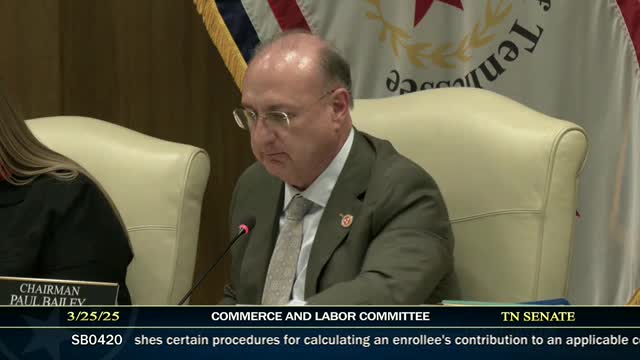
Pharmacists, patients and insurers clash in committee over alternative funding programs; bill moved to next year for revision
Summary
After extended testimony from pharmacists, patients, employers and insurers, the Commerce and Labor Committee agreed to carry SB 4‑20—the bill aimed at banning alternative funding programs that steer insured patients out of coverage—into early 2026 for further work and compromise.
Senate Bill 4‑20 prompted one of the longest panels of witnesses in the Commerce and Labor Committee, as pharmacists, patients with chronic conditions, employers and insurers described competing views on so‑called alternative funding programs (AFPs) and co‑pay maximizer arrangements.
Physicians and specialty pharmacists testified the alternative programs delay access to necessary drugs by steering insured patients away from an insurer’s standard pharmacy benefit, and create logistical hurdles—import requirements, telehealth visits with international providers, and weeks‑long delays. A specialty pharmacist presented internal health‑system data showing AFP‑enrolled patients waited nearly two months to receive medications, versus a typical 2–5 day turnaround for patients covered under the insurer benefit. A patient with severe hemophilia described that he could not go weeks without medication and said AFP delays could be life‑threatening.
Employers and some insurers defended tools that use manufacturer assistance (copay maximizers) to reduce employer cost and preserve benefit coverage. Executives from the Tennessee Employer Benefits Alliance and Blue Cross Blue Shield spoke about savings these programs produce and urged the committee to preserve co‑pay maximizer tools designed to lower costs while maintaining no out‑of‑pocket exposure for patients. Blue Cross told the committee it would accept a compromise that banned AFPs while preserving co‑pay maximizers such as its PrudentRx program.
PBM and employer representatives said the bill as drafted would eliminate some employer tools to manage high pharmacy costs and argued employers rely on a wide array of benefit design options to comply with fiduciary duties and control premiums.
After hours of witnesses and push‑and‑pull among stakeholders, Senator Reeves (the sponsor) and supporters urged the committee to move the bill out but to allow time to finalize compromise language. The committee agreed to roll the measure to the first calendar of 2026 to permit the parties to resolve a technical compromise that would ban AFPs while preserving legitimate copay‑maximizer programs. Committee members signaled the bill would return with a narrower, industry‑vetted amendment aimed at banning AFPs (which carve drugs out of insured coverage and funnel patients to assistance programs) while leaving employer‑sponsored copay maximizers intact.
The hearing showcased significant disagreement between patient advocates and employers/insurers on one side and pharmaceutical companies and certain auditors on the other. The committee’s decision to hold the bill for early 2026 reflected the complexity and competing fiduciary and access arguments.