Get Full Government Meeting Transcripts, Videos, & Alerts Forever!
Get email alerts on the 340b Program topic
No spam. Unsubscribe anytime.
Committee advances bill protecting 340B contract pharmacies after hours of testimony from hospitals, unions and pharma
Summary
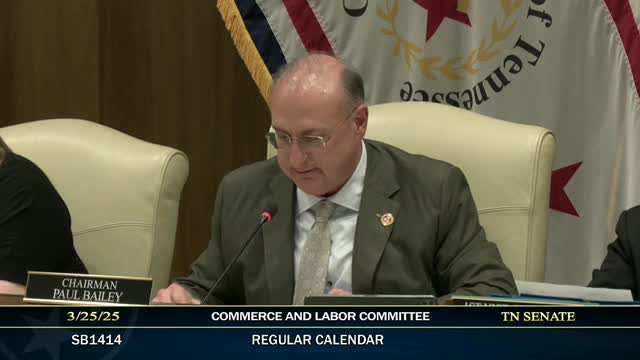
A divided Senate Commerce and Labor Committee advanced Senate Bill 14‑14, which would protect safety‑net providers’ contract pharmacy arrangements under the federal 340B drug discount program after extended testimony from hospitals, community health centers, pharmaceutical manufacturers and labor groups.
Senate Bill 14‑14, a measure addressing access and arrangements under the federal 340B drug discount program, drew more than an hour of testimony in the Senate Commerce and Labor Committee before the committee adopted an amendment and advanced the bill to the finance committee.
Sponsor Chairman Briggs described SB 14‑14 as a bill to protect safety‑net providers that serve uninsured and underinsured patients by ensuring manufacturers cannot block or restrict contract pharmacy arrangements that allow covered entities to obtain discounted outpatient drugs. "The bill protects patients and not the pharmaceutical companies," Briggs said, explaining the 340B program lets covered entities stretch scarce resources and reinvest savings in care for vulnerable populations.
Witnesses for and against the bill appeared. George Hampton, president and CEO of Curex Pharmaceuticals, opposed the bill, saying it would expand contract pharmacies, add middlemen and reduce transparency, which he argued could harm patient safety and drug innovation. Kermit Moore of the A. Philip Randolph Institute and Sharon Lamberton of the pharmaceutical manufacturers association testified that 340B has grown substantially and that audits show discounts are not reliably reaching patients; they urged congressional reform rather than state mandates.
Safety‑net providers and federally qualified health centers told the committee the 340B savings at their sites are reinvested in wraparound care—mobile units, substance use and mental‑health services, same‑day medications for uninsured patients—and that restricting contract pharmacy arrangements would reduce access in rural and underserved areas. Mercy Community Healthcare’s director of care coordination described how her center uses 340B savings to buy same‑day medications and support programs for low‑income patients.
Committee members questioned witnesses about the program’s growth—witnesses gave competing explanations that included expanded program eligibility, rising drug prices and changes to participation classes. Members also asked whether manufacturer dollars under 340B are federal or private; witnesses clarified that discounts are provided by manufacturers (the program was created in federal law as section 340B of the Public Health Service Act) and are not paid by general tax appropriations to the program.
On committee procedure, the committee adopted amendment drafting code 004543 (a conforming amendment described by the sponsor as aligning the bill with applicable state and federal law). Several other amendments were withdrawn. After debate and testimony, the committee voted to advance SB 14‑14 to the finance committee. The clerk announced the committee tally as five ayes and four noes.
As the bill advances it is likely to face continued debate on whether state action should intervene in a federal program and how to ensure savings reach patients rather than being absorbed elsewhere in the health system.