Get Full Government Meeting Transcripts, Videos, & Alerts Forever!
Get email alerts on the Homeless Shelter Buffer Zones topic
No spam. Unsubscribe anytime.
Senate adopts 3,000-foot buffer between homeless shelters and school property; exempts places of worship
Summary
Senate Bill 484, as amended, creates a 3,000-foot buffer between any homeless shelter and any school property and removes several earlier location restrictions while preserving an exemption for shelters operated in places of worship.
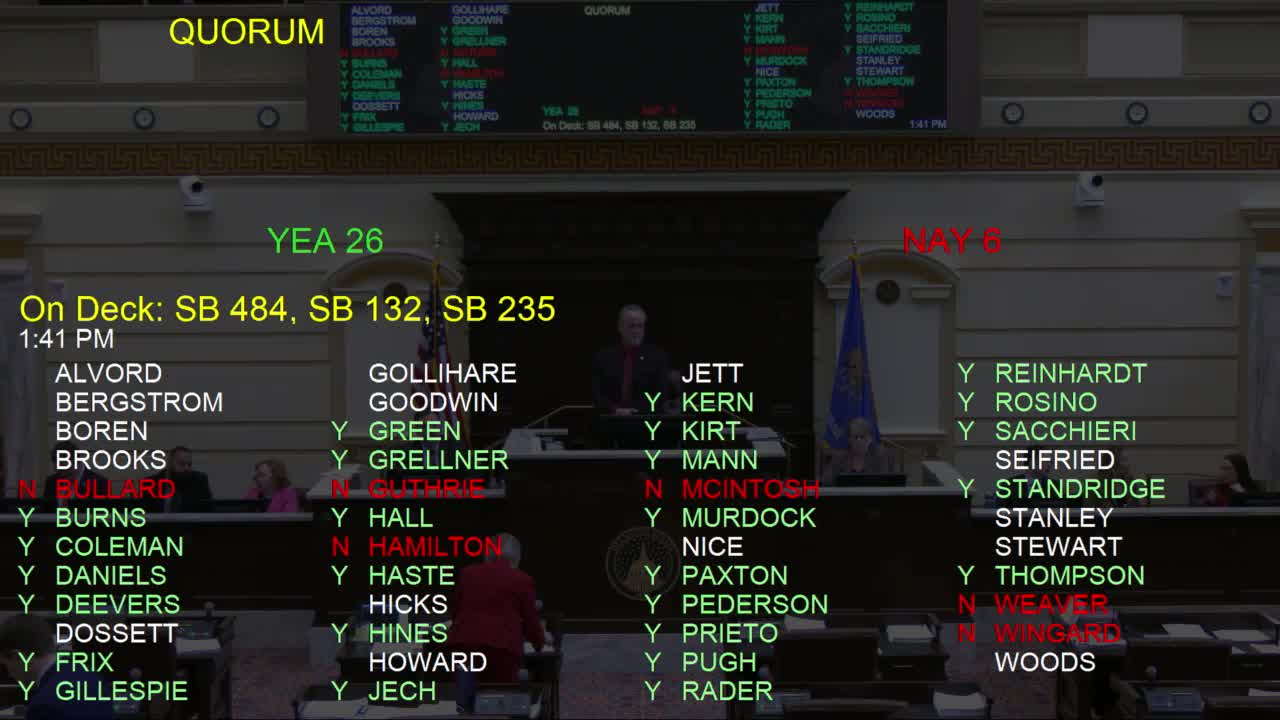
Senate Bill 484, as amended, creates a 3,000-foot buffer between any homeless shelter and any school property and removes several earlier location restrictions while preserving an exemption for shelters operated in places of worship. The Senate adopted the amendment and later passed the bill on third reading; it was also approved as an emergency measure.
The amendment approved on the floor narrowed the bill to apply only to shelters and school property — removing prior setbacks that had covered libraries, preschools and other sites — and struck a municipal zoning provision while inserting a population test that treats municipalities of 300,000 or more differently. Senator Standridge, the bill's author, said the amendment "basically creates, a buffer zone between any homeless shelter and any school property." He also told colleagues he had spoken with parents and some school officials about constituent concerns but said he had not talked directly with homeless shelters or individuals experiencing homelessness.
Supporters said the buffer is aimed at protecting children from disorderly or unsafe incidents near schools. Senator Standridge cited examples he said a superintendent reported, saying shelters can sometimes be associated with disruptive incidents: "There have been instances where, unfortunately, a homeless person has come into the school and completely stripped down in the lobby" and other episodes that prompted lockdowns, he told the chamber.
Opponents questioned the bill's policy effects and local impact. Senator Boren argued the bill would not address root causes and could impede cooperative work between cities and faith-based organizations: "All this does is create the illusion that something has been done, when in reality, the status quo will remain, and this will only impact and inconvenience municipalities moving forward," he said. Several senators said they had not seen evidence that shelters generally promoted the drug activity the author described, and Senator Boren and others emphasized that many shelters and churches provide services that reduce harm and help people rehouse.
Key provisions and clarifications
- Buffer distance: The floor amendment specifies a 3,000-foot buffer measured between homeless shelters and school property. The amended language removes earlier references to libraries, preschools, day-care centers and parks that had appeared in prior drafts. - Exemption for places of worship: The amendment explicitly allows homeless shelters operated in places of worship to be sited within the buffer. Senator Standridge said the change "allows churches to do that" because churches "are the hands and feet of God." Colleagues pressed why churches would be treated differently; the author responded that she expects churches not to encourage the conduct the bill targets. - Population carve-out / municipal preemption: The amendment removes an earlier, broader zoning preemption text and adds language that differentiates municipalities by population. Cities of 300,000 or more (the author said she believed that meant Oklahoma City and Tulsa) are treated differently under the bill's zoning provisions; the floor explanation indicated that larger municipalities had been the primary recipients of a recent federal allocation to the state and therefore are presumed to have greater shelter resources. - Grandfather clause: Existing homeless shelters properly zoned and operating on the bill's effective date are grandfathered and may continue to operate in their current locations. - Evidence cited: The author told the Senate that in January the state received roughly $18,300,000 in federal funds to help homeless services and said larger cities received the “lion's share” of that money. The record also includes a floor reference to statewide public-school reporting that about 26,000 students were identified as homeless in 2024.
Floor action and votes
- Amendment No. 1 (narrowing language, removing prior broader zoning subsection and establishing the school-only buffer) was put to a standing division vote and adopted by a standing count of 19 in favor to 18 opposed. - Final passage on third reading: The roll call later showed 26 ayes and 20 nays; the presiding officer declared Senate Bill 484 passed. - Emergency: A subsequent roll call on the emergency designation returned 36 ayes and 9 nays, and the Senate declared SB 484 passed as an emergency measure.
What the bill does and does not do
The bill is a spacing law: it does not close existing, properly zoned shelters, nor does it impose criminal penalties. It does not (in its amended form) institute a statewide ban on shelters; rather it changes where new shelters may be located relative to school property, while allowing shelters operated in houses of worship to locate within the distance. The bill no longer prescribes municipal zoning rules directly for cities above or below specific population thresholds; instead, the amendment alters where the state's preemptive language would apply.
Reactions and lingering questions
Lawmakers raised several areas that remained unresolved on the floor: whether the bill would increase burdens on families experiencing homelessness who rely on proximity to local schools and services; how smaller municipalities that already operate shelters would be affected despite the grandfather clause; what data supports a 3,000-foot buffer rather than a smaller or alternative distance; and the inconsistency that the author and some supporters described between treatment of shelters and treatment of other uses near schools (for example, liquor stores or licensed dispensaries, which are already regulated to limited distances in some cases).
Next steps
With final passage and emergency status recorded on the Senate floor, the bill advances to the next stage required under Oklahoma law for enactment. Implementation details, including measuring the buffer and handling municipal zoning interactions, will be addressed as the measure moves forward and as agencies or local governments adjust permitting and shelter siting.
Speakers quoted or referenced in the record include Senator Standridge (bill author), Minority Leader Kurt, Senator Boren, Senator Hicks, Senator Goodwin, Senator Nyece, Senator Mann and Senator Racino. Direct quotes in this article are taken from floor remarks in the transcript.
Ending note: The Senate debates repeatedly contrasted immediate safety concerns near schools with broader questions about whether spacing laws help or hinder the state's ability to reduce homelessness through services, housing and prevention.