
Oklahoma House extends harm-reduction syringe program for one year, adds annual reporting
Get AI-powered insights, summaries, and transcripts
Sign Up Free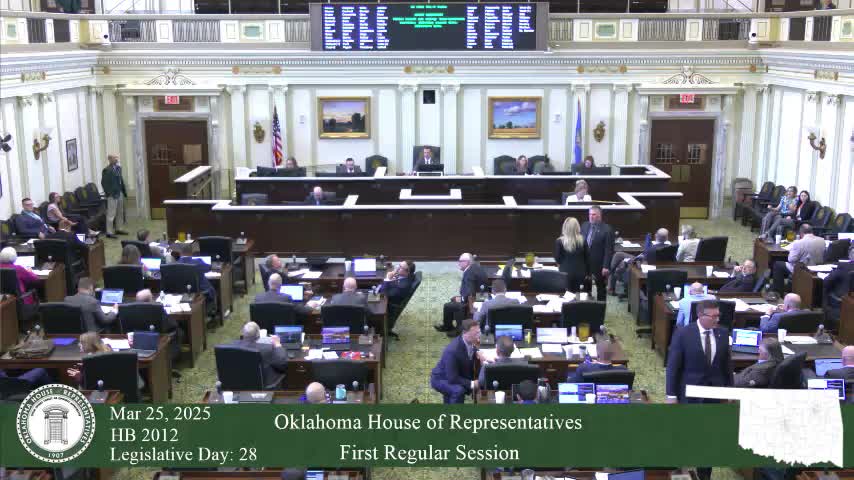
Summary
After heated floor debate over syringes and addiction, the Oklahoma House voted 52-41 to extend the statutory framework for community harm-reduction programs for one year and require an annual report to the Legislature and governor.
The Oklahoma House on Tuesday approved House Bill 20-12, extending by one year the state's legal framework that allows registered nonprofits and tribal entities to operate harm-reduction programs including syringe exchange and naloxone distribution.
The bill, carried on the floor by Representative Pei, passed 52-41 after more than an hour of questions and debate. An amendment adopted on the floor extends the program until July 1, 2027, and requires an annual summary of submitted harm-reduction data to be delivered to the Legislature and the governor's office.
Supporters said the programs reduce disease transmission, connect people with treatment and save lives. "The program is working," Representative Pei told the House, citing state-collected figures that were discussed during debate: about 8,896 individuals reportedly connected to services since 2021 and more than 1,200 reported overdose reversals tied to distributed naloxone.
Proponents also highlighted local examples. Pei said the Cherokee Nation reported reduced discarded needles in at least one public park after setting up services there, and that the programs have led to referrals to screening and treatment; one figure cited on the floor was about 1,528 referrals between 2022 and 2024.
Opponents repeatedly raised concerns about the number of syringes distributed. "They are giving out eight needles for every needle that they bring in," Representative West Kevin argued on the floor, and questioned whether distribution was increasing syringe litter in parks and along roadsides. Other critics said the House had not yet seen comprehensive, consolidated statewide data showing reductions in drug use or overdoses across Oklahoma.
Representative Pei said providers submit data to the State Department of Health and that the newly required annual legislative summary will increase transparency and oversight.
What the bill does
- Extends the existing statutory framework that authorizes registered nonprofit and tribal harm-reduction programs until 07/01/2027. - Requires participating organizations to register and report data to the State Department of Health; as amended on the floor, the House will receive an annual summary and the governor's office will receive the same report.
Who spoke
Representative Pei (sponsor) ' state representative, proponent Representative West Kevin ' state representative, opponent Representative McCain ' state representative, proponent Representative Olson ' state representative, opponent
Votes and formal action
- Amendment (floor) to extend the authorization to 07/01/2027 and require annual reporting to the Legislature and governor: adopted on the floor (no separate roll-call recorded on the floor transcript for the amendment). - Final passage, House Bill 20-12: Passed 52 yes, 41 no.
Context and numbers cited on the floor
During floor debate lawmakers and witnesses offered program-level numbers that became a central point of dispute: the sponsor said roughly 8,896 people had been connected to services since 2021 and more than 1,200 potential overdoses were reported reversed with naloxone. Opponents pointed to program materials shown in committee reporting roughly 578,000 syringes distributed and about 674 pounds of syringes collected (floor discussion converted those pounds to an approximate 67,000 syringes collected) and questioned whether distribution outpaced collection.
Support and opposition
Supporters named on the floor included professional firefighters and several nonprofit providers; the sponsor also referenced tribal programs such as those operated by the Cherokee Nation. Opponents included lawmakers who said they had received constituent complaints and that additional statewide aggregate evidence was needed before extending the law.
Why it matters
The vote keeps in place a legal framework that allows local nonprofits and tribal entities to run syringe collection, naloxone distribution and related outreach without state funding. Proponents say the programs reduce disease and connect people to treatment; opponents say the programs increase visible syringe distribution and want more comprehensive data.
Next steps
The bill as amended requires the State Department of Health to summarize submitted data annually and provide the summary to the Legislature and the governor, beginning after the next reporting cycle; that summary is intended to inform legislative oversight and future decisions about the program.
Ending
The House's decision preserves state law that enables harm-reduction providers to operate while adding a one-year extension and a formal reporting requirement intended to increase legislative oversight. The debate on the floor underscored continuing disagreement over whether existing data are sufficient to demonstrate the programs' public-safety and public-health benefits.