Get Full Government Meeting Transcripts, Videos, & Alerts Forever!
Get email alerts on the Wilderness Study Areas topic
No spam. Unsubscribe anytime.
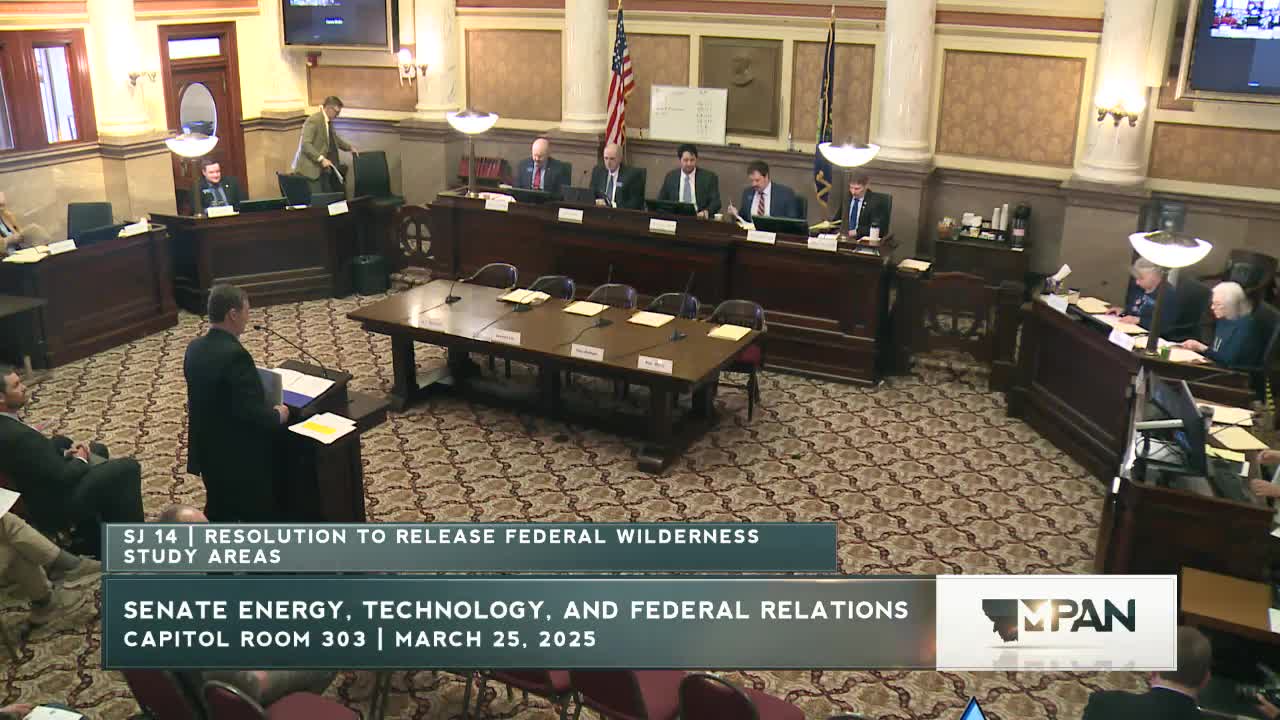
Long, divided hearing on SJ 14 over releasing wilderness study areas draws scores of witnesses
Summary
A lengthy, sometimes contentious hearing on SJ 14 filled the committee room as ranchers, conservationists, tribal representatives and county officials debated whether Montana should ask Congress to release Wilderness Study Areas designated in 1977.
The Senate Energy, Technology and Federal Relations Committee heard hours of public testimony and policy arguments over Senate Joint Resolution 14, a proposal asking Congress to release designated Wilderness Study Areas (WSAs) and certain inventory roadless areas from their study status so those lands would be managed under multiple-use authorities.
Sponsor and proponents: Senator Tony Tzak, sponsor of SJ 14, told the committee that the lands designated for study in 1977 have “been in limbo” for decades and that release would return management decisions to local BLM and Forest Service districts and the National Environmental Policy Act process. Proponents — including ranchers, county commissioners, the Rocky Mountain Stock Growers Association, Citizens for Balanced Use, and several local collaboratives — argued the study designations have restricted routine uses including grazing permit administration, reservoir maintenance, fuels reduction and fire suppression work, and local road repairs. Several proponents said local collaboratives and county officials want the WSAs released so local managers can pursue multiple-use projects and active forest management.
Opponents: Conservation groups, sportsmen’s organizations, tribal representatives, and a range of local civic groups urged the committee to reject SJ 14 or defer to ongoing local collaborative processes. Opponents argued the resolution is an overly broad, top-down approach that would undermine existing stakeholder-led collaboratives that have worked for years to craft balanced, place-based recommendations about particular WSAs. Speakers representing Wild Montana, Backcountry Hunters & Anglers, Trout Unlimited, the Montana Wildlife Federation and multiple local conservation groups emphasized wildlife habitat, water quality and recreation values tied to WSAs and inventory roadless areas. Tribal representatives, including speakers for the Blackfeet and Chippewa-Cree tribes, said they were not sufficiently consulted and urged protections for culturally important lands.
Process and key tensions: Many witnesses — both proponents and opponents — called for local, place-based collaboratives rather than a single statewide directive. Several witness panels cited prior recommendations from agency land-management plans and the 2019/2021 Environmental Quality Council work and urged Congress, not the state legislature, to act on final land dispositions. Opponents said SJ 14 would undercut ongoing collaborative outcomes that in some places are already proposing mixed packages (releases combined with designations) for particular WSAs.
Committee next steps: The sponsor closed by urging committee members to release the resolution so Montana leaders can press the federal delegation and federal agencies to act on long-dormant study-area findings. Committee members did not take a final vote on SJ 14 during the recorded hearing; members indicated they would consider testimony and, if appropriate, move the resolution forward after further staff work.
Ending: The hearing reflected deep division across rural counties, tribes, recreation groups and conservation organizations. Multiple witnesses said the issue cannot be reduced to a simple yes-or-no outcome and urged continued local engagement and follow-up with federal congressional staff.