Get Full Government Meeting Transcripts, Videos, & Alerts Forever!
Get email alerts on the Corrections Capacity topic
No spam. Unsubscribe anytime.
Sponsor seeks $250 million future corrections fund to address women's prison capacity; advocates urge investment alternatives
Summary
House Bill 833 would set aside $250 million to build a new women's correctional facility and fund short-term transition costs; supporters told lawmakers the state lacks capacity for female inmates while opponents urged investments in behavioral health and alternatives to incarceration.
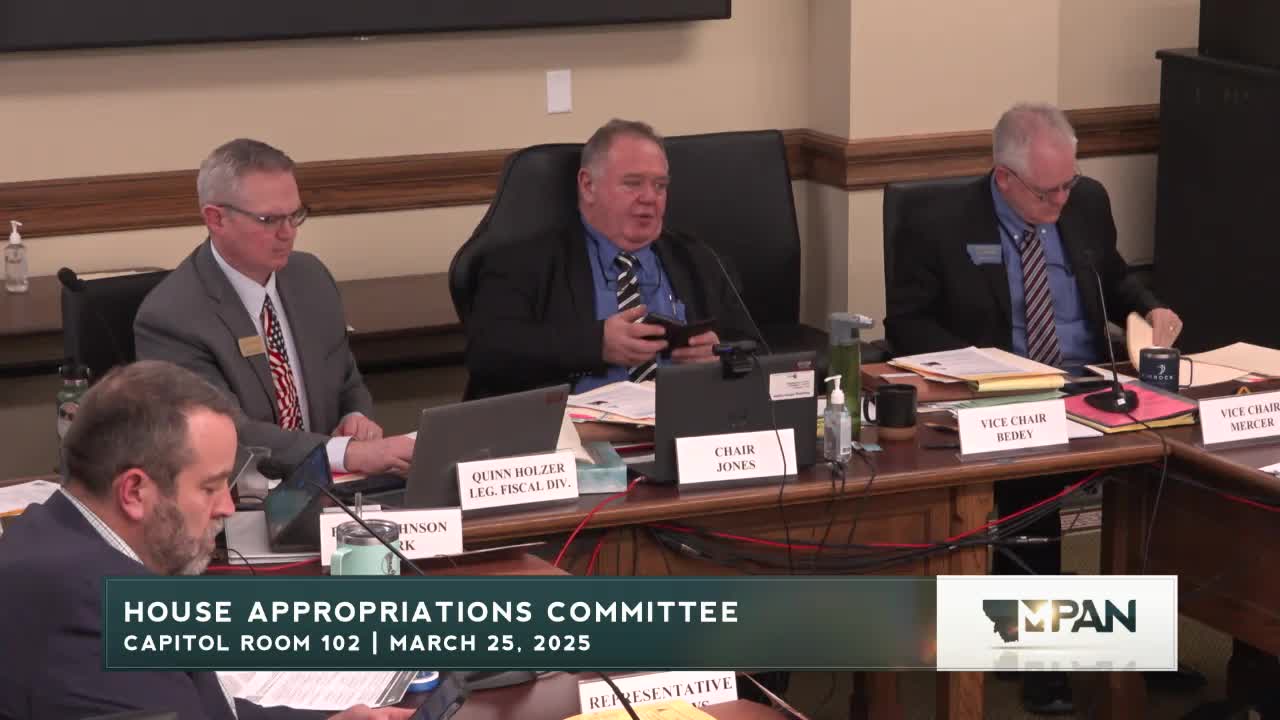
Representative John Fitzpatrick (House District 76) told the Appropriations Committee that Montana's two biggest executive-branch capacity issues are corrections and mental health and that House Bill 833 responds to repeated interim findings about prison overcrowding.
The bill would set aside $250 million to develop a new women's correctional facility. Of that amount, $30 million would be available for transition costs, the sponsor said, and $3.5 million would be earmarked for design and architecture work once a siting decision is made. The bill lists three development options to evaluate: state-constructed/state-owned/state-operated; private construction with a state lease and state operation (a model used at existing facilities); and private construction where the state would ultimately own the facility but operate it. The sponsor emphasized the bill does not create a private prison.
Director Brian Gootkin (Department of Corrections) described the system's current pressures: while recent construction and out-of-state placements have reduced male jail holds, the state has little ability to move female inmates out of county jails or to out-of-state placements. He said the department is considering near-term options including repurposing the Riverside facility in Boulder with modest remodeling (estimated $12—illion? No: testimony said $12—3 million) to create space for roughly 80 to 90 female inmates and installing modular housing at Montana State Prison as a temporary measure.
Proponents included the Montana State Building and Construction Trades Council, the Montana Sheriffs and Peace Officers Association, and the Governor's Budget Office, which said the bill appears in the governor's budget. Proponents emphasized the need for bed space to reduce jail holds and to free county jail capacity for local law enforcement.
Opponents, including the ACLU of Montana, the Montana Budget and Policy Center, and Catalyst Montana, urged the committee to consider upstream investments instead of long-term prison construction. The ACLU and Catalyst argued that revocations of community supervision and drug-possession admissions are major drivers of population growth and that investments in substance-use treatment, mental-health services, employment and housing supports, and public defenders could reduce admissions and recidivism.
Committee members asked for operational and timeline details. The sponsor and DOC staff said transition actions (modular units and repurposing Riverside) could occur in roughly six to 12 months; full construction and procurement could take several years, and the sponsor said a five-year horizon for having facilities operational is conceivable under an accelerated timetable. The sponsor said the legislative package includes reporting requirements and that the bill requires the Department of Corrections to develop siting, financing, and procurement options and to report to legislative fiscal bodies.
The committee heard extended testimony and questions; no final committee action was recorded in the transcript provided.