
Beacon City School District details special education services, rising costs and staffing needs
Get AI-powered insights, summaries, and transcripts
Sign Up Free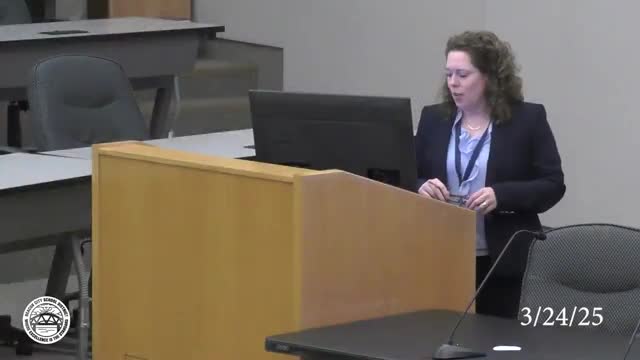
Summary
Assistant Superintendent Heather Chadwell Dennis presented the pupil services and special education budget, outlining current enrollment, out-of-district placements, contracted services, staffing projections and projected Medicaid and federal reimbursements for 2025–26.
Assistant Superintendent Heather Chadwell Dennis told the Beacon City School District Board of Education on March 24 that the district is serving about 458 students under individualized education programs across six school buildings and is managing growing preschool-level need that is adding pressure to next year’s pupil services budget.
Chadwell Dennis said 74 classified preschool students are in the district now, with 13 evaluations pending. She reported 40 students currently in out-of-district placements (six of them residential), and noted the district is within last year’s budget projection of 43 such placements. She said a number of students who require services previously traveled to other schools for programing but increasingly receive services in their home building — for example, a rise from 34% to 59% for students whose home school is JVF who now receive programming in that building.
The presentation described statutory frameworks the department follows, including the Individuals with Disabilities Education Act and Section 504 of the Rehabilitation Act, and noted the Office for Civil Rights as the federal oversight office Chadwell Dennis referenced. She reviewed the district’s contracted services and external placements, and outlined on‑campus expansions in inclusion and professional development.
Chadwell Dennis listed contractual and partner providers the district works with, including Anderson Center for Autism, Devereux, Green Chimneys and others; she said the Dutchess County BOCES program has been renamed Resilience Academy. She said the district contracts for occupational and physical therapy, braille services, teacher of the deaf support, speech language pathologists, BCBA services and hospitalized-student tutoring, and that specialized skilled nursing has been provided only rarely in recent years but that the district expects two to three such cases next year from preschool programs.
She described a new clinic partnership for Rambaugh Middle School (referred to in the presentation as an Aster/Astra clinic) that will provide flex hours and psychiatric connections when school is closed and said the district is expanding inclusive transportation professional development so drivers and monitors can better support students on buses.
On staffing, Chadwell Dennis said the district projects the need for an additional 0.5 full‑time speech‑language pathologist, two physical therapists (one currently contracted), 4.5 occupational therapists, six psychologists and eight social workers (no change), plus one additional special education teacher at the elementary level and one fewer at the high school, achieved in part by planned retirements. She said much of the preschool cost pressure is driving the budget increase and that one-year fluctuations can arise when a single student with very high needs enrolls or leaves.
She reviewed parent engagement metrics, showing that from July 1 to the date of the presentation the office had held 1,002 meetings with 1,612 parent/guardian participants; she also said the district supports 69 homeschooled students via quarterly plans through Dutchess BOCES and serves 60 students who qualify for McKinney‑Vento services for unhoused families.
Chadwell Dennis presented federal program funds the department expects to use to offset salaries and services, noting “$6.11 and $6.19 funds” that she said will amount to just under $900,000 next year, and a projected Medicaid reimbursement figure she described as close to $500,000 compared with just over $200,000 last year; she said the Medicaid increase is driven by improved recordkeeping, use of a contracted consultant and reimbursement for higher‑cost transportation for some students.
She summarized that the special education projected cost for the coming year (presented verbally as “5.9”) represents a budget‑to‑budget increase of about $700,739.94. Chadwell Dennis emphasized that current counts are a snapshot in time and that caseload and costs can change quickly depending on individual student needs and placements.
Board members asked follow-up questions during and after the presentation about social‑work staffing by building, how transportation training is delivered to drivers, the degree to which preschool enrollments are driving cost increases, and the extent to which students’ needs later diminish. Chadwell Dennis answered that social‑work staffing varies by level (for example, the high school has three social workers), that transportation training has been done at opening‑day and in smaller conversations with the transportation director, and that outcomes depend on the individual student — some needs resolve over time and others are long‑term.
No formal board action on policy or budget adoption was taken at the March 24 meeting during the presentation; Chadwell Dennis concluded by inviting questions and saying she was available for follow-up.