Get email alerts on the Education Transformational Learning topic
No spam. Unsubscribe anytime.
Committee hears Bill to Move Transformational Learning Program into Phase 2 and Limit Phase Participants
Summary
Representative David Beatty proposed House Bill 573 to move Montana’s Transformational Learning grant program into a focused phase 2 that would select up to five districts to scale proficiency‑based models and to require OPI to approve, fund and report on results within set deadlines.
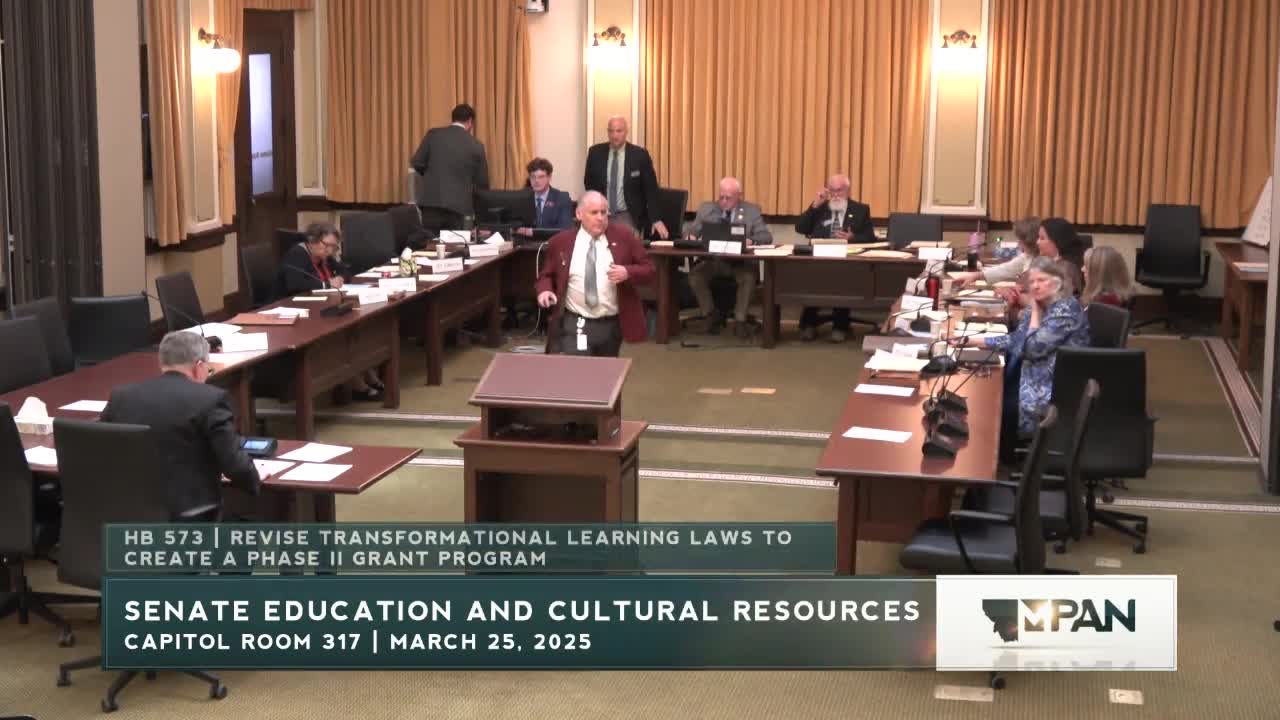
Representative David Beatty, sponsor of House Bill 573, told the Senate Education and Cultural Affairs Committee that the bill would move Montana’s Transformational Learning grant program from a broad ‘‘concept’’ phase into a development phase focused on scaling promising proficiency‑based models in a limited number of districts.
‘‘Phase 2 is set to end at the end of 2028,’’ Beatty said, and he outlined a timeline in the bill: OPI (Office of Public Instruction) would submit no more than five districts to the Board of Public Education for approval by Feb. 1, 2026; funds would be distributed no later than July 15, 2026; districts would have until June 30, 2028, to build out the programs; and OPI would report to the education interim committees by Sept. 1, 2028.
Lance Melton of the Montana School Boards Association, speaking for the Coalition of Advocates for Montana’s Public Schools, said the coalition supported the bill and called it a ‘‘vital part’’ of developing scalable models for proficiency‑based learning. ‘‘We helped draft the original legislation in 2019,’’ Melton said, and described HB 573 as a way to ‘‘refocus’’ resources on districts and approaches that have demonstrated promise.
Deputy Superintendent Ron Whitmoyer described phase 2 as ‘‘about scaling innovation’’ and said the bill aims to turn pioneering districts into mentors that share best practices statewide. Whitmoyer said the bill would ‘‘empower [districts] to implement these approaches districtwide’’ and emphasized statewide sharing of lessons learned.
Committee members asked for details about how many districts had participated to date and how many will be invited into phase 2. Witnesses and staff referenced prior grants and reporting: committee discussion cited that about $11 million had been distributed to districts in previous grant phases and that an OPI report identified 17 districts participating in the initial phase (as reported to the committee). Beatty and witnesses said the superintendent and the Board of Public Education will determine which districts move forward based on demonstrated promise.
No opponents appeared at the hearing. Proponents emphasized that the proposal repurposes funding that otherwise would lapse at the end of the initial grant period and focuses state support on models judged most likely to be replicated by other districts.
The hearing closed with the sponsor standing ready for questions; no committee action on the bill was recorded in the transcript provided.
AI generated
The text on this page is AI generated. Summaries, highlights, analysis, and video transcripts are all produced from the original source material.
AI can make mistakes, so if you spot one, and we will fix it for everyone.
Note: the source content is unaltered by us. Any content source we link to, be it a video, an audio recording, or a document, is presented exactly as its publisher released it. That publisher is usually a government body, sometimes an individual official or another organisation.