Get Full Government Meeting Transcripts, Videos, & Alerts Forever!
Get email alerts on the Water Service Disconnections topic
No spam. Unsubscribe anytime.
Committee backs steps to reduce water shutoffs at San Antonio apartment complexes
Summary
The Municipal Utilities Committee voted to forward staff recommendations to full council that would expand SAWS notification and payment options, allow liens for large, delinquent multifamily accounts, and amend the city's proactive apartment ordinance to speed enforcement when tenants lose service.
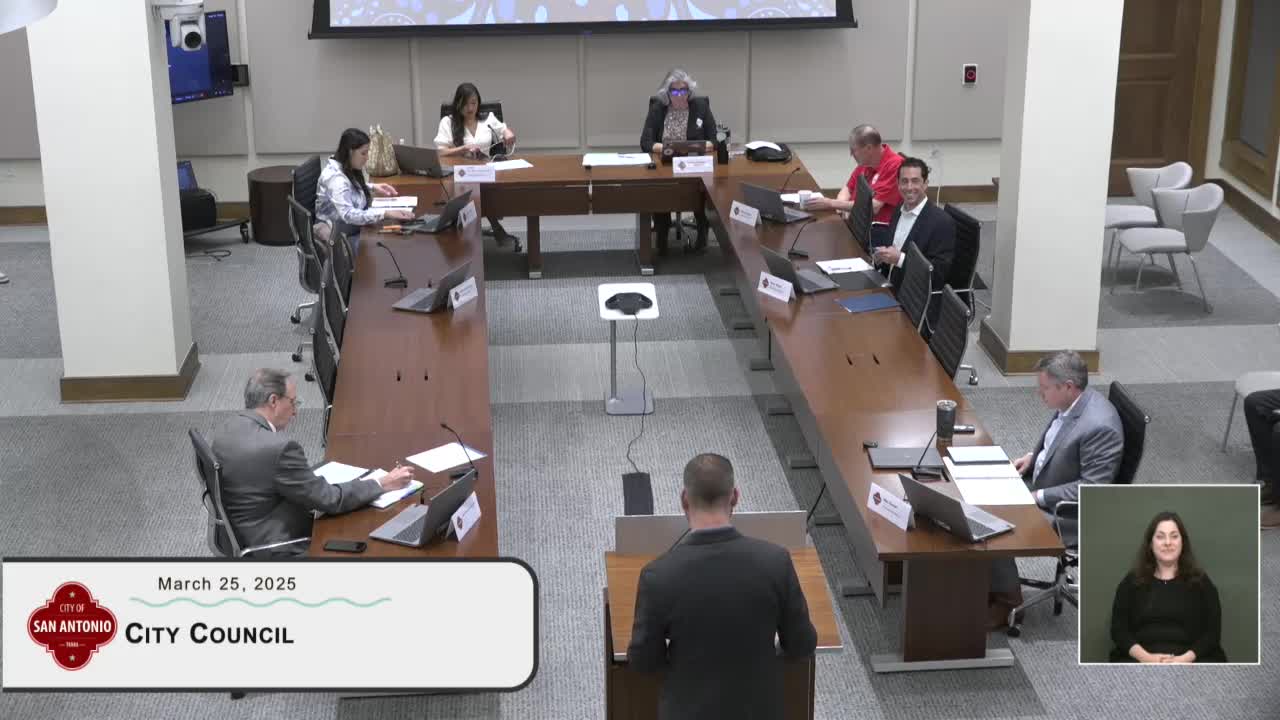
The Municipal Utilities Committee on Wednesday voted to send to the full City Council a package of measures intended to reduce water disconnections at multifamily properties in San Antonio.
City staff told the committee the recommendations center on a mix of operational changes by the San Antonio Water System (SAWS), a new lien authority for large delinquent accounts and a targeted change to the city's proactive apartment inspection ordinance to make disconnection by the landlord an automatic trigger for enforcement.
The measures grew from a council consideration request (CCR) filed by Councilman Makir Rodriguez and Councilmember Aldrete Gavito and were presented to the committee by Mike Shannon, Development Services director. "SAWS has added to their normal processes over the past 6 months to a year: certified letters to the identified BCAD owner, formal site visits, and door hangers on each tenant's doors earlier," Shannon said. He told the committee those steps, plus expanded payment arrangement options, have already reduced the number of actual shutoffs.
Shannon recommended three parts: continue SAWS's expanded outreach and coordination with Neighborhood and Housing Services (NHSD) and Development Services (DSD); give SAWS authority under city code to place liens in select, high-balance cases; and amend Chapter 6 of the municipal code so that a water disconnection caused by an owner's nonpayment becomes an automatic point toward entry into the proactive apartment inspection program.
In public comment, Ryan Baldwin, chair of the San Antonio Apartment Association Government Affairs Committee, supported stronger communication and code changes that would allow SAWS and the city to place liens on properties and to synchronize code enforcement with SAWS notification. "We agree that it is critical to keep water on for all of San Antonio's residents," Baldwin said.
Committee members pressed staff on the practical thresholds and likely costs. Shannon said SAWS staffing and process changes have reduced shutoffs and that, for a lien tool, staff recommended starting with very large delinquencies — initially citing a $50,000 threshold as a pilot. He said SAWS identified nine accounts above $50,000 out of roughly 600 accounts in the February snapshot. Several council members argued for a lower initial threshold; the committee discussed $25,000 and $20,000 during debate. Councilman Courage said owners should be warned in early notices that lien authority is available: "When we send a letter to the owner, ... there should be a warning that that is a tool that's available for SAWS or the city to put in place."
Shannon described how liens would work in practice and the administrative trade-offs: a lien is usually filed for a static amount and may require amendment if the balance falls or grows, which creates additional cost. SAWS staff said they and city legal counsel will study implementation details to find the break-even point where filing a lien is cost-effective.
Other process details presented by staff and discussed by the committee: - SAWS's notification timeline was lengthened to give owners and tenants more time to arrange payment, with multiple door-hanger visits and certified mail to listed owners (BCAD records) before any disconnect activity. - Tenants receive advanced notice (a multi-week notification window) and SAWS is expanding payment-plan options. - The city's proactive apartment inspection ordinance currently assigns a "point" after repeated violations (three points within six months). Staff proposed that a landlord-caused water disconnection become an automatic point to expedite entry into the program. - Staff said the lien tool would be used selectively (starting with the largest delinquencies) and that it may be paired with other collection and enforcement actions.
During committee discussion, members pressed for data and legal analysis. Shannon and SAWS representatives said staff would return with more specifics on thresholds, the cost to file and amend liens, and any legal questions about code changes.
The committee voted, by voice, to forward staff's recommendation to the City Council (A session) for consideration. The motion was moved and seconded in committee; the clerk recorded a voice vote and the chair announced "motion carries." No roll-call tally was provided in the committee record.
The matter now moves to the full City Council for final action; staff said they will provide follow-up detail on lien costs, recommended thresholds and any required ordinance language before that meeting.