Get Full Government Meeting Transcripts, Videos, & Alerts Forever!
Get email alerts on the Election Integrity topic
No spam. Unsubscribe anytime.
Senate committee approves bill to ban payments for petition signatures, expands civil enforcement
Summary
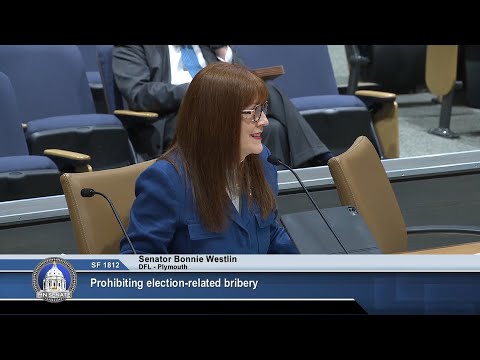
The Senate Elections Committee on March 25 approved Senate File 18‑12, a bill that makes it a felony to directly or indirectly pay or offer incentives to induce voter registration or signatures on election‑related petitions and gives new civil enforcement authority to the attorney general and county attorneys.
Senator Westland told the Senate Elections Committee on March 25 that Senate File 18‑12 is aimed at stopping efforts by outside groups to pay voters for petition signatures, calling the practice an attempt to “bribe citizens for their votes.”
The bill, which the committee approved 7‑4, would expand Minnesota's anti‑bribery prohibitions to make it a felony for a person who willfully, directly or indirectly advances, pays, gives, promises or provides money, goods or similar incentives to induce an eligible or registered voter to sign a petition directly related to an election or to induce an individual to register to vote. The bill also grants civil enforcement authority over violations to the state attorney general and county attorneys.
Sen. Westland said the proposal was driven by reports of paid petition‑signing schemes in neighboring Wisconsin, where outside groups and independent expenditure committees offered money to voters for signatures. "This bill expands the current prohibitions on bribery," Westland said, adding it is intended to "protect our elections" and "send a message that we do not want billionaires coming into our state attempting to bribe our citizens and influence our elections." The bill includes a time window that applies from the first day of the absentee voting period through election day.
Two nonprofit advocates testified in support. Mary Hartnett, executive director of Clean Elections Minnesota, called the Wisconsin practice "bribery, plain and simple" and urged the committee to "vote yes to protect the integrity of our democratic process." Paul Huffman (testifying as an elections advocate) said the targeted payments are not campaign speech or ordinary outreach and emphasized they directly inject money to influence voters: "This is not free speech. This is not funding campaign information." Both groups asked the committee to support the bill.
Opponents and skeptics on the committee questioned whether the problem described had occurred in Minnesota and criticized what they called selective focus on particular donors. Senator Kranz said he viewed the measure as a "knee‑jerk reaction" to events in Wisconsin and requested a roll call vote. Senator Lucero and others argued for evenhanded enforcement against all large donors and urged broader work on dark‑money transparency.
The committee adopted the author's A2 delete‑all amendment (with a small oral change substituting the word "directly" for "materially" in one line) and then advanced the bill on a roll call. The clerk recorded the final outcome as 7 ayes and 4 nays; the measure was recommended to pass and was referred to the Judiciary Committee for further consideration.
Votes at a glance: the committee recorded a 7‑4 roll call to advance SF 18‑12 as recommended. Individual, named votes were read into the record during the roll call but the committee tally in the proceedings was reported as 7 ayes and 4 nays.
The committee discussion makes clear the bill is narrowly targeted at payments or other incentives tied to petition signatures and voter registration in a specified election period; it does not change campaign finance limits generally. Supporters said the change narrows a loophole used to pay voters for electoral actions, while opponents urged broader measures aimed at dark money or questioned the scale of the problem in Minnesota.
The committee sent the measure to the Judiciary Committee; no further action was taken in the March 25 meeting.