Get Full Government Meeting Transcripts, Videos, & Alerts Forever!
Get email alerts on the Medicare Supplement Medigap topic
No spam. Unsubscribe anytime.
Committee hears bill to reinstate guaranteed‑issue rights for Medigap plans
Summary
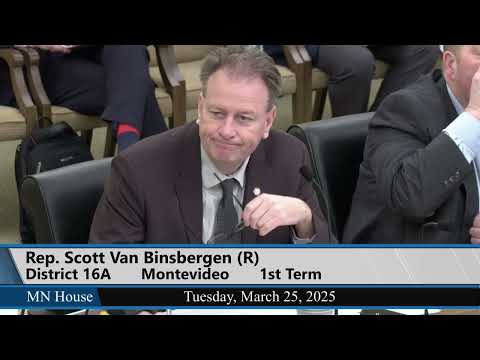
Representative Brad Elkins on March 25 asked the House Commerce Finance and Policy Committee to lay over House File 2,335, a bill to rescind a 2023 change and restore the prior guaranteed‑issue rules for Medicare supplement (Medigap) plans.
Representative Brad Elkins on March 25 asked the House Commerce Finance and Policy Committee to lay over House File 2,335, a bill to rescind a 2023 change and restore the prior guaranteed‑issue rules for Medicare supplement (Medigap) plans.
The measure would return Minnesota to the pre‑2023 enrollment approach under which newly Medicare‑eligible people had a guaranteed‑issue window during which insurers could not charge higher premiums or require medical underwriting. Elkins said the choice between a Medicare Advantage plan and a Medigap plan is consequential and often permanent because moving from Advantage back to a supplement can trigger medical underwriting.
Why it matters: Committee members and testifiers said the bill affects Minnesota seniors on fixed incomes. Seamus Dolan, director of government relations for Blue Cross Blue Shield of Minnesota, told the committee that his company’s actuarial analysis and membership data show large premium pressures if the 2023 change remains in place. The Department of Commerce’s earlier evaluation, he and others said, estimated a 16–20% increase in Medigap premiums over time; Dolan said Blue Cross projected a larger increase, telling the committee his actuaries “predict a staggering 90 premium increase over current rates by the fifth year.”
Supporters’ and opponents’ arguments: Elkins, who described his own experience choosing Medicare plans, urged members to weigh the tradeoffs between zero‑premium Medicare Advantage products that can carry copayments and out‑of‑pocket maximums, and Medigap plans that typically have premiums but more predictable first‑dollar coverage. “If you go down the Medicare Advantage plan route, and decide later … you have to go through medical underwriting,” Elkins said, arguing that the change enacted in 2023 creates adverse selection risk and could drive supplement premiums higher.
Seamus Dolan of Blue Cross Blue Shield urged passage, saying the bill would “preserve the affordability of the market” for more than 200,000 seniors the company associates with the supplemental market and citing Blue Cross’s membership and actuarial projections.
Dana Bacon, senior director of government affairs for the Leukemia & Lymphoma Society, opposed the bill. Bacon told the committee that returning to the earlier guaranteed‑issue rules would again allow insurers to consider preexisting conditions when people seek Medigap after the initial window. Bacon said that could penalize people who develop conditions later in life, citing examples in which an application asks about diagnoses in the prior five years and denies eligibility for certain conditions, including cancer.
Committee discussion and clarifications: Members asked for details about enrollment windows and special enrollment events. Committee members and testifiers noted that an initial six‑month guaranteed‑issue window typically applies and that other qualifying events can create additional entry points; Commerce and industry witnesses described multiple special enrollment circumstances. Committee members also asked about experiences in other states; a testifier said several states (New York, Massachusetts, Connecticut, Maine and Rhode Island) have implemented variations of guaranteed‑issue protections, and KFF data was mentioned as a comparative source.
Action: Representative Elkins moved the bill and the chair laid House File 2,335 over for possible inclusion in a future omnibus bill.
What remains unresolved: The Commerce Department has produced a detailed actuarial study that members were urged to read; proponents and opponents disagreed on the magnitude of premium impacts and on whether the Commerce recommendations represent an acceptable middle ground. The committee did not take a final vote on policy; the bill was laid over for further consideration.