Get Full Government Meeting Transcripts, Videos, & Alerts Forever!
Get email alerts on the Attendance topic
No spam. Unsubscribe anytime.
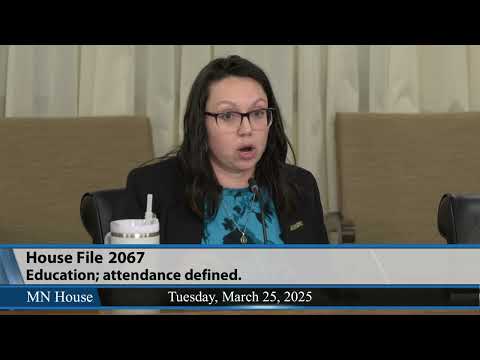
Committee advances HF 2067 'attendance minibus' after amendments and testimony
Summary
The Minnesota House Education Committee adopted two amendments to House File 2067, debated county reporting and re-enrollment provisions, heard testimony on chronic absenteeism, and placed the bill on the general register after additional oral amendments removed an MDE re-enrollment mandate.
Members of the Minnesota House Education Committee advanced House File 2067, an "attendance minibus," adopting the DE2 and A1 amendments, then approving additional oral amendments and placing the bill on the general register after testimony and discussion about county reporting, re-enrollment and the 15-day unenrollment rule.
The bill, presented by Representative Anne Keeler and co-author Representative Baekeberg, assembles policy changes from a nine-month task force on attendance. "This bill is our best attempt to create what we're calling, attendance minibus," Representative Anne Keeler said as she opened the bill presentation.
Committee members focused on three central changes in the DE2/A1 package: (1) updating who schools list as the reporting contact for parent or adult absence notifications so districts may identify principals or principal designees rather than school board members; (2) clarifying that a student who is with a full-time school employee (for example, a counselor, behavior coach or coach) during school time may be counted as in attendance; and (3) requiring school districts to notify county authorities when a student is dropped from enrollment for 15 consecutive unexcused days so counties can try to determine whether the student transferred or needs wraparound services.
Representative Baekeberg said the reporting-contact change "is just putting things in line with how things actually work in a school," noting that calls are often handled by an administrative assistant or a principal designee rather than a school board member.
Supporters testifying said the changes are intended to reduce the number of students who disappear from school records and to improve coordination between districts, counties and the Minnesota Department of Education (MDE). Matt Shaver, senior policy director at Allies, said the scale of the problem motivated the bill: "25 is the percent of Minnesota students who are chronically absent in the most recent year we have data for school," and he added that the percentage represents about 199,000 students and roughly 3,000,000 combined missed school days.
Hennepin County Attorney's Office Be at School program representative Ashley Hightower described the county-level workload and urged a presumption change in the truancy statute. "To date, as a couple of seconds ago, we were at 7,167 referrals," Hightower said, and she urged moving the statutory presumption that shifts responsibility from caretakers to the child from age 12 to age 16 so counties and diversion programs can use supportive interventions instead of court petitions.
Megan Adeola, legislative policy manager at the Minnesota Department of Education, told the committee MDE is "committed to working on making Minnesota schools places where students feel like they belong and places they feel like they want to be," but cautioned that making MDE the party responsible for providing individual case management would carry costs and might not create the immediate, consistent trusted-adult connections students need. Adeola noted MDE provides statewide guidance and can help convene local partners but that portions of the re-enrollment language would be moved to House File 1053 for fiscal consideration.
Members asked for clarification about how attendance data reaches MDE and what happens after MDE receives reports. Adeola explained that districts report attendance primarily as aggregate hours used for average daily membership (ADM) funding, and that more nuanced, near-real-time student-level reporting would require additional technical and policy work.
During floor action in committee, Representative Keeler moved and members adopted the DE2 amendment and the A1 amendment by voice vote. Later, Keeler offered and the committee adopted oral amendments that struck Section 7 of DE2 and later struck Section 6 of DE2 (the portion the department had identified as carrying a cost); the committee chair and authors indicated portions of the removed language will be handled in HF 1053 as the fiscal vehicle. Representative Keeler renewed her motion and the committee placed House File 2067, as amended, on the general register by voice vote.
Votes at a glance
- DE2 amendment to HF 2067 — adopted (voice vote) - A1 amendment to HF 2067 — adopted (voice vote) - Oral amendment striking Section 7 of DE2 — adopted (voice vote) - Oral amendment striking Section 6 of DE2 — adopted (voice vote) - Final motion to place House File 2067, as amended, on the general register — approved (voice vote)
What remained unresolved in committee: some authors said they will remove or refine language that overlaps with child welfare statutes and will coordinate with the Department of Children, Youth and Families (DCYF) staff and county partners before bringing any new statutory changes back. Authors also said they plan to continue work over the interim and expect further proposals in the next policy year.
Context and next steps
Authors described HF 2067 as a package of near-term, operational changes aimed at keeping students enrolled and improving interagency notification. The committee recorded a mix of technical fixes (who receives absence calls; how schools count certain adult-supervised activities as attendance) and policy-level coordination (county notification after 15 consecutive unexcused days and re-enrollment processes). Representatives said some re-enrollment responsibilities initially in HF 2067 will move to HF 1053 for fiscal review. Several members and testifiers urged faster, more integrated data sharing across districts, counties and state IT systems so counties and MDE can find and support students in near real time.
Representative Anne Keeler and Representative Baekeberg told the committee they will keep working on attendance policy during the interim and intend to return with additional proposals in the next policy year.