Get Full Government Meeting Transcripts, Videos, & Alerts Forever!
Get email alerts on the School Consolidation topic
No spam. Unsubscribe anytime.
Rural districts push for higher state consolidation aid to keep small schools open
Summary
Representatives from two Carlton County districts urged the Education Finance Committee to update Minnesota's consolidation aid formula and consider micro-districts, saying current aid has not kept pace with inflation and consolidation costs threaten small-town schools.
Representatives of two small northeastern Minnesota school districts urged the House Education Finance Committee on March 25 to increase state consolidation aid and pay attention to the needs of "micro" rural districts.
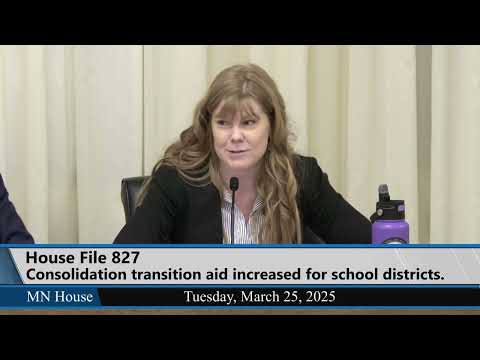
Renshaw School Board Chair Mary Carlson and Carleton School Board Chair Laura Nielsen testified in favor of House File 827, a bill sponsored by Representative Dotseth that would increase one-time consolidation aid for districts that merge. Carlson said Renshaw serves 343 students and faces about a 5 percent budget cut in the current forecast; she said Carlton faces roughly a 10 percent cut. Carlson told the committee the districts have exhausted routine budget reductions and said consolidation is the remaining viable option to preserve a school in each community.
The testimony stressed the costs and complexities of consolidation. Carlson said Carlton has a building that must be sold or demolished — citing a local example of a demolition that cost about $600,000 — and that Renshaw will need to reconfigure classrooms and invest staff time to combine operations. She told the committee consolidation aid has not been updated since 1994 and urged an increase in the per-resident-pupil consolidation payment from $200 to $424 in the first year and from $100 to $212 in the second year to reflect inflation and higher costs.
Nielsen described multiple failed referendums, aging facilities and lost programming in small rural districts, and said the proposed aid increase would let the districts plan strategically and preserve career and technical education and other programs important to local workforces. Both testifiers asked the committee also to monitor local option revenue (LOR) and micro-districts that receive little or no LOR aid.
A short committee exchange with nonpartisan staff and board members discussed rough thresholds for viable school size. Nonpartisan staff indicated the state has historically treated a "two-section" school as a workable minimum; single-section schools face steep operational limits. Representative Dotseth said she would work on draft language and follow up with additional detail as the bill moves forward.
The chair laid House File 827 over for possible inclusion in an omnibus bill for further consideration.
Mary Carlson and Laura Nielsen were the main witnesses. Carlson described the districts' financial projections and the specific aid amounts requested; Nielsen described facility and program shortcomings that consolidation aid could help address.