Get Full Government Meeting Transcripts, Videos, & Alerts Forever!
Get email alerts on the Law Enforcement Scholarship topic
No spam. Unsubscribe anytime.
Higher Education panel hears bill to create law enforcement last-dollar scholarship, lays it over
Summary
The Minnesota House Higher Education Committee heard testimony on House File 2454, the Minnesota Law Enforcement Scholarship Act, which would create a last-dollar scholarship for police officers and their dependents; committee members laid the bill over for further work and fiscal review.
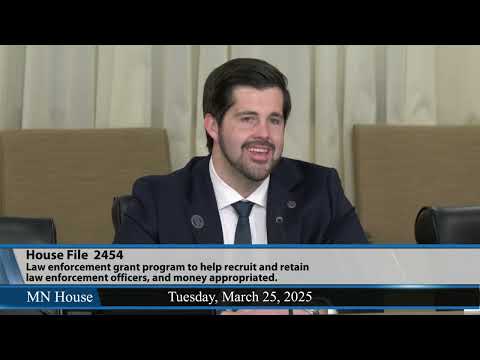
Representative Matt Wolgamott, the bill's chief author, presented House File 2454, the Minnesota Law Enforcement Scholarship Act, to the House Higher Education Committee and asked the panel to lay the bill over for further work and a fiscal note. The proposal would establish a last-dollar scholarship for licensed police officers and their dependents to pursue criminal justice or law-enforcement-related degrees at Minnesota State institutions and the University of Minnesota.
The bill’s sponsor said Minnesota faces a law enforcement recruitment and retention challenge and argued scholarships are a tool to help. "Right now, there are over a thousand open positions in law enforcement that are vacant waiting to be filled," Representative Matt Wolgamott said, adding that roughly 2,700 officers are reaching retirement age and that those numbers represent "up to a third of our workforce in law enforcement." The bill was modeled on a Nebraska program, Wolgamott said, and is aimed both at retaining current officers and attracting officers from other states.
Mark Ross, president of the Saint Paul Police Federation, testified in support. Ross said his department is down about 75 officers and that Minneapolis is down roughly 400; he described the statewide shortfall as about 1,000 positions. "This is a great step in dealing with our recruitment and retention issue," Ross told the committee, adding that the scholarship could help officers who lack a four-year degree and make dependent benefits attractive in recruitment.
Committee members asked program-design questions and raised standard budgeting concerns. Representative Lottie asked whether unused funds would roll over; Wolgamott said a fiscal note had not yet been produced and indicated the sponsor hopes any unspent funds would roll into future biennia so the scholarship remains available. Representative Delaney asked how the last-dollar structure would interact with other grants; Wolgamott confirmed the bill is explicitly last-dollar, meaning other sources would be applied first.
Nonpartisan staff described the current status: the committee has not yet received a fiscal note for the bill, and members said that fiscal discussions would continue with budget chairs and the Office of Higher Education. After testimony and member questions, Representative Wolgamott renewed his motion and the committee laid House File 2454 over for further consideration.
The committee did not take a final vote on program design, funding level or statutory text; all such details were deferred pending a fiscal note and further negotiations.
Members and testifiers
Representative Matt Wolgamott — chief author and sponsor, Minnesota House (presented the bill) Mark Ross — president, Saint Paul Police Federation (testified in support)
Why it matters
Minnesota’s law enforcement staffing levels and retirement demographics were cited repeatedly during testimony; the bill would use higher-education scholarship tools to try to address recruitment and retention. The committee laid the bill over to obtain fiscal information and continue negotiations.
Ending note
House File 2454 was laid over for further work and to await a fiscal note. Committee staff and the bill sponsor indicated they will continue discussions about target funding and program design prior to the committee’s next consideration.