Get Full Government Meeting Transcripts, Videos, & Alerts Forever!
Get email alerts on the Geothermal Rebates topic
No spam. Unsubscribe anytime.
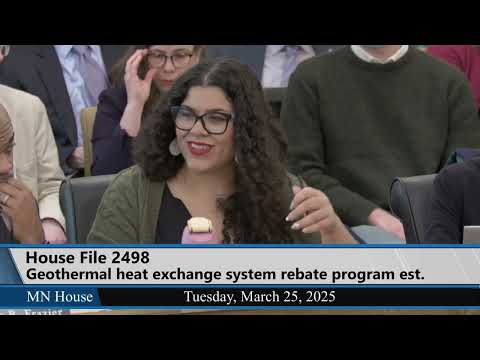
House committee lays over bill to create geothermal rebate program for commercial and multifamily buildings
Summary
A House committee heard testimony on House File 2,498, a bill to create a geothermal rebate program focused on commercial and multifamily buildings; an author's amendment (A1) was adopted and the bill was laid over for possible inclusion.
House File 2,498, a measure to create a geothermal rebate program aimed primarily at commercial and multifamily buildings, was laid over for possible inclusion after a committee hearing on the bill and adoption of an author's amendment.
Representative Hemmingson Yeager, the bill's author, told the committee the proposal is intended to help Minnesota scale thermal energy networks and reduce emissions from the heating sector by encouraging larger parcel projects that the bill's sponsors say will be efficient uses of public funds. The A1 amendment adopted during the hearing sets a per-project cap and identifies a funding range for initial appropriations.
The bill would offer a maximum rebate of $100,000 per project or up to 15% of a project's cost, according to language discussed during the hearing. The A1 amendment also put a placeholder dollar amount of $5,000,000 and indicated funds could come from either the RDA account or the state general fund. The amendment includes a provision allowing up to 10% of an awarded rebate to be applied toward addressing energy-audit findings on a project, if those findings exist.
Supporters who testified said the program is meant to move projects from planning into construction. Aurora Vaughtred, identified as legislative director for 100% (testimony packet), said the rebate would let local governments and building owners move past planning grants and "into building and benefiting Minnesotans." Willie Miley, regulatory director at Darcy Solutions, said geothermal systems can lower carbon emissions and reduce the need for additional generation and grid upgrades because they rely on earth's relatively constant underground temperatures and use less peak electricity than conventional HVAC systems.
Committee members pressed testifiers and the bill sponsor on costs, payback and lifecycle questions. Testimony to the committee described typical project payback timelines for the technology presented as roughly five to 10 years; Darcy Solutions' speaker said their company forecasts a five- to 10-year payback and expects major below-ground components to last multiple decades. Representative Hemmingson Yeager described the proposal as a way to help municipalities and nonprofit owners "get over that hump" of higher upfront capital costs.
Members discussed equity and distribution questions, with the sponsor noting examples of interest from both Minneapolis and Winona and saying the program does not limit projects to metro or greater Minnesota but expects project selection to consider geographic distribution. Committee members also asked whether the rebate would mainly accelerate projects that would happen anyway or change project decisions; testifiers said the incentive would affect some projects on a case-by-case basis.
The committee adopted the A1 amendment by voice vote and later laid the bill over for possible inclusion. No final appropriations were adopted by the committee during the hearing; the adopted amendment identified a $5,000,000 figure as a budget placeholder but did not convert that into an enacted appropriation.
Representative Hemmingson Yeager said she would return to seek the committee's support as the bill moves forward.