Get Full Government Meeting Transcripts, Videos, & Alerts Forever!
Get email alerts on the City Budget topic
No spam. Unsubscribe anytime.
Mayoradministration presents $2.3 billion in new operating investments and multi-year capital program to Council
Summary
The Committee of the Whole of the Philadelphia City Council opened a public hearing on the administration's proposed fiscal 2026 operating budget, the six-year capital program and a five-year fiscal plan.
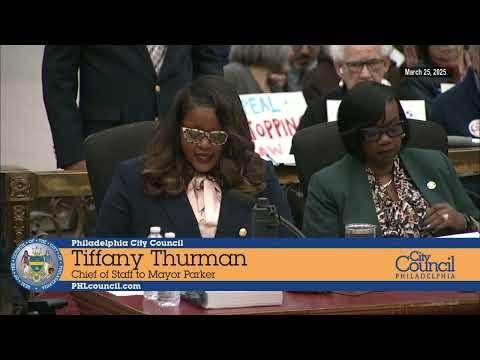
The Committee of the Whole of the Philadelphia City Council opened a public hearing on the administration's proposed fiscal 2026 operating budget, the six-year capital program and a five-year fiscal plan. Tiffany Thurman, chief of staff to Mayor Parker, told the panel the five-year plan includes $2,300,000,000 in new operating investments and almost $1,500,000,000 in new capital investments and balances major priorities with the city's fiscal stability.
Why it matters: the package would fund major new city initiatives and long-term tax changes while the city faces the end of one-time federal American Rescue Plan funding and a large pension-bond payment due in fiscal 2029. Administration leaders said the plan aims to preserve at least 6% to 8% in reserves across the five-year horizon.
Thurman summarized the administration's five priorities for the plan: housing, multi-year contracts for city workers, tax reform, the city's wellness ecosystem, and preparations for 2026 special events. On housing, she said the plan includes "two $400,000,000 borrowings as part of an overall $2,000,000,000 financing strategy for the Housing Opportunities Made Easy or HOME initiative." Thurman said the HOME initiative is intended to help build or preserve thousands of housing units across income bands.
The administration also outlined labor and tax proposals. Thurman said the five-year plan includes a $550,000,000 labor reserve to support multiyear contracts with unions, and proposed "historic changes to the city's business and wage taxes," including phased reductions to parts of the business income and receipts tax and steady decreases in the wage tax from FY2026 through FY2030.
Octavia Howell, executive director of the Philadelphia City Planning Commission, presented the recommended capital program and budget. She said the commission's recommended six-year program proposes more than $1,400,000,000 in new city general obligation bond funding and $17,800,000,000 in total improvements when all funding sources (including aviation, water, federal, state, and private funds) are counted. For FY2026 she said the recommended capital budget calls for $337,000,000 in new general obligation bond funding.
Howell described priority investments in "clean and green" projects, public safety (including the Riverview Wellness Center and fire academy renovations), core support such as IT upgrades, economic opportunity projects and education and cultural institution investments. She told council the planning commission worked with 22 departments and that the planning commission approved the proposals on March 11, 2025.
Administration witnesses detailed other targeted items. Thurman said the plan adds roughly $40,000,000 in FY2026 to previously approved spending to prepare for 2026 events, bringing the city's total event-preparation investment to about $100,000,000; she said the broader special-events effort totals $500,000,000 for improvements including airport, transit and roadway projects. Angela Brooks, the chief housing and urban development officer, said preventing housing instability and expanding eviction-prevention and rental-assistance programs are north stars of the HOME initiative.
Council members questioned fiscal assumptions, the timing of borrowings, and the operational steps needed to deliver housing projects quickly. Administration officials said they had issued an executive order to identify bottlenecks across city agencies, had directed a new Office of Policy Planning and Delivery to improve implementation, and planned public reporting of recommendations. Finance staff said they expect to pursue additional borrowing this summer for existing programs.
No formal legislative votes were taken during the hearing. Council members scheduled follow-up hearings and written follow-ups; administration officials repeatedly offered more detailed schedules, program-level spend-down plans and department-level staffing projections to be supplied to council in writing.
Looking ahead, the administration said it will provide finer-grained spending timelines and staffing plans as the Council continues budget review. Council and administration members identified additional hearing dates and technical follow-ups on the HOME plan, capital delivery, and tax reform.