Get Full Government Meeting Transcripts, Videos, & Alerts Forever!
Get email alerts on the State Budget topic
No spam. Unsubscribe anytime.
Maryland House adopts budget package after contentious debate over Program Open Space cuts and new taxes
Summary
The House of Delegates adopted the fiscal 2026 budget report and hundreds of committee amendments on March 25, 2025, after hours of debate that centered on a $25 million-a-year reallocation from Program Open Space, proposed new business and vehicle taxes, and competing floor amendments to replace tax increases with deep spending cuts.
The Maryland House of Delegates on March 25 adopted the Appropriations Committee's report on the fiscal 2026 budget, voting to accept the committee's hundreds of amendments and moving the package forward after a day of divided floor debate.
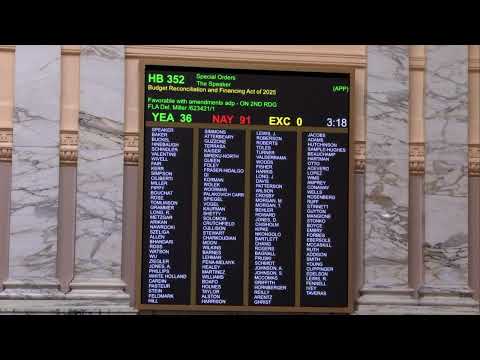
The most contested moves during floor consideration included changes that shift $25,000,000 a year out of Program Open Space toward the state's balancing plan, a cluster of new or increased business and vehicle-related taxes, and a high-profile floor amendment from the minority caucus that would have imposed large-scale cuts instead of the tax package. Lawmakers adopted the committee's report as amended; the Appropriations Committee and floor leaders repeatedly told the House the companion budget reconciliation financing bill (the "burfa," House Bill 352) is required to make the overall package balanced.
Why it matters: The budget is the principal policy document for state priorities. The adopted measures lock in funding decisions and revenue changes that will affect land preservation programs, local government budgets, transportation projects and taxes on consumers and businesses. The Program Open Space shift drew the sharpest reaction from backers of farmland and open-space preservation, who warned the change would reduce immediate resources for conservation. Supporters of the overall package argued the choices were painful but necessary to avoid still larger tax hikes or deeper cuts.
What the House did
- The House adopted the Appropriations Committee's package of committee amendments to the general appropriations bill (House Bill 350) after the committee introduced and moved groups of amendments covering nearly every agency and program. The committee chair regularly moved grouped adoptions and the House repeatedly voted to adopt them. The full favorable report was adopted by voice vote.
- Two amendments to the budget that drew sustained floor discussion were committee amendments identified as 62 and 65. The language moved $25,000,000 a year from Program Open Space allocations into the state's plan to close a structural shortfall. Floor debate included repeated questions about the effect on the Rural Legacy Program, the Maryland Agricultural Land Preservation Program, and local open-space funding. Supporters described the change as a painful but necessary multi-year measure; opponents said it would weaken longstanding conservation efforts used by farmers and local governments.
- Members also debated a package of revenue changes in the burfa: proposals in committee amendment groups included changes to vehicle-related revenues (certificate-of-title fee increases and vehicle excise adjustments), a sales/use expansion aimed at certain technology/digital services (often discussed as a "tech tax"), and other revenue adjustments (including changes to gaming and betting tax allocations). Those revenue proposals were central to the fiscal plan the majority presented as the least-worst way to balance spending needs.
- The House also considered but rejected a sweeping floor amendment from the minority leader that would have replaced the proposed tax increases with immediate spending cuts across multiple programs (including Medicaid eligibility changes, freezes to portions of the Blueprint for Maryland's Future, and pauses to other initiatives). That amendment failed on a roll call.
Representative quotes (attributed to floor roles)
- "This is the amendment that takes $25,000,000 out of Program Open Space and moves it in each year to help balance the budget," said the Floor Leader during the Program Open Space exchange.
- "My big concern with this is these programs are unbelievably important for all of us ' for our farms, our rural areas, for all our green spaces," said a Delegate representing a rural district during the Program Open Space debate. "We should not be cutting this funding to these folks right now."
- On the alternative offered by the minority, the Minority Leader said: "This amendment cuts, I just heard we don't want to cut anything, cuts $1,600,000,000 roughly as scored by the Department of Legislative Services." The minority amendment failed on a roll call.
Background and supporting details
- The package before the House was tied to House Bill 352 (the Budget Reconciliation and Financing Act), the companion measure that the Appropriations Committee and floor leaders said is required to enact the revenue side of the plan that balances the overall budget.
- The Department of Legislative Services (DLS) was cited repeatedly on scoring questions; members noted DLS had recommended larger reductions to some special funds that the committee did not adopt.
- Committee and floor action made numerous technical and programmatic adjustments across state government: staffing changes, restrictions pending reports, and modifications to contingencies and special fund appropriations were among the routine but consequential edits adopted.
What comes next
The House'passed package now moves toward final enactment only after the companion burfa and any conference negotiations between the House and Senate. Several lawmakers signaled they expect follow-up work in conference committee, and several floor exchanges showed appetite for further changes before final signature.
Votes at a glance (selected items from the floor session)
- Committee amendments grouped adoption (multiple groups covering agencies and policy areas): adopted by voice votes or grouped roll calls (adoptions recorded throughout day).
- Committee amendment 62 (Program Open Space reallocation of $25,000,000/year): adopted after floor debate; recorded affirmative count reported on the floor (vote recorded; adoption announced).
- Committee amendment 65 (companion to 62): adopted after separate consideration (vote recorded; adoption announced).
- Minority leader's large spending-cut alternative: failed on roll call (roll call recorded; amendment did not pass).
- Final favorable report on House Bill 350 (as amended): adopted by the House (voice vote recorded that "the favorable report is adopted").
Details of recorded roll calls and group adoptions are in the House journal and the posted roll-call record. This article highlights the most consequential floor debates; the House adopted many additional technical and programmatic amendments in grouped votes during the day.
Ending: The House completed the key floor work on the general appropriations bill and associated committee amendments after a full day of debate. The budget now proceeds with the financing bill and likely conference negotiations; the provisions adopted on March 25 will shape state priorities and revenue collections for fiscal 2026 pending final conference and the governor's action.