Get Full Government Meeting Transcripts, Videos, & Alerts Forever!
Get email alerts on the Cattle Assessment Committee topic
No spam. Unsubscribe anytime.
Senate committee reviews wide package of amendments to House Bill 0119 on Montana cattle assessment and committee structure
Summary
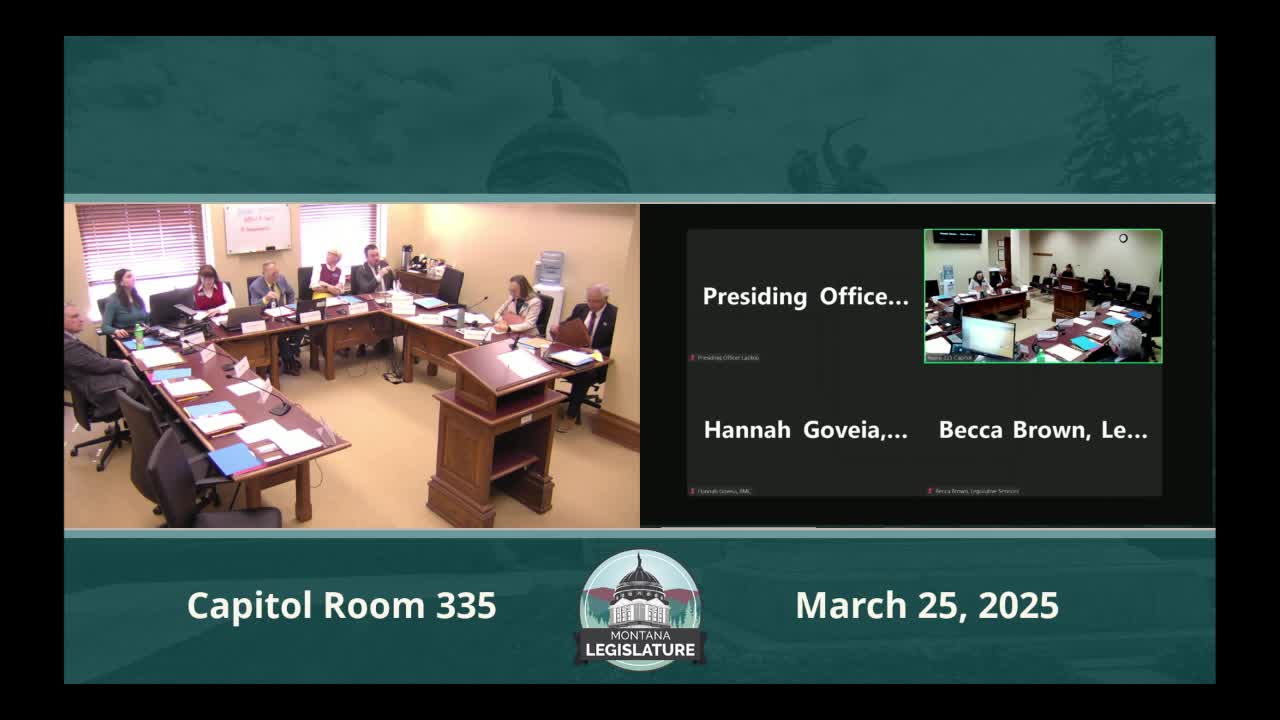
The Senate Agriculture, Livestock and Irrigation Committee spent its meeting reviewing a package of amendments to House Bill 0119, a proposal to create a Montana cattle assessment and an associated cattle committee; members discussed committee membership, referendum funding, refund timing and legal-use limits but did not take a final vote.
The Senate Agriculture, Livestock and Irrigation Committee spent its meeting reviewing a package of amendments to House Bill 0119, a measure to create a Montana cattle assessment and a statewide cattle committee to administer promotional and industry-support activities. Committee members and stakeholders discussed changes to who may nominate committee members, how an initial referendum would be funded, turnout thresholds for a valid vote, refund timing and procedures, and limits on how committee funds could be used. No final vote on the bill or the amendment package was taken at the hearing.
Committee discussion centered on several recurring topics. Several amendments would broaden the language that governs nominations, replacing a list of specific named organizations with a wider category — “agricultural groups with an interest in the production and marketing of cattle and cattle byproducts” — intended by proponents to keep the statute "evergreen" and to allow, for example, tribal agricultural groups to submit nominations. At the same time other amendments would retain named groups and increase committee membership from seven to 11, creating an explicit conflict between amendments that the committee flagged for resolution.
Stakeholders and staff repeatedly discussed how to pay for an initial referendum to establish the assessment. Multiple amendments would allow privately raised funds to be used to cover the cost of the first referendum; staff and proponents said that the committee’s special revenue account currently contains only small private donations and that running a statewide mail referendum would have nontrivial costs. Rachel Prevost of the Montana Farmers Union told the committee, “I think one of the really important things to us that's not included in the amendments here is that we'd see a voter threshold turnout ... 40%.” That 40 percent turnout threshold was proposed by Farmers Union as a qualification for the referendum to be binding; proponents noted that bond elections and other state referenda historically use similar thresholds.
The packet includes alternative approaches to refund and ballot administration. One amendment would require refunds to be processed on a quarterly timetable and give the department limited flexibility for requests arriving close to a quarter’s end; other amendments would simplify refund requests and make producer applications an annual administrative process. The larger amendment authored by proponents would change the refund-processing cadence to semiannual payments (the drafter noted that "semiannual" is intended to mean twice a year) and would eliminate a minimum refundable amount that had been in the original draft.
Committee members and stakeholder representatives also debated whether committee funds could be used to support legal proceedings. Some amendments strike language that would permit the committee to finance legal actions, reflecting concern from some members and stakeholders about using an assessment fund for litigation; others would leave the option in place but, proponents said, would require committee approval to expend funds in that way.
The packet also includes nontechnical provisions that were discussed: adding proponent and opponent information statements to mailed ballots (similar to the state voter information packet); striking "national organization" in favor of local, tribal or state entities for certain cooperative duties; and adjustments to procurement and employment language to align the cattle committee’s operations with other commodity committees.
Multiple members of the committee, and staff who read the amendments aloud, noted direct conflicts among the amendments (for example between the amendment that increases appointed members to 11 and the amendment that removes named organizations and the governor’s explicit appointment authority). Committee staff said the group could not enact conflicting amendments simultaneously and would need to choose which approach to adopt in each contested section.
Committee staff and proponents repeatedly urged careful consideration of implementation costs. A Department of Livestock fiscal estimate cited in the hearing estimated roughly 9,700 producers in the referendum voter list used for fiscal modeling. Stakeholders who traveled to testify included Montana Farm Bureau Federation, Montana Farmers Union and members of the cattle committee working group; several student and young-producer visitors also addressed the committee briefly to describe their interest in ranching and concerns about assessment costs.
No formal committee vote on House Bill 0119 or on any of the amendments was recorded at the hearing. Committee staff indicated that they would prepare a conflicts summary showing where amendments overlap and suggested further work before the measure moves to the Senate floor.
Ending: Committee members said they will continue to reconcile the competing amendments and review fiscal impacts before any final committee action. The bill remains under active amendment discussion.