Get Full Government Meeting Transcripts, Videos, & Alerts Forever!
Get email alerts on the Floor Roundup topic
No spam. Unsubscribe anytime.
Montana House adopts dozens of bills on second reading; several measures move forward without extended debate
Summary
The Montana House on March 25 passed or concurred in numerous bills on second and third reading, including measures on polystyrene food containers, electric-vehicle resolution, child welfare revisions, and vote-count procedures. Most moved with little floor debate; several unanimous or near-unanimous tallies were recorded.
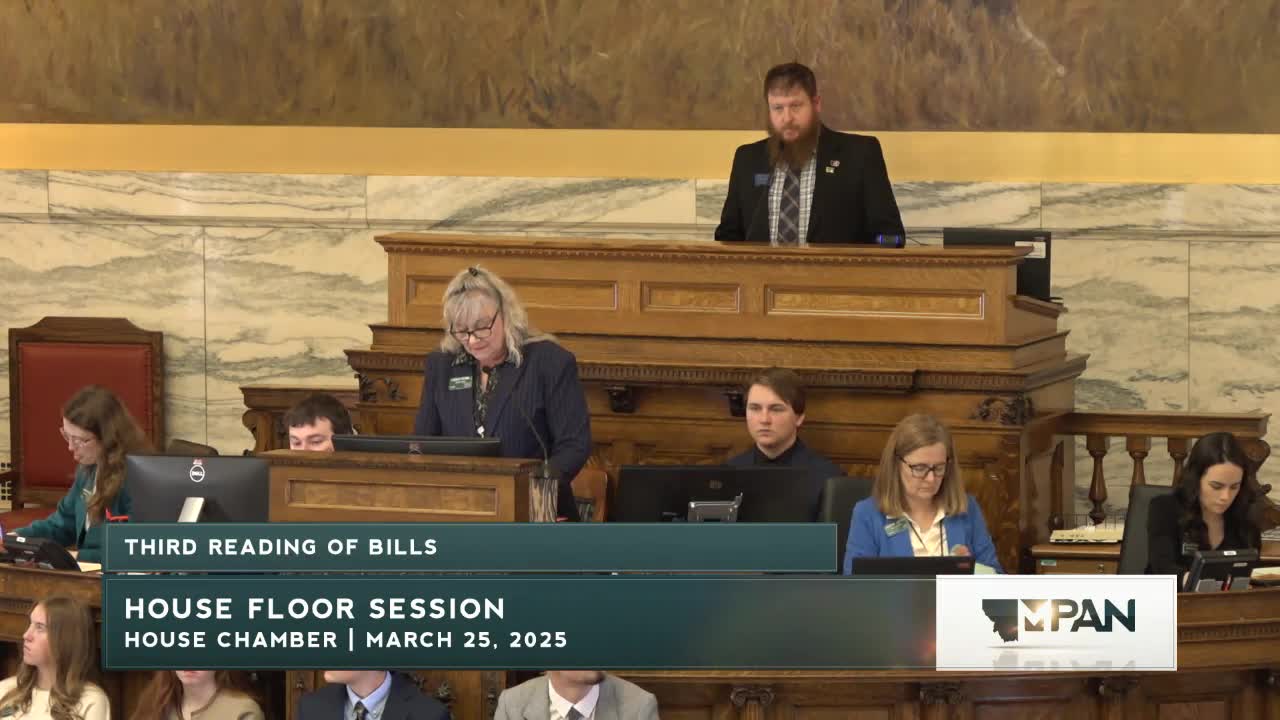
Helena — The Montana House of Representatives on March 25 voted on a slate of bills on second and third reading, approving or concurring in a range of measures from environmental regulation to election-counting procedures and criminal-justice technical changes.
Why it matters: The quick passage of many measures advances them to the next step in the legislative process — concurrence, final passage, or return to the House — and signals the chamber's priorities on public policy items that have not provoked extended floor debate.
What happened: Lawmakers took recorded votes on numerous bills during a lengthy floor session. Several of the recorded outcomes included:
- House Bill 477, “Phase Out Polystyrene Single Use Food Containers with Exceptions,” passed the House on third reading, 56-41.
- House Joint Resolution 12, a resolution regarding electric vehicles, passed the House, 57-42.
- Senate Joint Resolution 9, a joint resolution on federal debt and deficits, passed the House, 59-40.
- Senate Joint Resolution 3 passed the House overwhelmingly, 96-3.
- Senate Bill 309, relating to the Scenic Historic Byways Advisory Council, passed the House, 96-3.
- Senate Bill 206 (revisions related to child abuse and neglect proceedings and investigations) passed the House unanimously, 99-0.
- Senate Bill 110 (amusement, bridal and safety revisions) passed the House, 94-5.
- Senate Bill 256 (revised child abuse and neglect laws) passed the House unanimously, 99-0.
- Senate Bill 9, a technical cleanup allowing state agencies to deposit small cash receipts, was concurred in on second reading with a unanimous recorded tally in committee and on the floor (100-0 in committee reporting).
- Senate Bill 29 (authorizing electronic bid bonds for state construction projects) was concurred in on second reading, 100-0 in committee reporting.
- Senate Bill 33 (transferring plan review and building code enforcement for state-owned public buildings to the Department of Labor and Industry) was concurred in on second reading, 59-41 on the floor.
- Senate Bill 58 (vote-count procedures, requiring investigation when ballot counts do not reconcile) was concurred in on second reading, 100-0 in committee reporting.
Several other bills were taken up and carried to the next step with little or no floor discussion. Committee reports recommending concurrence or do-pass were adopted by recorded votes and the House moved to adopt the committee report as a package later in the session.
Context and next steps: Many bills acted on were described on the floor as technical fixes or incremental policy changes that had previously passed through committee hearings. Several measures recorded unanimous or near-unanimous support; others drew closer votes and now proceed to conference, final passage, or referral to appropriations or the governor, depending on their status and origin. Lawmakers also made several motions following the roll call votes, including re-referrals to appropriations for fiscal items.
Votes at a glance: The floor tally cited above are the official recorded counts read aloud by the clerk during the session. Bills that passed or were concurred in at this session will continue through the legislative process: some to the Senate, some to the governor for signature, and others to committees for budgetary review.