Get Full Government Meeting Transcripts, Videos, & Alerts Forever!
Get email alerts on the Fish Wildlife Parks Budget topic
No spam. Unsubscribe anytime.
House committee debates Fish, Wildlife & Parks funding for hunter education, nongame programs and genetics research
Summary
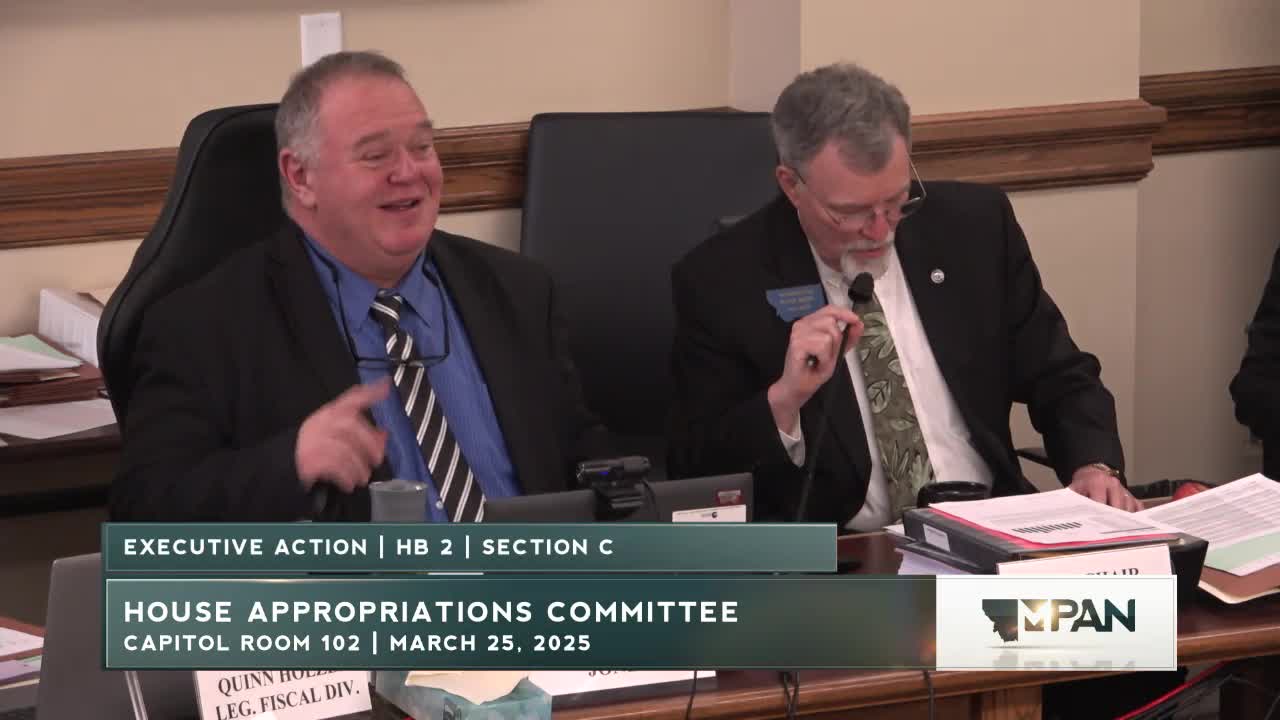
Lawmakers in the Montana House Appropriations Committee debated several amendments tied to Fish, Wildlife & Parks during executive action on House Bill 2, Section C, with votes on restoring hunter-education staff and on cuts to nongame and other FWP programs.
Lawmakers in the Montana House Appropriations Committee debated several amendments tied to Fish, Wildlife & Parks (FWP) during executive action on House Bill 2, Section C, with votes on restoring hunter education staff, trimming nongame and wildlife programs and funding genetic and fish-health research.
The most immediate debate came over an amendment to restore DP801, which would add seven positions in FWP’s Communications and Education Division and budget $233,628 in state special and $700,882 in federal funds for the biennium to support hunter and boating safety, licensing help and regional office customer service. Representative Betsy Powers, the amendment sponsor, said the positions would “enhance regional customer service, expand outdoor education programs like boating safety and hunter education and support regional offices during peak seasons.” Powers noted the funding would not come from the general fund but from state special accounts and federal matches tied to licenses and entries.
Quentin Kujala, chief of conservation policy for FWP, explained in committee that nongame and game species are managed differently and that for many nongame species “we're still very much on the front end of just understanding abundance, the distribution of some of these species.” He told members that lack of baseline data can prompt petitions to list species and that directed inventory and monitoring are the typical uses for nongame funding.
A related amendment proposing a one-time appropriation to support hunter-education programs (a separate OTO amendment described as restricted and intended to be distributed via grants) failed on a roll-call vote of 2 yes, 21 no. The earlier amendment to restore DP801 (the seven positions) failed on a roll call of 11 yes, 12 no.
Committee members objected to some of the increases on the grounds that state special funds derive from hunter-license fees and other user charges; Representative John Schillinger and others warned that expanding programs funded by those sources may eventually require fee increases. Representative Powers and several colleagues countered that many of the proposed activities — hunter education, boating safety, volunteer recruitment, licensing assistance — are core FWP services and had been part of the governor’s budget request.
Separately, the committee considered rollbacks offered by Representative Schillinger that would have removed authority and funding for several FWP initiatives, including: a $1.6 million biennial reduction in nongame fisheries (DP302), a $2.7 million reduction in nongame wildlife programs, elimination of positions for water-hydrology studies ($227,289), two positions for wildlife genetics ($418,007), and two positions for the fish-health laboratory ($534,230). Of those, the committee voted to approve the $1.6 million reduction in nongame fisheries (12 yes, 11 no) and rejected the other proposed cuts: the wildlife program reduction (10 yes, 13 no); the hydrology position cut (7 yes, 16 no); the genetics positions cut (7 yes, 16 no); and the fish health lab cut (7 yes, 16 no).
FWP witnesses told the committee that the genetics and fish-health efforts are intended to support species management, hatchery broodstock health and to improve scientific rigor for policy discussions on sensitive topics such as delisting and harvest management. Kujala described genetics work as providing “a mix in genetics from the other [populations]” and said genetics improves resilience and informs management for species that are hard to count by traditional methods.
Committee members repeatedly noted that most of these FWP accounts are state special revenue supported by license and user fees, not general fund, and several members expressed concern about expanding workloads without explicitly identifying longer-term impacts on license costs.
The committee closed executive action on Section C after voting through the package of amendments. The mix of outcomes left some FWP expansions intact while approving one targeted reduction to nongame fisheries funding.
Ending: The committee wrapped Section C and moved to a brief break before opening Section D, where funding issues for other agencies were addressed.