Get Full Government Meeting Transcripts, Videos, & Alerts Forever!
Get email alerts on the Kratom Regulation topic
No spam. Unsubscribe anytime.
Montana committee hears competing views on HB 407 to regulate kratom; no vote taken
Summary
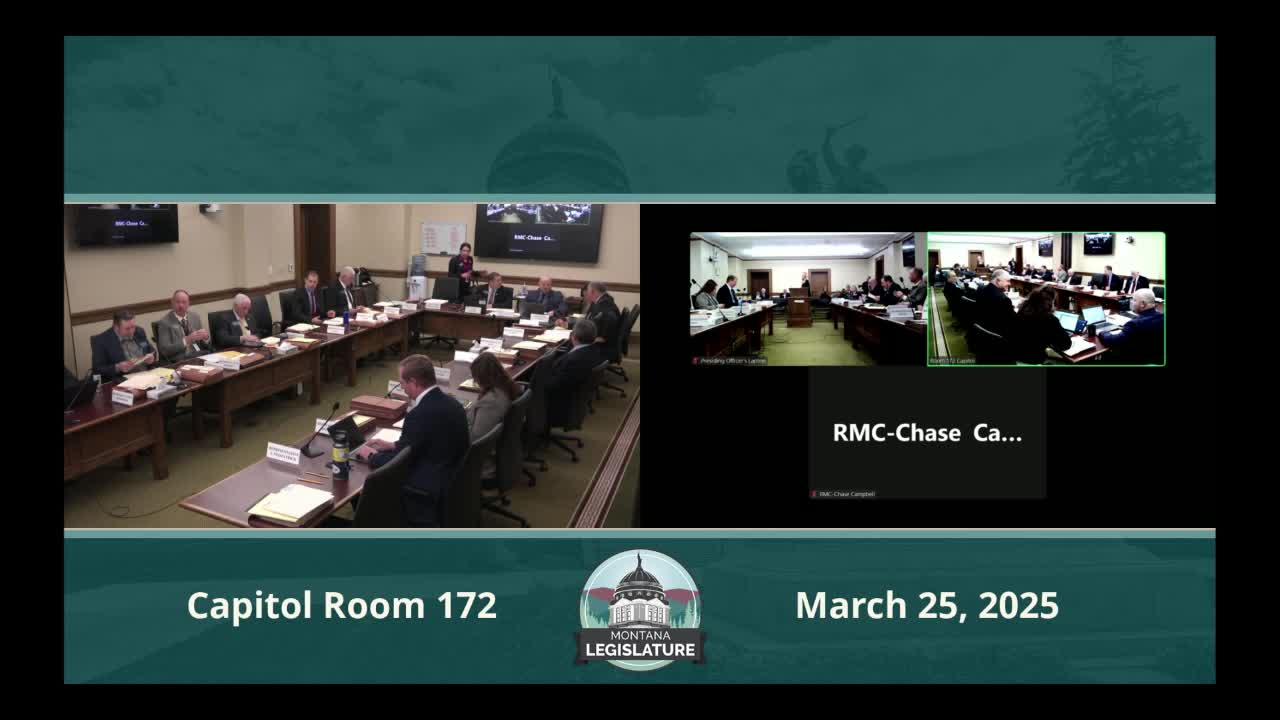
The Montana House Business and Labor Committee opened a hearing Feb. 25 on House Bill 407, the Kratom Consumer Protection Act, which would create state-level regulation for kratom products sold in Montana.
The Montana House Business and Labor Committee opened a hearing Feb. 25 on House Bill 407, the Kratom Consumer Protection Act, which would create state-level regulation for kratom products sold in Montana.
Representative Neli Nickel, sponsor of HB 407, told the committee she seeks to move the state between the current absence of oversight and federal scheduling, and to craft a regulatory approach that protects consumers while allowing lawful commerce. “I am hoping that what we can do is get together with this Kratom Act...and try to find something that all of us in the committee can agree upon,” Nickel said.
The hearing drew industry trade groups and retailers, who generally supported regulation with limits, and a string of public-health, medical and regulatory witnesses who said the bill, as drafted, prioritized industry and lacked clear administrative detail.
Matt Haddow, senior fellow on public policy for the American Kratom Association, said federal regulators have failed to provide a workable framework and urged Montana to adopt state-level rules requiring good manufacturing practices, accurate labeling and age limits. “What this legislation will do is establish a regulatory format for those products sold to Montana residents that says that the products have to be safely formulated. They have to follow good manufacture,” Haddow said, and he cited National Institutes on Drug Abuse research funding and prior federal reviews as backing for a regulatory approach rather than a ban.
Industry witnesses including Isaac D. Hammer, chief operating officer of Kava Roots, and Walker Gahlman of the Global Kratom Coalition said HB 407 should distinguish between naturally derived kratom products sold by tea houses and other retailers and fully synthetic isolates or lab-made products they and other witnesses described as the greatest public-safety risk. “Let us lead the way by banning synthetic kratom from our state,” Hammer said, while Gahlman urged the committee to remove overly broad language that could capture common food ingredients when describing enzyme interactions.
Opponents included county and city public-health officials, clinicians and the Montana Department of Revenue. Becky Schlau, administrator of the Alcoholic Beverage Control Division at the Montana Department of Revenue, said the bill “is not ready for prime time and needs a lot of work before it could be administered by the department.” Riverstone Health and Missoula Public Health witnesses said the bill as written could make kratom easier to access and asked the committee to consider higher age limits and clearer serving-size, labeling and retail restrictions.
Meghan Zawacki, an addiction medicine clinician and representative of the Montana Academy of PAs, described clinical cases she said demonstrate kratom dependence and rising tolerance that can require opioid-recovery medications. “I am treating more patients with kratom addiction than I'm treating patients with fentanyl addiction,” Zawacki said.
Several witnesses urged stricter age limits than the bill proposed and asked the committee to clarify whether kratom could be sold at licensed food establishments. Clark Snyder, an environmental health manager at Riverstone Health, said that under current food-code interpretations kratom cannot be lawfully added to conventional foods and that sanitarians need explicit rules to inspect licensed establishments that sell kratom.
Witnesses also debated specific regulatory details that appear in the draft bill and in circulating amendments: a proposed 2% alkaloid cap on 7‑hydroxymitragynine (7‑OH), whether to prohibit “synthesized” material or only “fully synthesized” laboratory products, milligram serving limits, and whether the bill’s language on cytochrome P450 (P450) enzyme inhibitors is too broad. Jonathan Miller of the Holistic Alternative Recovery Trust and others said milligram-based limits are a better regulatory approach than a flat alkaloid percent cap; Walker Gahlman and other industry witnesses warned that the P450 language could unintentionally include common dietary ingredients.
Committee members pressed witnesses on costs of enforcement. Haddow cited Utah’s Kratom Consumer Protection Act, which he said currently operates with two full‑time equivalent staff and a fiscal note of about $250,000 for the year; he said other states’ fiscal impacts vary widely depending on enforcement approaches. The committee also heard an industry estimate that the national kratom market is roughly $1.3 billion with about 24 million users, and one tea‑house owner reported gross revenue near $790,000–$800,000 for his businesses in Billings and Laurel.
Representative Nickel told the committee she is working with stakeholders and will propose amendments; she asked public‑health officials, industry and regulatory agencies to continue collaborating. The committee did not take formal action or vote on HB 407 during the hearing.
The debate centered on three core tensions: whether Montana should regulate to preserve consumer access while removing adulterated or synthetic products; how to craft enforceable manufacturing, labeling and retail rules the Department of Revenue and local sanitarians can administer; and how to set potency and serving limits that separate traditional leaf products from lab‑made isolates. Several witnesses from public health recommended raising the minimum purchase age and adding clearer serving‑size warnings and restrictions on sales at licensed food establishments.
The committee will consider amendments and may hold additional meetings; no committee votes or dispositions were recorded at the hearing.