Get Full Government Meeting Transcripts, Videos, & Alerts Forever!
Get email alerts on the Court Funding topic
No spam. Unsubscribe anytime.
Cochise County supervisors hear briefing on court funding, staffing and technology gaps
Summary
County and court leaders told the Board of Supervisors on March 25 that Cochise County is covering a growing share of court costs, faces probation staffing shortages near statutory caseload limits, and has uneven public-access and case-management technology compared with larger Arizona counties.
On March 25, 2025, the Cochise County Board of Supervisors heard a work-session briefing in Bisbee on the county’s court system funding, probation caseloads and technology needs.
The briefing, led by Craig Sullivan, executive director of the County Supervisors Association, and court leaders including Presiding Judge David Thorn and Presiding Juvenile Judge Terry Bannon, outlined long-term trends showing counties — including Cochise — paying a larger share of court-related costs while state funding has remained largely flat. Sullivan said the association and the courts have compiled new data to help counties and legislators evaluate funding responsibilities.
The shift in who pays matters because local budgets and property-tax capacity vary widely, Sullivan said. "Historically, we have not had a lot of information to share with county decision makers and the legislature about the state county relations," Sullivan said. "This really came to a head among our Board of Directors about 5 years ago." He added that the association’s recent resolution emphasizes seeking more sustainable state funding for probation officers and other court responsibilities.
County contribution rising, state share stagnant
Data presented by Vanessa Fielder, director of research and analytics for the County Supervisors Association and drawn from Administrative Office of the Courts (AOC) reports, showed court expenditures in Cochise County rose roughly 90% over 25 years while county-sourced funding for courts increased about 150% in that span. Fielder summarized that Cochise’s share of court funding has moved from roughly a mid-60s county share in the early 2000s to closer to a 70/30 county/state cost split in more recent years.
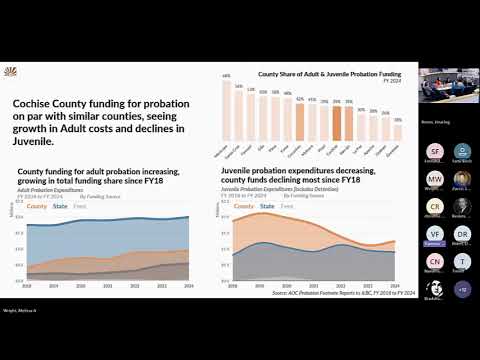
Fielder also highlighted probation-specific trends: adult probation expenditures have increased with the county covering a growing proportion, while juvenile detention-related expenditures showed declines in the AOC data. She noted the AOC’s monthly probation reports track staffing-to-caseload ratios mandated by statute and that Cochise’s adult-standard caseloads were recently reported as very near, and in December slightly above, statutory maximums; a January report showed the adult standard caseload ratio moved to just below the statutory maximum.
County officials and judges described local impacts
Presiding Judge David Thorn and court staff outlined how the county-level funding burden affects facilities, staffing and service delivery. Rachel Gray, chief deputy clerk of the Superior Court, said the clerk’s office processed more than 100,000 documents annually and assisted more than 22,000 customers last year across two locations in Bisbee and Sierra Vista. "We are the official record keeper for the Superior Court," Gray said.
Chairman Antinori (District 3) voiced frustration at the cost-share slide shown by the presenters: "I really hate that slide. I mean, I really do. I mean, that's that's an embarrassing slide," he said, describing the county’s property-tax base and rates as limiting factors in generating revenue.
Justice and probation leaders detailed workload and programs
Justice of the Peace courts handle the bulk of filings in the county. A justice-court briefing noted six justice-court precincts with roughly 41,000 cases handled countywide in 2024; one precinct (JP 4 in Wilcox) recorded about 8,778 cases in the packet provided to the board. The justice-court presentation emphasized the volume of duties that limited-jurisdiction courts perform — traffic, small claims, evictions, warrants and preliminary felony matters — and the time required for mandated tasks such as in-custody appearances.
Presiding Juvenile Judge Terry Bannon described juvenile-court programs aimed at diversion and re‑entry, including a restitution assistance program funded by a modest state grant (the court said it received $8,000) to let juveniles earn wages to pay restitution, and an educational response to rising on-line child-exploitation cases. "What we do is try to intercept the juvenile's behavior before it escalates," Bannon said, and he thanked the board for prior support of juvenile services.
Probation staff said officers carry heavy, sometimes specialized caseloads and that Cochise lacks some of the treatment and specialized program capacity available in larger counties. April Sadoff, chief deputy probation officer, described hiring and training requirements for officers and gave examples of supervision tools: Cochise has used GPS for certain supervised offenders and is planning to use the AOC's phone-based "reconnect" app to support check-ins, document uploads and geofencing alerts. "Our officers do more than monitor probationers — they help reshape lives," Sadoff said.
Technology, public access and case-management gaps
Clerk and court officials said Cochise relies on the AOC-managed case-management system (Ajax) and lacks the in-house IT and resources that larger counties maintain. Rachel Gray said documents filed in Ajax are generally available through public access within about 24 hours and that the clerk's office is working with court staff on a higher‑profile cases page and other improvements. She and others noted that Maricopa and Pima counties run their own case-management systems and provide more immediate public access and automated e‑filing notices.
Judge Thorn pressed for modernization: he said Cochise should move toward remote appearances, better self-help online tools and AI-enabled guides that would let people complete required forms more easily. "If we can harness the technology that exists today, then folks can show up to court without ever leaving their house," Thorn said.
Statutes and administrative context
Presenters referenced Arizona’s open-meeting law and several statutory or administrative provisions governing courts. The meeting notice cited Arizona Revised Statutes §38-431.02 (open meetings). Fielder and court staff referred to statutory caseload ratios for probation officers and to clerk fee statutes when discussing document fees; court speakers also cited the records-sealing statute in Title 13 (transcribed as "13-911") and enforcement/fee authority in the statutes governing clerk fees (transcribed as "Chapter 12-284"). These were discussed as constraints that shape what courts and counties can do administratively and financially.
Board discussion and next steps
No formal action or vote took place during the work session. Board members and court leaders discussed using the new AOC and county data to press for more state funding, revisiting intergovernmental agreements with cities that co-locate justice courts, and exploring ways to reduce detention transports and costs for juvenile defendants. County staff and court leaders said they would continue working on technology improvements, including the clerk’s high-profile-cases web improvements and the planned rollout of the AOC "reconnect" app for supervised persons.
The session closed after the courts and probation described staffing needs, required equipment (including vehicles used to transport juveniles), and training priorities. Presenters described Cochise's dependence on county general-fund support for court services and urged greater, sustainable state support to reduce pressure on property-tax rates and county budgets.
While the briefing raised no specific board votes, it identified several budget and policy issues for future consideration: how to address probation and clerk vacancies, whether to invest in improved local case‑management/public‑access tools or rely on AOC services, and how to coordinate with the state legislature on funding shifts.