Get Full Government Meeting Transcripts, Videos, & Alerts Forever!
Get email alerts on the Judicial Accountability topic
No spam. Unsubscribe anytime.
Proposal to create judicial performance commission draws heated debate over cost, partisanship and value
Summary
Sen. McGillivray proposed creating a Montana Judicial Performance Evaluation Commission to produce midterm and pre‑election performance reports for supreme court justices and district judges. Supporters said voters lack information about judges; opponents warned of cost, partisan influence and duplication of existing tools.
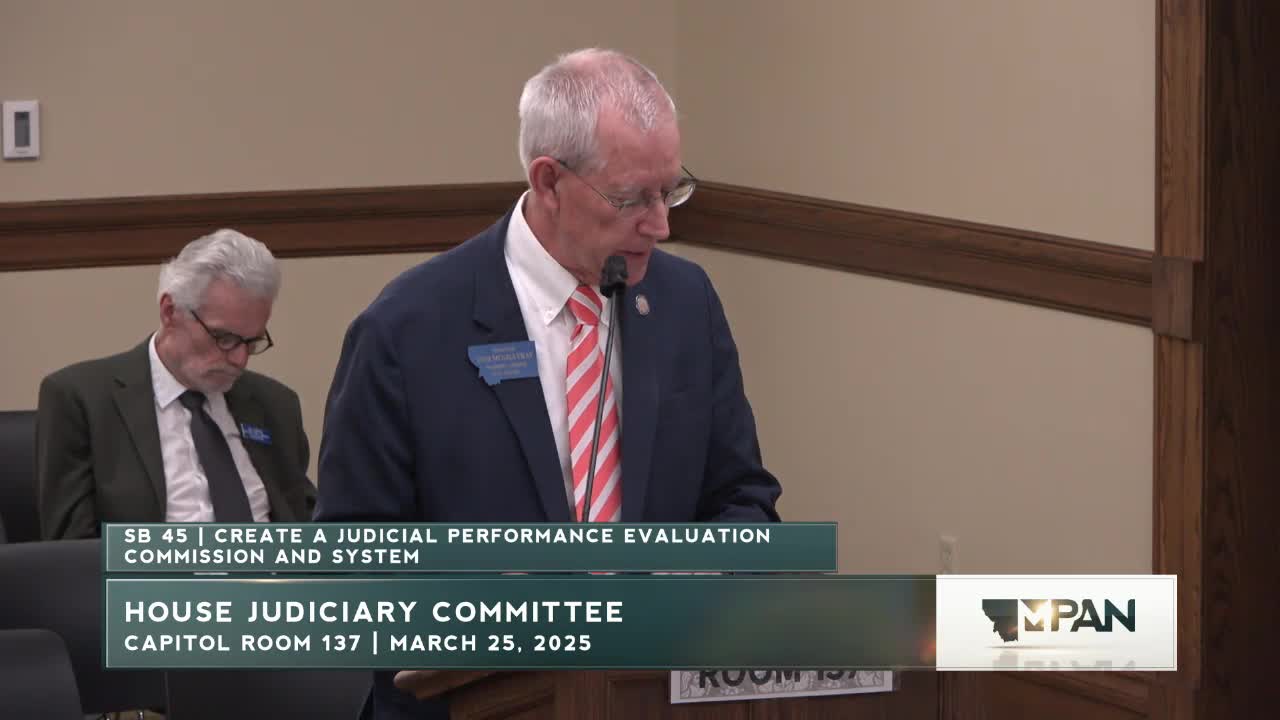
Sen. McGillivray brought Senate Bill 45 to the House Judiciary Committee proposing a Montana Judicial Performance Evaluation Commission to produce independent midterm reviews and pre‑election reports for Supreme Court justices and district court judges.
Under the bill, an 11‑member commission appointed by legislative and executive leaders and the chief justice would contract with an independent vendor to produce surveys, collect public input and assemble pre‑election summaries that would appear in the voter information pamphlet and on a public website. The bill includes midterm reports intended for judges’ internal improvement and pre‑election reports intended to inform voters.
Supporters at the hearing said voters typically have little information about judges’ records and temperament. Spence Pence of Billings testified that the proposal would increase accountability and help voters. “Most frequent question I get is who do I vote for for judges? They have no public record,” Pence said.
Opponents from judicial and legal groups said Montana already has objective benchmarking tools and urged caution. Anne Sherwood of Friends of the Third Branch told the committee the state Supreme Court and the District Court Management Advisory Committee already produce objective timeliness and performance metrics; she raised concerns that the bill duplicates existing processes, could require more staff than the fiscal note lists and might expose confidential proceedings to courtroom observers. "This is a slightly different bill than the one in the Senate…we think it's bad policy and also it's way too expensive for very little benefit," Sherwood said.
Other opponents warned the commission could be used for partisan purposes. Patrick Yawaki, representing tribal communities, told the committee the commission risks delegitimizing the courts if it reflects partisan imbalance. The Montana Trial Lawyers Association representative also urged caution and suggested the Utah model’s web‑based approach may be preferable to adding material to the voter pamphlet.
Lawmakers pressed the sponsor on several practical points: how observers would be trained, how the commission would account for confidential proceedings and whether the commission's reports should be included in the state voter pamphlet. The sponsor said observers could be trained and that midterm reports were designed as confidential feedback for judges while pre‑election reports would be public and the judge could respond in writing to the commission’s narrative.
The fiscal note drew criticism: opponents said the bill budgets a single executive director at about $140,000 and $25,000 annually for surveys, which they called insufficient to produce the proposed statewide work. The sponsor said the bill could be adjusted over time and emphasized the value of independent, critical feedback for judges.
The hearing featured extensive questioning and no committee vote. Several lawmakers indicated they might offer amendments to address composition and funding questions before a final decision.