Get Full Government Meeting Transcripts, Videos, & Alerts Forever!
Get email alerts on the Judicial Recusal topic
No spam. Unsubscribe anytime.
Bill would limit 'rule of necessity' use to avoid recusal when other judges are available
Summary
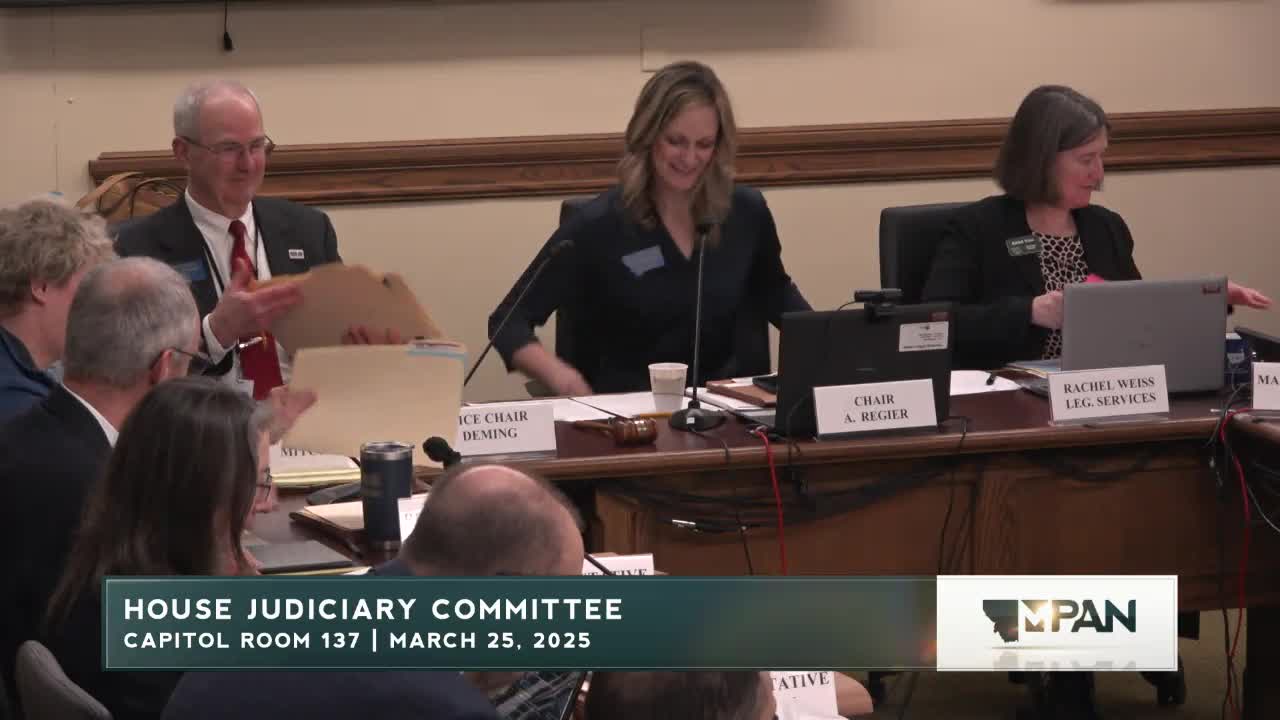
Sen. Tom McElvray told the House Judiciary Committee that Senate Bill 30 would bar judicial officers from invoking the common-law 'rule of necessity' to avoid recusal where other judicial officers with less-significant conflicts can serve as substitutes.
Sen. Tom McElvray told the House Judiciary Committee that Senate Bill 30 would limit use of the judicial "rule of necessity," a doctrine that has historically allowed judges to hear cases despite conflicts when no impartial judge is available.
Under the change McElvray proposed, a judicial officer could not rely on the doctrine to avoid recusal if another judicial officer with a lesser or insignificant conflict of interest was available to serve. McElvray said the measure grew out of the 2021 McLaughlin v. State of Montana litigation in which, he said, the Supreme Court concluded that no available substitute judicial officer existed to remove a perceived conflict and therefore relied on the rule of necessity.
McElvray framed the bill as a narrow statutory clarification intended to preserve impartial adjudication and public confidence: "Recusal is a legal process by which a judge or adjudicator steps aside from participating in a case due to potential bias, conflict of interest, or appearance of impropriety," he told the committee. He said the bill would codify a limitation so that the rule of necessity could not be used when less‑conflicted substitutes exist.
No proponents, opponents or informational witnesses signed up to testify at the hearing. Representative Staffman asked whether the sponsor’s placement of the text in the judicial code section that addresses financial contributions meant the change would be limited to that set of recusal circumstances; McElvray said the drafter placed it in the judicial-officer restrictions section and that the provision is intended to be a restriction on judicial officers generally.
The committee did not take a vote on the bill during the hearing.