Get Full Government Meeting Transcripts, Videos, & Alerts Forever!
Get email alerts on the Property Tax Deferral topic
No spam. Unsubscribe anytime.
Committee hears bill to let lower‑income seniors defer property tax increases via state loan program
Summary
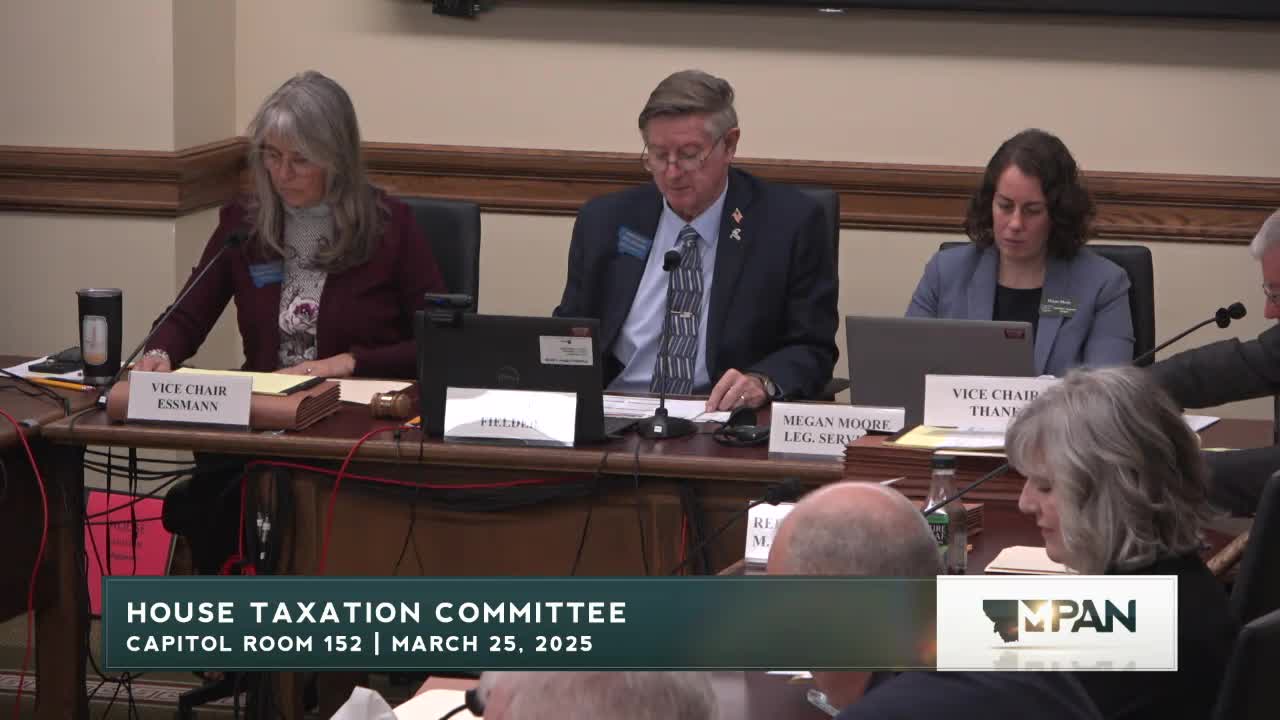
Representative Scott Rosenzweig, sponsor of House Bill 8 36, told the House Taxation Committee the bill would create a property tax deferral loan program intended to help lower‑income seniors remain in their homes as property tax bills rise.
Representative Scott Rosenzweig, sponsor of House Bill 8 36, told the House Taxation Committee the bill would create a property tax deferral loan program intended to help lower‑income seniors remain in their homes as property tax bills rise. "The intent of House Bill 8 36 is to help Montana's seniors stay in their homes when their property taxes increase beyond their budget," Rosenzweig said.
The bill would let qualifying owners defer only the increased portion of their property tax bill and finance that increase through a state‑administered, simple‑interest reverse‑mortgage‑style loan. Rosenzweig said the program would be administered by the Montana Board of Housing and funded initially with a request for $50,000,000. "We will offer these reverse mortgage loans at the prime mortgage rate, or 5%, whichever is less," Rosenzweig said, adding the loan would use simple (non‑compounded) interest and would be repaid by a lien when the home is sold or by the estate upon the owner's death.
Why it matters: Rosenzweig framed the bill as an alternative to grant‑style property tax assistance that shifts tax burdens. He said the design aims to avoid general fund loss because the assistance is structured as loans secured by liens. He told the committee, "This program causes no general fund losses because all assistance is in the form of loans covered by liens."
Informational witnesses from state agencies answered committee questions. Cheryl Cohen, executive director of the Montana Board of Housing, said the Board would manage origination and servicing for these unique loans, and that Board staff would examine title and obtain payoff verifications to determine whether an applicant meets the equity thresholds. "For determining the eligibility, we would propose that for all applicants, we would pull title, look at all of the items on title," Cohen said.
Bryce Kotz, Bureau Chief of the Property Assessment Division, was present as an informational witness and available for questions.
Key program parameters discussed during questioning by committee members: - Eligibility: Rosenzweig said borrowers must be age 62 or older with at least 20% equity in the home; active‑duty military could qualify with 10% equity. Rosenzweig: "Who qualifies? Anyone age 62 or over who has 20% or more equity in their home, or active duty military personnel with 10% equity." - Income and price limits: Rosenzweig said eligibility income limits and purchase‑price limits would follow the Board of Housing's existing loan program limits (as shown on the sponsor's handout). "The bill does contemplate on the first page of the handout, the income limits are those set by the Department of Board of Housing," he said. - Loan mechanics and duration: The sponsor described the loan as payable when the home is sold or by the estate after death; spouses could remain in the home and the lien would remain with the property. Committee members asked whether borrowers would need to reapply annually for additional increases; the sponsor and Cohen explained an annual certification process would allow increases up to the difference between current taxes and 2022 taxes, and the Board envisioned a lien structure similar to a home equity line of credit. - Interest mechanics: Rosenzweig emphasized the program's use of simple (non‑compounding) interest and the 5% cap: "...we're offering this at a simple interest rate. Which means if you borrow $100,000 ... you would only occur $5,000 worth of interest annually. It would not be compounded." - Funding and fiscal note: Rosenzweig said Director Cohen had provided a fiscal rough estimate of about $500,000 per year to cover 2.5 personnel and administrative costs; he also requested an initial $50,000,000 lending fund. He said loans should begin to return funds by the second or third year.
Concerns and clarifications raised by committee members included questions about the effect on heirs and resale, whether the lien would appear on title and be paid at closing, how the Board would verify outstanding liens and equity, and whether the program could unintentionally increase long‑term borrower indebtedness. Rosenzweig and Cohen responded that liens would appear on title and be paid at closing and that Board staff would verify payoffs and balances to determine equity.
No proponents or opponents from outside the sponsor's side testified in the room; the sponsor invited amendments and said he was open to changes. The committee closed the hearing on House Bill 8 36 after the sponsor's closing remarks.