Get Full Government Meeting Transcripts, Videos, & Alerts Forever!
Get email alerts on the Criminal Justice Pretrial Supervision topic
No spam. Unsubscribe anytime.
Bill would let domestic-violence intervention grants pay for pretrial GPS monitoring
Summary
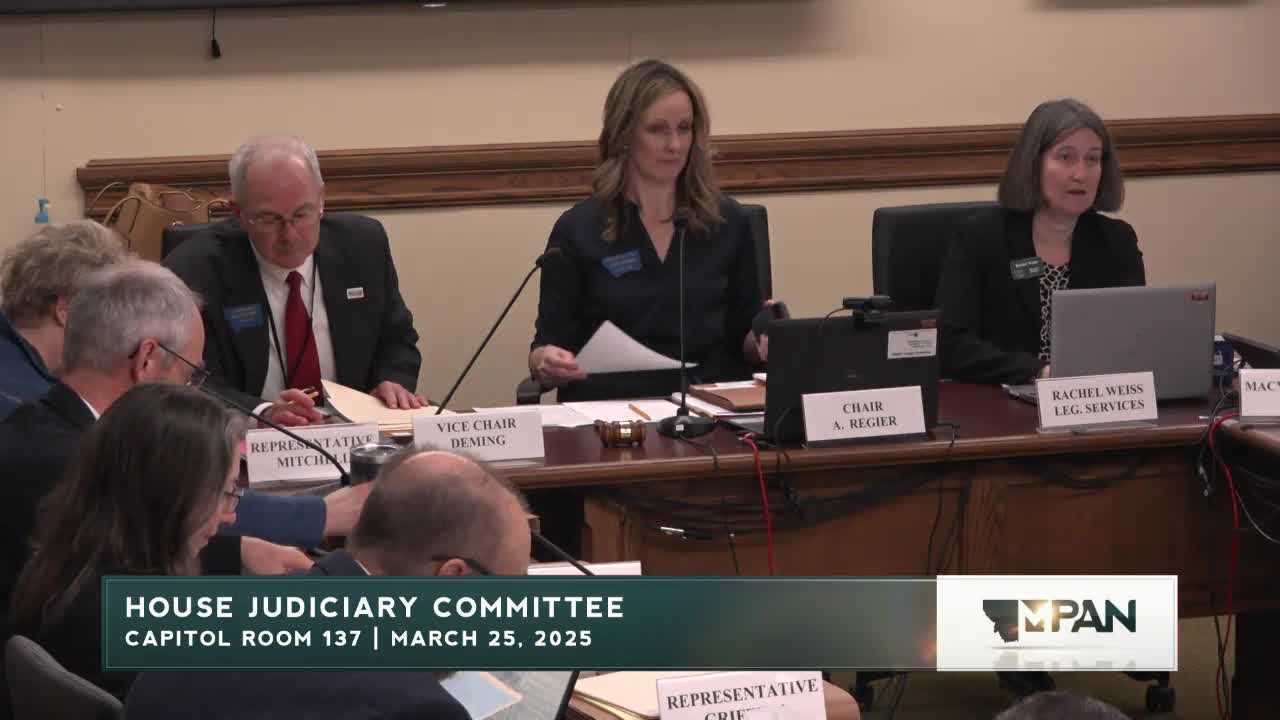
Sen. Mike Yakawich told the House Judiciary Committee that Senate Bill 280 would allow Montana’s domestic violence intervention fund to cover GPS monitoring and other pretrial services for people charged with domestic violence, with the aim of reducing jail populations and supporting victims’ safety.
Sen. Mike Yakawich, sponsor of Senate Bill 280, told the House Judiciary Committee on Thursday that the bill would allow grant money from the state’s domestic violence intervention fund to be used for pretrial electronic monitoring for people charged with domestic violence.
Yakawich said the funding at issue already exists in a Board of Crime Control fund financed by marriage license fees and that the bill would not add spending, only adjust how existing grant dollars are allocated. “The funding comes from the domestic violence intervention budget…30 dollars of every marriage license fee goes into this fund,” Yakawich said, adding the fund currently holds about $400,000 and the board typically authorizes about $120,000 to be spent each year.
The sponsor described the measure as a way to reduce jail populations and to provide defendants who qualify with supervision and services while awaiting trial. “The intent here is to allow people in community corrections to be able to receive a monitor pretrial to be able to go out into the community,” Yakawich said. He said that pretrial monitoring can allow people to continue paying bills, keep jobs, and participate in treatment or other programs before a case is resolved.
Amanda Stonerock, a consultant who works with domestic violence intervention programs in Yellowstone County, testified as a proponent and said current grant rules limit uses to post-conviction services and do not match more recent pretrial practices. “Since 2014…organizations that have applied for this funding have been limited and unable to keep up with adjustments in the criminal justice system,” Stonerock said, endorsing the bill’s change to permit pretrial and felony-level uses of the grant.
Committee members asked practical questions about monitoring technology, enforcement and eligibility. Representative Kelly and Representative Sharp pressed the sponsor and Stonerock on how GPS geofencing and alcohol-detection monitors work and whether monitoring actually protects victims. Yakawich and Stonerock said technology has improved and that judges would determine eligibility by court order; Stonerock said courts typically require risk assessments such as the PSA or misdemeanor assessment tool before ordering monitoring. Yakawich acknowledged limits: “The person who’s really bad, that’s another situation,” and Representative Kelly warned against overstating what monitoring can prevent.
Yakawich cited the detention facility work group interim report (March 2024) noting a need for increased pretrial monitoring subsidies. He argued the bill would allow subsidies where defendants cannot afford monitoring costs and could therefore spend long periods in jail awaiting trial. Yakawich also provided local context, saying Yellowstone County’s jail has a capacity of 436 but is holding about 600 inmates.
There was no formal opposition at the hearing; Yakawich said the Board of Crime Control was neutral and had not opposed the bill when it was heard in the Senate. The committee did not vote on the bill. Yakawich asked for a carrier and Representative Baum agreed to carry the measure.
The committee record shows proponents emphasized both reducing pretrial incarceration and keeping victims’ safety in mind; several members urged clarity about how monitoring would be implemented and enforced and about eligibility criteria.