Get Full Government Meeting Transcripts, Videos, & Alerts Forever!
Get email alerts on the Wrongful Conviction Compensation topic
No spam. Unsubscribe anytime.
Montana committee reopens debate on wrongful-conviction compensation program after years of revisions
Summary
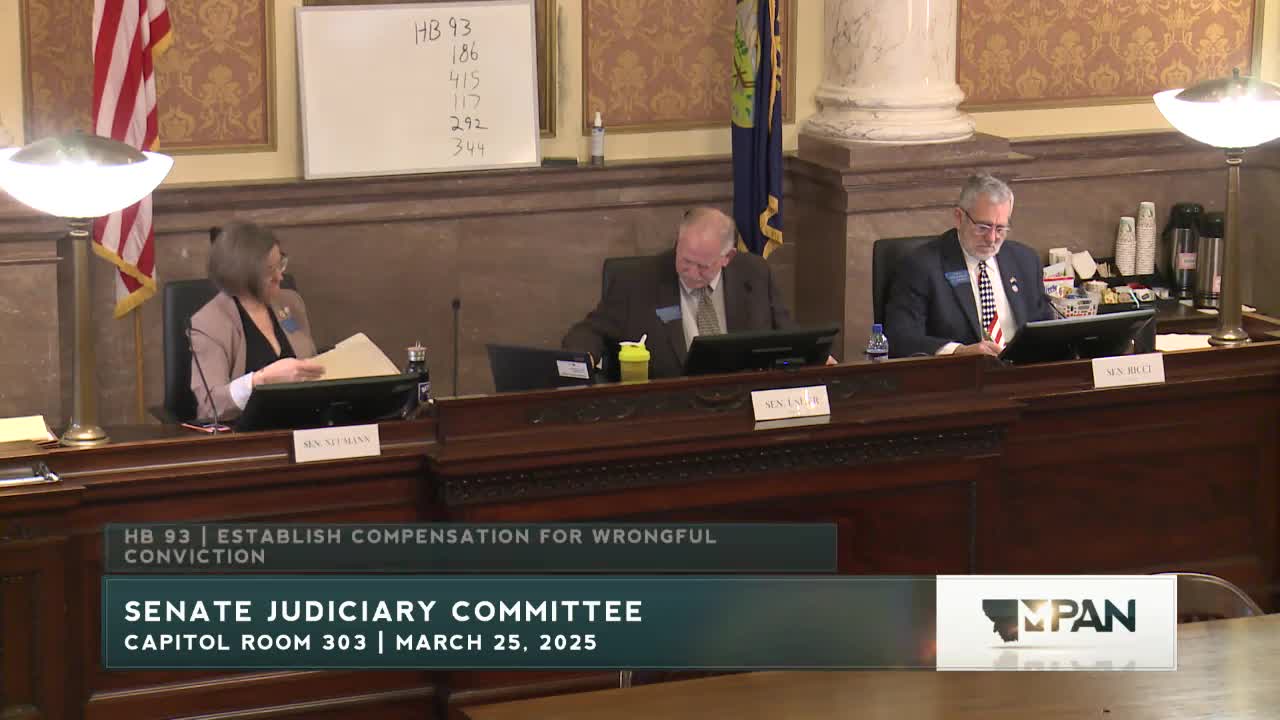
Representative Carrie Seekins Crowe, sponsor of HB 93, told the Senate Judiciary Committee the proposal to create a compensation and transition program for people whose convictions were vacated or who later were acquitted is the product of six years of interim study and compromise, and urged the committee to pass the revised bill.
Representative Carrie Seekins Crowe, sponsor of House Bill 93, told the Senate Judiciary Committee the measure is the product of six years of study and compromise intended to compensate people wrongfully convicted and to provide post-release transition assistance. "This is the third version of this bill you've seen over the last 3 sessions," she said, and urged members to "vote green."
The Montana Innocence Project and other proponents said the state lacks a statutory compensation program and that exonerees frequently leave custody without housing, medical care or employment supports. SK Rossi, speaking for the Montana Innocence Project, described the measure as the culmination of a multi‑year interim study and emphasized broad stakeholder participation. "This is a good program. It's a result of 6 years of compromise and conversation," Rossi said. Amy Singh (Timber), also with the Innocence Project, told the committee that Montana has 16 known exonerations whose combined time in custody exceeded 175 years, and said Montana is one of 12 states without a compensation statute.
Department of Justice witnesses and some county attorneys opposed the bill in its current form, saying a provision in Section 2 could allow payments in cases that were dismissed or vacated for legal or procedural reasons rather than because the person is factually innocent. Alex Sturhansfeld of DOJ said the bill, as drafted, "opens up a much wider scope" than traditional wrongful‑conviction statutes and that the fiscal note cannot predict the number of claims. Tammy Plubell, appellate services bureau chief at DOJ, used a hypothetical to explain the concern: a conviction reversed on evidentiary grounds could be dismissed after many years for reasons unrelated to factual innocence, and Plubell said such a dismissal should not automatically trigger compensation.
County attorneys and a former prosecutor echoed DOJ's call for a stronger gatekeeping mechanism. One county attorney described a prior case he called the "poster child" for problems under an earlier version, saying there was not a showing of factual innocence yet the prior statute allowed a claim. Witnesses proposed amendments to require a showing of reliable evidence of factual innocence and to raise the evidentiary standard for compensation (for example, to clear and convincing evidence).
Sponsor Carrie Seekins Crowe and Innocence Project representatives said they are open to amendments that provide clearer front‑end screening while preserving transition aid for true exonerees. "If there is language that would tighten up so that a terrible instance ... could be prevented, the Montana Innocence Project would be open to that," Amy Singh said. The committee chair asked DOJ, the sponsor and advocates to meet and attempt to produce agreed amendments by the end of the week.
No formal action was taken during the hearing; the committee closed the hearing on HB 93 after a request for follow‑up negotiations. The record includes multiple informational witnesses (including staff from the Department of Corrections and Department of Administration) and detailed back‑and‑forth on whether a statutory remedy should require proof of factual innocence rather than rely on a post‑conviction dismissal or not‑guilty finding.
The committee repeatedly distinguished between discussion (policy options and concerns raised during testimony), formal action (none taken during the hearing), and staff directions (the chair urged stakeholders to meet and craft an amendment), and asked that any future language be explicit about standards and procedural gatekeeping to limit claims that are based on procedural reversals rather than factual innocence.